But you can almost always play consistent defense.
Defense isn't about natural physical skills. It's about focus and effort. That's why guys like Bruce Bowen and Raja Bell -- fairly average NBA athletes -- were able to become elite defensive players.
Several years ago, I decided I wanted to become a better defensive player. This attitude is pretty rare in pickup ball. After all, it's the first team to 11 points, not 11 steals, right? But trust me, you can swing games by playing great defense.
Here are the defensive principles I live by:
Commit to defense: The majority of pickup ballers are pretty lackadaisical on defense. In most cases, the only time they actually try is when their man has the ball during a halfcourt set. They jog back in transition and they space out when their man isn't directly involved in the current play. This behavior results in easy baskets for the other team. Consistent effort results in stops.
Committing to defense is step number one to becoming a better defender.
Develop the proper defensive stance: This is step number two. Here are the 10 keys to a great defensive stance from Breakthrough Basketball:
1. Fronts of the Feet - Most of your weight should be on the fronts or balls of your feet and the majority of the weight should be on the big toes. Heel should still be in contact with the ground.Watch your man's midsection: No, not to admire his six-pack abs. This is a follow up to step 8 of a great defensive stance. Watching the midsection is the best way to determine which direction he's moving. That way, you won't get tricked by ball fakes, head fakes or foot fakes.
2. Wide Base & Feet Turned Slightly In - Your feet should be pointing straight ahead or slightly turned in (pigeon-toed). This creates an angle that allows you to provide more force against the ground. In the picture to the right, the feet are bowed out which is improper form.
Your feet should also be slightly wider than shoulder width apart.
3. Hips Back & Knees Bent - Butt should be behind the heels and your knees should be pointing forward, but not past the toes.
4. Knees Inside of Feet - This helps create better push-off power.
5. Butt Down - Staying low helps maintain balance.
6. Shoulders Over Knees - Your shoulders should be over your knees with your chest out and back straight or slightly arched.
7. Hands up - Depending on the tactic (Hands out or hand up to defend shot/dribble).
8. Eyes focused on the player's waist or chest.
9. You should be able to draw a vertical line from the front of your forehead thru the front of your knees thru the front of your toes.
10. All of this should create GREAT BALANCE.
Play off-the-ball defense: Karate Kid III taught us that "If a man can't stand, he can't fight." Similarly, if a man doesn't have the ball, he can't score. Chase your man all over the floor. Deny him possession whenever possible. This doesn't always work in the NBA because coaches are able to write up plays that free up their players, and the players are good enough to execute those plays. Pickup basketball isn't that organized. With the right amount of effort and intensity, you handicap your man by limiting his shot attempts.
To do this, pay close attention to the ball-man line. That's what coaches refer to as the imaginary line between the ball and your man. Do your best to a) stay between that line and the basket and b) impede that line so that your man can't easily receive the ball.
Sprint back on defense: It's amazing how many buckets you can stop by doing this. I can't tell you how many two-on-ones and even three-on-ones I've stuffed just by getting my ass back in transition. Remember, this isn't the NBA. There's no guarantee a pickup baller is going to finish a fast break.
Block out: They call them "defensive rebounds" for a reason, people. Rebounding is the final step of a successful defensive play. When the ball goes up, put your body between your man and the basket and make contact so he can't get around you. It's as simple as that. But you'd be surprised how many people can't or won't do it.
Grab rebounds with two hands: Dr. J was the master of the one-handed rebound. When he did it, it looked fucking cool. Guess what? You aren't Dr. J. Don't try to one-hand the rebound. Don't tap at it. Go after it and grab it with two hands.
Jump to the pass: Whenever somebody passes teh ball, take a few quick steps in the direction the pass was thrown. This will put you in the proper position to stop your man if he cuts to the basket or help a teammate who gets beaten off the dribble.
Call out picks: Seriously. Your teammates need to know.
Fight through picks: A lot of people get stopped cold by picks...or they stop themselves cold. Seriously, a lot of people hit the pick and then give up on the play. Fight through it. Again, this isn't the NBA. You can get through that pick.
Pressure your man when he has the ball: Make him work. Make him think. And whatever you do, don't keep backing up and letting him move to his sweet spots. Never concede anything. The harder you make life for the man with the basketball, the better the chance your team gets a stop.
When pressuring your man, keep your hand up and active so he can't see the court, shoot an open shot or make an easy pass.
Stay between your man and the basket: That's where he's trying to go. On that subject...
Slide your feet: When guarding a man who's dribbling the ball, step sideways with the lead foot (the foot closest to the direction you want to go), then push off with your trail foot. Keep your feet in contact with the floor. Stay in a low stance and keep your feet wide. Make quick slides.
Deny the middle at all costs: Always keep your inside foot high to deny dribble penetration toward the middle of the court. Overplay toward the middle to force your man baseline. This way, the baseline becomes an "extra" defender. The backboard can also become an extra defender if you force yoru man to dribble partially behind it.
Get in your man's shot pocket: Never heard of the shot pocket? Here's the definition: The position the basketball is in when a player begins his jumpshot. Typically, the ball is "in the shot pocket" when all parts of the shooting arm -- upper, lower, hand, and two shooting fingers (index and middle) -- are in a vertical plain to the side of the face, out in front of shoulder.
If you keep a hand inside your man's shot pocket, he's going to have to move the ball around your hand in order to shoot. This effectively takes him out of his natural shooting motion. Muscle memory is a key component of shooting, so making a player shoot in an unusual way often results in a missed shot.
Contest every shot: But do it the smart way: Stay on your feet and keep your hands up.
Do some scouting: Remember: Most pickup ballers have limited skill sets. They probably have only one or two moves. They can only hit a few pet shots. You should be able to figure out what someone's tendencies are after a handful of games. Once you know what they like to do, you can stop them.
My buddy Mister P loves to shoot threes from a specific spot. I always put extra pressure on him when he's near that spot. He also has this move where he takes on hard dribble to the right, comes back to the left and then pulls up for a jumper. When he's going into that motion, I overplay him left because I know he wants to come back that way. It disrupts the move and he usually has to pass the ball away.
Guard everybody: I don't care if your man isn't an offensive threat. D him up anyway. Why give somebody an open shot? Even bad players hit the occasional jumper. Or they earn garbage points -- open layups or putbacks -- because their defender isn't paying attention. I've been on teams that lost because bad players were given the green light. Many times. On the flip side, putting intense pressure on lousy players can cause turnovers. That's a better outcome, right?
Avoid All-Star Defense: Blocked shots and steals. There are people who think these are the only defensive plays that can be made. Blocking lots of shots or grabbing a lot of steals help make people an All-Star in the NBA. They also make SportsCenter. But fundamental defense rarely results in blocks or steals. Going for them, on the other hand, will get you beat. I play with guys who love to gamble for steals so they can go the other way for an easy bucket. Unfortunately, more often than not, the team defense gets disrupted by their wild gambles.
Labels: defense, pickup basketball
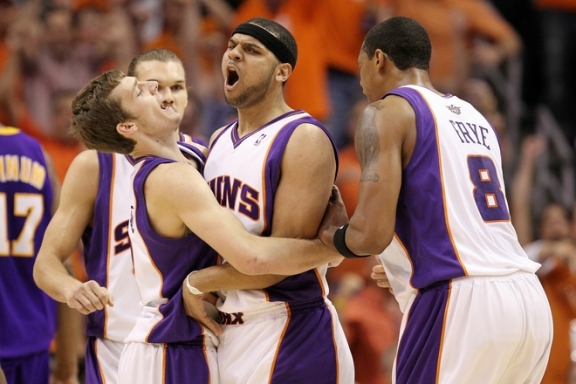
The Los Angeles Lakers: Last night, I got to watch the game with long-time commenter and site contributor Wild Yams. To my dismay, I found out that he's a pretty cool and intelligent guy despite being a Lakers fan. It was kind of like meeting a serial killer who donates to charity and volunteers at the local homeless shelter. But it was a good time nonetheless...even better because the Suns won the game.
Let me be frank: I expected the Suns to lose this one. I did. I figured that, in Game 3, they made the only adjustment they could make...going to the zone defense. That and Amar''''''e Stoudemire went bonkers. To me, it was a gimmick win, something that couldn't be duplicated.
And it wasn't. Turns out, it didn't have to be.
Going into Game 4, I felt there was no way Phoenix could be the Lakers straight up. The Suns apparently felt otherwise. Mind you -- unlike Boston's stink bomb in Game 4 of their series against the Magic -- the Lakers didn't play poorly. They scored 106 points on 50 percent shooting and committed only 7 turnovers for a mere 4 points going the other way. L.A. outscored the Suns 42-32 in the paint and held the run-and-gunners to only 6 fast break points.
And of course Kobe had one of "those" games: 38 points, 15-for-22, 6-for-9 from downtown, 10 assists, and 7 rebounds. That's the kind of stat line you usually associate with LeBron James...the kind of line that LeBron fans use as evidence that James is in fact better than Bryant.
But it wasn't enough.
The Suns -- so much weaker up front than the Lakers -- won the rebounding battle 51-36, including 18-13 on the offensive glass. Think about that. Did you think this Phoenix team could ever grab 18 offensive rebounds against this L.A. team? If you said yes, I'm calling shenanigans. But sometimes rebounding is simply about wanting the ball more than the other guy. And get this: Steve Nash finished with almost as many boards (4) as Pau Gasol (5). What does that tell you?
In addition to their rebounding deficit, the Lakers could not handle the Phoenix bench. That's right: The Suns' much-maligned reserves rose from their mass grave to score 54 points on 20-for-32, including 9-for-20 on threes. And check this. Here are the plus-minus scores of the Phoenix starters: Grant Hill (-3), STATUE (-5), Robin Lopez (-3), Nash (-9) and Jason Richardson (-4). The reserves: Channing Frye (+12), Leandro Barbosa (+13), Louis Amundson (+14), Jared Dudley (+12), Goran Dragic (+18), Jarron Collins (HA!).
TrueHoop's Kevin Arnovitz breaks down the Suns' bench play:
And because I want to, here's Dragic's sick layup around Fish and the Candyman:
Now, I'm not seriously suggesting that the bench players are better than the starters...even if Dragic was 27 points better than Nash on the night. But their effort and intensity changed the game. Frye -- who entered last night 1-for-20 for the series -- hit four treys, including a "Rally Monkey" shot in the fourth -- he drilled it right before the shot clock buzzer buzzed -- that was followed by threes from Barbosa and Dudley. Boom, boom, boom...and the Lakers never really recovered.
In terms of final tallies and raw numbers, the Suns' bench outscored L.A.'s pine riders 54-20 and outrebounded them 23-11. And as ESPN's J.A. Adande pointed out:
The unit of Frye, Dudley, Barbosa, Goran Dragic and Louis Amundson played the first seven minutes of the second quarter and turned a tie score into a 10-point lead even with Bryant on the floor for the Lakers. It was part of a 41-point second quarter. And after the Lakers won the third quarter it was that same unit for the Suns that played deep into the fourth and won the game on a night Amare Stoudemire scored only half of the 42 points he put up in Game 3 and Nash made only three of 11 shots.L.A.'s defense: Well, let's see: They've given up 233 points over the last two games. In Game 4, the Suns scored 115 points, hit nearly 50 percent of their shots, and earned 32 free throw attempts.
Yeah, I'd say defense is a problem for the Lakers.
Of course, I've been beasting on the Lakers' D for a couple weeks now. It sure ain't what it was during the regular season, when L.A. ranked 4th in Defensive Rating. Now they rank 10th out of 16 playoff teams...giving up 111.1 points per 100 possessions. My take is that Andrew Bynum's general ineffectiveness is the root cause. With Gasol and Bynum at 100 percent and patrolling the paint, the rest of the Lakers could overcommit on their assignments without fear. After all, their two big men would swallow up anybody who got past them.
Well, Bynum has been hampered by a bum knee, and he isn't the defensive force he was. If L.A.'s perimeter defenders overcommit, opponents are getting to the rim or earning fouls. If they don't overcommit, guys are dumping in threes. And, well, there you have it.
But hey, maybe I'm wrong. Maybe D isn't the problem. Let's see what Mamba has to say:
"Our defense could have been much better, I think."And, well, there you have it.
"Coming up here, we lost a sense of urgency defensively. I think our concentration was focused on how to attack the zone."
"I think it kind of flipped our attention to detail defensively. Our focus was on the other side of the floor, which doesn't win championships. So we need to get back to ground zero when it comes to that."
"We lost the game because our defense sucked."
"Like I said, we've got to do a much better job defensively. Paying attention to [Phoenix's bench], all of them, and staying in front of your man and things like that."
"Looking forward to the challenge. I know my guys are. [We need] to get back to the basics of playing defense the right way."
"Our attention needs to be on the defensive end, period. That's second-chance opportunities [as well]."
"I was more aggressive in the second quarter. Felt the game slipping away, got going, make some shots [and] kept it going. But that has nothing to do with us getting to the next round. We can't -- offensively, we scored enough points. We've got to do a better job defensively, period."
"That's not what wins championships. Everybody wants to talk about the offensive side of the ball. It has nothing to do with it. Gotta defend."
L.A.'s offense: The Suns played a mix of man-to-man and zone...and the Lakers offense wasn't bad, per se. Like I said, they finished with 106 points and shot 50 percent. BUT...Phoneix again succeeded in seducing the Lakers into chucking an awful lot of jumpers. The result: L.A. attempted 28 three-pointers and only 13 free throw attempts. And as hot as Kobe was, he did most of his damage on contested jumpers of the "No, no, no...yes!" variety.
Is that a formula for success? I don't think so.
The Zen Master doesn't think there's a problem, nor does he think the Suns' zone is having an affect on his team's offense: "We shot 49 percent, didn't we? That's pretty good. Nothing wrong with that. I wouldn't say we're struggling against the zone. I think we're struggling at the defensive end. That's where I see it."
Maybe P-Jax watched a different game than I did, because I saw "clutch" three-point attempts by Ron Artest (1-for-5 on treys) and Lamar Odom (1-for-3 from distance) that bricked badly. I also saw Shannon Brown go 0-for-4 from way out there. Derek Fisher was 0-for-2 and also bricked a crunch time three.
For what it's worth, Bynum thinks he knows what the problem is: "It's the zone. We're settling for outside jump shots. They were out there moving that ball, they were confident playing at home and they really just shot the ball well. They had everybody spaced out so everybody's running around."
Hey, remember back in Games 1 and 2, when Phoenix was scoring points and shooting reasonably well but couldn't get it done? Isn't that basically what's happening to the Lakers right now? Sure, defense is L.A.'s biggest foil...but jacking up contested (and even contested) long-range jumpers sure hasn't helped their cause down the stretch in Games 3 and 4.
Reader comments: Here's where Basketbawful readers' voices can be heard, er, read:
From Miles:
As a Suns fan for decades, I can only say "That - was - effing - beautiful."From Heretic:
As a basketball fan for longer than that, I can only lament that the Phoenix Runs shot the ball unusually well when it counted (even for the the Runs), and that the Lakers blew it when it counted, and that I don't expect this trend to continue even for one more game this series. (Don't get me wrong, I'm still crossing my fingers).
Phil is too great a coach to let a defensively weak team like the Suns run all over his Lakers with zone defense for three games in a row, I doubt it will happen again.
Kobe, Gasol, Odom, Bynum, Fisher are too damn good to not put up a better combined performance for three games in a row, I doubt it will happen again.
The Suns bench, god bless them, are pretty good as far as benches go, but they PROBABLY won't have another 54 point game, and "Stat" PROBABLY won't have another 42 point game in this series.
I will weep like a baby if we can see Nash in the finals for the first time in his career, but I still can't help but think it's going to take a miracle.
Still, tell me you didn't jump out of your seat and spill chips and salsa all over your crotch when Frye hit that first tre.
And the lakers do it again, pull out a bazooka and blast their own feet. This game is a prime example of why during the playoffs I prefer the aggressive Bryant than the passer. Took very few shots in the first quarter and his team still fucked it up. As talented as Gasol is, he's so soft that I'm surprised he hasn't been named "The Stay Puft Marshmallow Man". Wtf is it about Europe that produces the softest, most pillowy players on earth? I thought all the pussies were in France but apparently once a country joins the EU they're contractually obligated to remove the testicles of their basketball players.From Karc:
Bryant pretty much bailed them out from a blow out. For god's sake the suns were playing the zone!! how hard is it to destroy zone defense? High school students can do it. Even if the lakers do end up winning this series they really don't deserve to. Schooled by a team that would have been legally labeled as midgets in 28 states. I honestly prefer to watch Bryant fire away from half court than watch Bynum trip over his own feet as he looks confusedly at the orange sphere in his hands.
The bench don't even warrant a discussion, its been long established that Phil Jackson has murdered them and replaced them with cardboard cut outs. Hopefully next season everyone one the bench with the exception of Odom have been traded (yes even Shannon Brown). Another game they could have easily won shot to pieces with the laker tommy gun of ineptitude.
The Lakers were totally owned tonight. That vaunted "length" of the Lakers got crushed on the boards (at least 50, including a gazillion offensive boards), got crushed by the Suns bench (at least 50 points), and were exposed in the second quarter, giving up 41 points to the Suns, despite having the "4th" ranked defense in the NBA. Note to Andrew Bynum, this is exactly why you do not look ahead to the Boston Celtics. You are not winning this series right now.Channing Frye, quote machine: How did that 1-for-20 shooting through three games affect him? Apparently, not at all: "I told you guys I'm just going to continue to shoot, and my teammates believed in me and I continued to just believe in myself. Why work so hard and why still be playing when it's almost June if you're not going to go out there and just have fun and let it ride?"
Hell, look at the trend. The Lakers scoring has been 128, 124, 109, 106. Meanwhile, the Suns score 107, 112, 118, and now 115. Their offense is getting better, and their defense is getting better. The LA media is going to freak. I love it.
As for whether his confidence was shaken: "Come on, man, you're asking the wrong dude. My confidence is great every day. I'll be honest, last game I was what, 0-for-7? If I shot another seven I thought I was going to go 7-for-14."
Jared Dudley, quote machine: "You could tell right away tonight that they wanted to take away Amare (Stoudemire) early on. Once they did that, we just set up like target practice."
Labels: bench play, defense, Los Angeles Lakers, NBA playoffs, Phoenix Suns
Is your life missing something? Do your friends and family not respect you? Do you not have a contract with the LA Clippers worth $12.1 million this year alone? Do you not have a friendship with Cash Warren? Have you ever wondered why? Well, now we know. It's because you aren't Baron Davis, and perhaps more importantly, you don't have Baron Davis's beard.
But I have good news! Now you CAN have Baron Davis's beard to help enrich and improve your life! Just watch this commercial and learn how you too can have B-Dizzle's magic facial hair.
This article is a must-read take on defense: "A new way to look at basket protection." This article includes a great breakdown of opponent shooting percentage at the rim plus the opponent free throw rate to determine which teams do the best job of preventing easy points in the paint and don't allow many free throw opportunities. It makes me look bad for complaining about Dwight Howard's defense, but remember that limited statistics don't always tell the whole story. His high emphasis on ego-ectomy blocks that fly into the stands still don't help his team as much as he thinks, for example. However, it does validate that Golden State is just atrocious at defense. Swish!
In news that certainly is of high importance to any Basketbawful reader, Greg Oden update!! As noted by JE Skeets: " 'Greg Oden slowly jogged on an anti-gravity treadmill ...' is already my favorite line of the day." Also from the article:
"You have to be able to stay loose about everything that's going on with my injury problems," Oden said. "With this happening twice and the amount of time and games I have missed, the No. 1 pick pressure, it's tough. You have to be able to look at yourself and have fun."Good stuff. You've always gotta listen to the advice of your elders. And hey, he's got a new haircut!
And in a little footbawful crossover, the bastion of news reporting that is TMZ tells us that Ben Roethlisberger is being accused again of sexual assault. Ugh. Some people are saying "He's been accused before, and now it's happening again. Two women can't possibly both be wrong/lying!" I have no opinion yet since we haven't heard anything, so all I can say is...
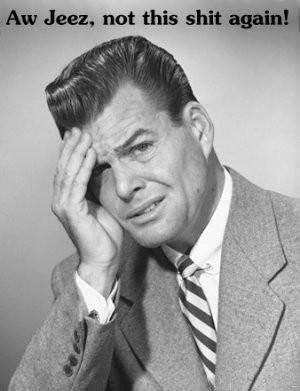
Worst of the Night in Pictures:
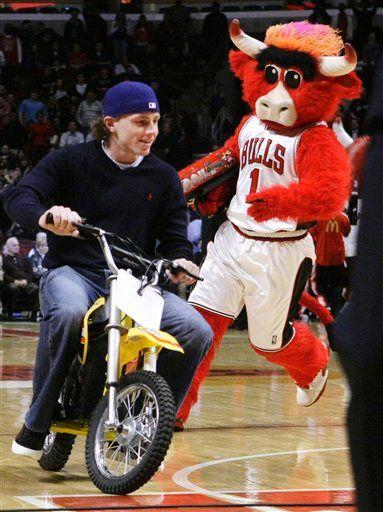
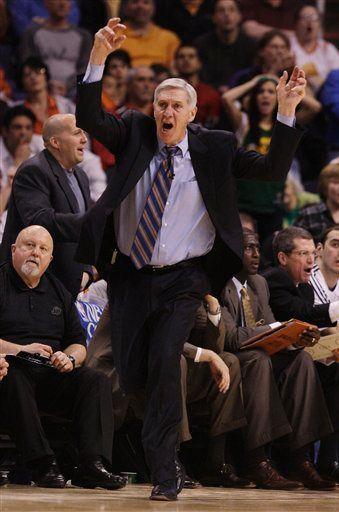
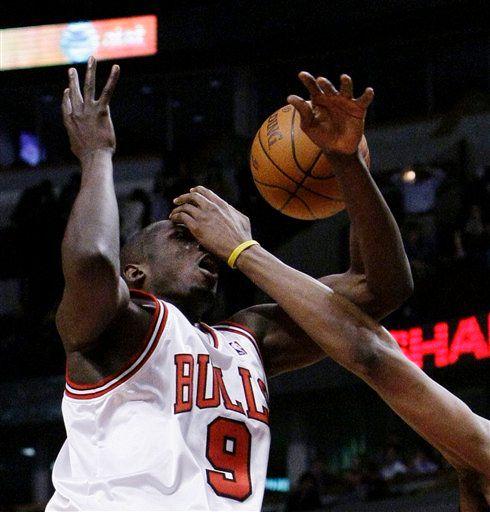
Nationally Televised Friday Games:
Pistons at Crabs: We are all witnesses... to the further demise of Joe Dumars' credibility.
Hornets at Spurs: The last game the Spurs played was Monday... against these very same Hornets. Now the Spurs play 15 games in the next 25 days, including five back-to-backs. Good thing LifeAlert is always there for them just in case.
All The Other Friday Games:
Celtics at 76ers: Whenever I think of Zombie Michael Finley suiting up for the Celtics, I think of Weekend at Bernie's 2. Will they have to constantly play music over the PA system to keep him moving?
Bucks at Bullets: Hey, doesn't it seem like these two teams just played? Oh, that's right. They did.
Bricks at Raptors: You are now entering a defense-free zone. (Wait, the word "zone" implies a kind of defense. Nevermind.)
Lakers at Bobcats: The 'Cats show up for big games, and the Lakers might be tired from a grind-out OT loss. Good game.
Warriors at Hawks: The Warriors have lost 16 of 17 on the road. I wonder if that is somehow related to not only being coached by Don Nelson, but also being composed of benchwarmers filling in for other injured benchwarmers?
Magic at  : As noted by AnacondaHL "BBref's Playoffs Probability Report has the Nets winning 10+ games. I don't want to believe." Neither do I.
Kings at Mavericks: The Mavs have to play the night after this as well. Good thing they can get plenty of rest in this game!
Pacers at Nuggets: Back in the day, Indy dominated Denver. But then Indy remembered "hey, we're in Indiana, we should suck so we fit in with the rest of the state," so now they've lost 9 of the last 11 to Denver. (Hey, I live 20 minutes from the Indiana border and go in that state frequently, I know of what I speak.)
Thunder at Clippers: Whenever you need a little pick-me-up after a couple bad games, there's always the Clippers to cheer you right up.
* * *
Nationally Televised Saturday Games: at Bricks: Oh no. The only thing that could possibly be worse than this is if they made Police Academy 8. Wait, they ARE making Police Academy 8??? I need Michael Winslow to come make sounds for me so I can accurately mime shooting myself in the temple.
All The Other Saturday Games:
Warriors at Bobcats: Another Warriors road game, another Warriors loss.
Hawks at Heat: Okay, so the Heat looked pretty darn good against the Lakers Thursday. However, I'm still not buying into them being a good team.
Mavericks at Bulls: According to that defensive stats analysis article I mentioned earlier, the Bulls are a decent defensive team. Now watch the Mavs crap all over that idea.
Rockets at Timberwolves: I don't really have anything interesting to say about this game, so I'll just link to this awesomeness by the Onion instead. Who wants to spoof Mutombo? (h/t Jonah Keri for retweeting the link)
Spurs at Grizzlies: Did you know Hasheem Thabeet is the 2nd highest paid player on the Grizzlies?
Crabs at Bucks: Watch out, King Crab! The John Salmons Era is in full force! (Sorry, couldn't say it with a straight face.)
* * *
Nationally Televised Sunday Games:
Lakers at Magic: When I first read "Lakers" and "Magic" next to each other, I got all excited and thought about the Showtime Lakers with Magic Johnson dueling with the Celtics. Then I remembered we'll see Kobe versus the Pumaman in this game, and I died a little inside.
Bullets at Celtics: On second thought, perhaps Zombie Michael Finley will be more like the zombie in Zombie Nightmare. Now, we just need to find Adam West and that guy from Thor...
Frail Blazers at Nuggets: Another quality Western Conference game, and it's on national TV. Love it.
All The Other Sunday Games:
76ers at Raptors: Not so much a quality game here...
Rockets at Pistons: The Discount Store era isn't going so well in Houston. I wonder if the Sactown fans still are bitching about trading him? Chris?
Thunder at Kings: Speaking of the Purple Paupers... Well, at least they do have Tyreke the Freak putting up insane numbers. Case in point... the Reke-o-Meter!
Labels: Baron Davis, Bawful After Dark, defense, Greg Oden is old jokes are still funny
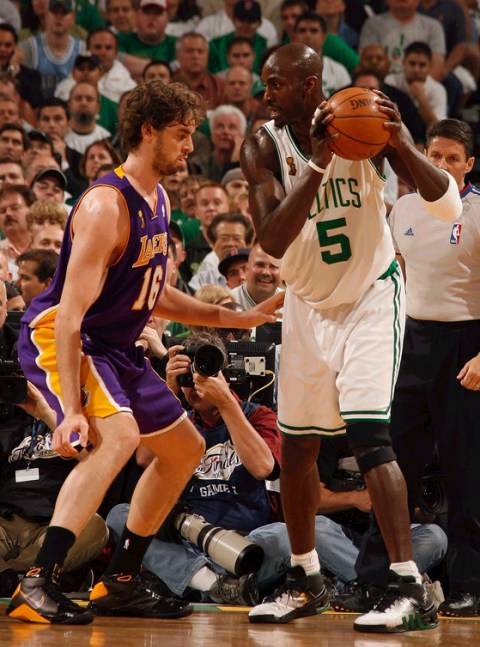
I knew I'd seen this awkward squat somehwhere before, and after a little poking around -- I swear by all that's holy that wasn't a pun -- I found it. (Sidenote: Is Timmy giving Pau an off the heezy?)
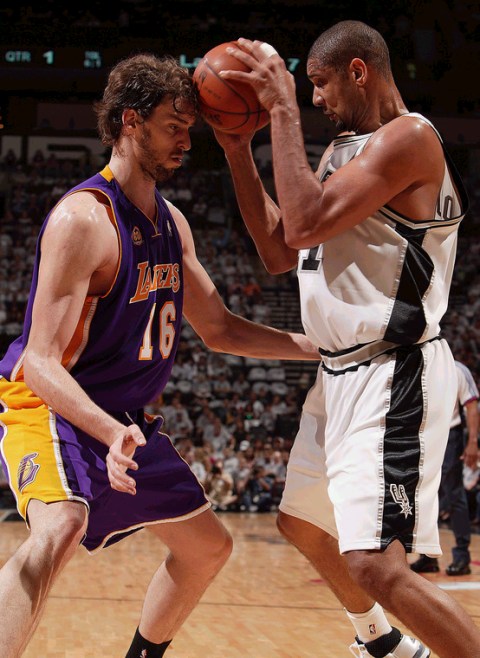
Sure, it's the proper defensive stance and everything, but, well, there's no blunt way to put this: It looks like Pau's taking a very uncomfortable (and probably unsatisfying) dump. Which, of course, reminded me of the classic defecating Pau Gasol "action" figurine... which is still available for only 14.00 Euros!
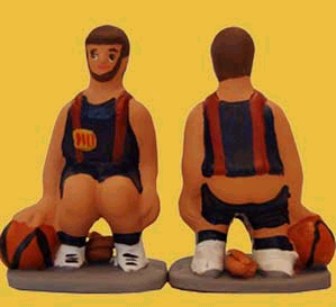
Whew. And I was worried I wouldn't be able to work in any poop jokes today.
Labels: action figures, defense, NBA Finals, Pau Gasol
Basketbawful recap: Put your right foot forward, keep your feet shoulder width apart, and stay on the balls of your feet. Is that too compicated for people to follow? Only if Michael Jordan's teaching it.
Labels: defense, instructional videos, Michael Jordan
In most cases, the defensive strategies used by the average pickup baller can be best explained by the following axiom: "Defense is just waiting to get back on offense." The intense focus and concentration that a player exerts while trying to create space for his "patented fallaway jumper" are almost completely absent on the defensive end. Pickup defenders usually display the droopy-eyed, slack-jawed, stiff-armed posture of a Romero-style movie zombie, except that at least a zombie is motivated to eat human brains. There is no "human brain equivalent" for a pickup defender. They're just killing time.
Another truism is that pickup ballers don't just avoid defense themselves, they want others to avoid it as well. Nothing annoys a pickup baller more than being tightly defended, denied the ball, or blocked out. I've received the kind of disgusted looks for playing sound, fundamental defense that are usually reserved for lawyers and child molesters. It's always important to remember that, in pickup basketball, offense is everything. I am often reminded that, "Hey, it's the first team to 11 points, not 11 steals."
The following list describes the various defensive strategies you're likely to encounter while playing pickup basketball. Remember: These strategies are not mutually exclusive, and many are actually used interchangeably depending on the dynamic circumstances of the game.
All-Star Defense: This style of defense focuses on gambling for cheap steals, leaping wildly into the air to deliver a spectacular blocked shot, and violently slapping the ball on an uncontested rebound. The flashy things, the showy things, the things that look really impressive until the player gives up several easy layups. This is what Red Auerbach liked to call "false hustle." However, it's a pretty sure bet that the all-star defender won't stay in front of his man, keep a hand in his face, or block out.
[Update!!] Anything Goes Defense: This is the pickup equivalent of the "Bad Boys" brand of basketball played by the Detroit Pistons in the late 80s. In other words: No blood, no foul. There are variations on this theme, of course. A high school buddy used to insist on playing by "bardyard rules," and as a result lost a chunk of ear cartilage during one of our after school one-on-one games. Anything Goes Defense works only if there is an agreement, be it spoken or unspoken, to abide by the "no rules" rule prior to the game. If you're the only player playing Anything Goes D, chances are you're going to become Pickup Enemy Number 1, and fast.
Dirty Bastard Defense: This is the style employed by the Bruce Bowens of your pickup league. They take defense very seriously, and even abide by some of the fundamental principles, but they also cheat. They cheat at every opportunity. They grab, they hold, they shove. Thanks to Bowen, they've even added the infamous "foot defense" to their repertoire. And it doesn't matter who they're guarding, because they do it to anybody and everybody. I used to be pretty good friends with a dirty bastard defender. We'd hang out before the game, do a little jogging, shoot around, laughing and joking the whole time. Then, right before the ball was inbounded, he'd step on my foot and grab my jersey.
Ego Defense: Some guys just automatically think they're better than everybody else. They're so good that they can play half speed on offense and zero speed on defense. In fact, they play with the kind of aloof disinterest that makes you wonder why they're playing at all. They will often make allusions to how they are accustomed to "better competition" to cover up their defensive inadequacies and general lack of effort. The ego defender will always let you shoot the jumper, then yell something like "off" or "short" to explain to his teammates why he didn't get a hand up (this will continue regardless of how many shots go in). When an offensive player drives, the ego defender will eschew moving his feet and choose instead to deliver a solid body bump or hack. Foul calls are usually met with a sarcastic look, loud complaint, or yelling.
Good Defense: It's true. Some pickup ballers actually play good defense. Many times, these players are a coach's son or someone who sat on the end of the bench for their high school basketball team. They always get into a proper defensive stance, move their feet, don't buy head fakes, and block out at every opportunity. They are tireless and never lose focus, which means they pursue you aggressively, limiting your touches and shot attempts. You know it's going to be a long, frustrating night when you get matched up against a good defender.
Hands-free Defense: There is a myth that all "Old Guy" players employ an aggressive, overly physical style of defense. This is not strictly true. While there are many old guys that cover their lost step(s) with well-timed pushing and shoving, some old guys harken back to a more civilized age, when even the most basic physical contact wasn't allowed. True, these old-schoolers probably call a lot of ticky-tack fouls, but they also tend to give up a lot of ground on defense. Most of the time, this goes unnoticed because some pickup ballers choose to go easy on the old guys. But pay close attention. If you end up matching up against a hands-free defender, you should post up or take it to the hole every time.
Helpless Defense: No matter how good or bad you are at defense, there are going to be times you lose your man and need a little help. Maybe you got picked, maybe you had to pick up somebody else's man on the fast break. Whatever the scenario, it is up to your teammates to make the proper rotations. However, you're more likely to see the Pope show up in short pants than to get proper defensive help. Pickup ballers usually have tunnel vision on defense; they see their own man and no one elses. Yelling "switch" sometimes improves the possibility of getting help, but not always. That's why it's always best to just fight through a pick. And don't bother trying to criticize a helpless defender. He'll just remind you that "He's not my man."
Matador Defense: This has been covered previously. This strategy is typically employed by players who don't pay attention. Then, when their man is about to score, they do a quick reach or wave their hand in the air to give the appearance of consistent defensive effort. This, of course, fools no one.
[UPDATE!!] Moviegoer Defense: These guys might as well show up with a box of popcorn and some contraband candy stuffed in their shorts, because all they do is stand around and watch. They watch as their teammates get posted up or beaten off the dribble, they watch as rebounds carom off the backboard, and they watch as their man streaks to the basket and/or hoists up shot after uncontested shot. These players provoke rage and even hatred in their teammates. Conversely, opposing players can almost always look forward to a "career night" (within the context of pickup league play) against them.
'Roid Defense: If you play pickup basketball at your local gym, you will sometimes encounter hugely muscular guys attempting to play basketball. These guys always point out that they're "just here to get in a little cardio." Translation: They are high on strength and low on skill. So, as you would expect, they try to use that Hulk-like strength to their advantage whenever possible, even if they must bend, break, or shatter the rules to do so. This is most apparent on rebounds, when they will use their giant arms to shove you, like a hapless rag doll, out from under the basket. When encountering a 'roid defender, be prepared for a high degree of physical contact, as they try to show off the fact that they can bench press your car.
Shame Defense: The shame defender uses various psychological tactics to convince you to either play light defense or, better yet, no defense at all. "Hey there big guy," they'll say, "take it easy on me, would ya? I'm old/injured/tired/hungover/depressed/etc." They might share a "private" story about a fight they just had with their wife, or explain how they just blew out their knee last week. The same person, when playing offense, might try to butter you up. "Uh oh," they'll tell you with a wink, "I have to play against the best defender in the league." Ultimately, they will say whatever it takes to make you feel a deep sense of shame for guarding them. You might ignore them at first and play your usual, hard-nosed defense. Then, they'll try to frown and pout until you back off. Sometimes, they'll stand far outside the three-point line and grouch that, "I might as well not even try, since you aren't gonna let me score." Don't be fooled, though. If you turn your back on them for a single second, they won't hesitate to streak in for an uncontested layup.
Labels: defense, pickup basketball
So why did Nuggets finish with a pathetic 20-62 record and waaaaaaay out of the playoffs? Because they were the worst defensive team of all time. Seriously.
Just how bad were they? They gave up 130.8 PPG. You read that right: Per game. Just think about that for a minute. Can you imagine putting up almost 120 points every night and still losing by an average of 11 a game? By the way, that 130.8 PPG is, indeed, the most allowed by any team in NBA history. And while it's true that team scoring averages were higher in '91 than they are today -- the league average was 106.3 PPG -- the Nuggets still allowed 24.5 PPG more than the league average. That means they could add Dirk Nowitzki's 2006-07 scoring average and still barely break even.
But wait! There's more. As a team, they shot 44.0 percent from the field -- worst in the league that season -- while allowing their opponents to shoot 51.2 percent, another league-worst. What's even more absurd is that they never, not once, held an opponent under 100 points. In fact, they held an opponent under 110 points only four times. By comparison, they allowed nine teams to score more than 150 points against them. Here's a breakdown of the number of points allowed by the Nuggets over the course of the 1990-91 season:
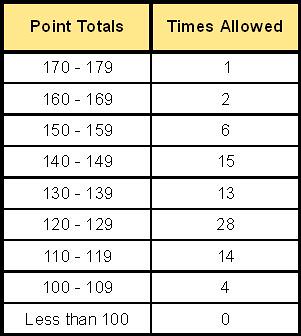
The coach of the team was Paul Westhead, best known for getting run out of Los Angeles by Magic Johnson. He decided before the season to implement an up-tempo offense that emphasized pushing the ball at every opportunity. Unfortunately for the '91 Nuggets, Lawler's Law -- which states that the first team to 100 points usually wins -- only works when you can actually stop the other team a couple times.
Runner Up: Strangely enough, the second-worst defensive team of all time was the 1981-82 Denver Nuggets, who surrendered 126 PPG while allowing opponents to shoot 52.4 percent. Coach Doug Moe used a motion offense he called "playground ball with a little supervision." Apparently there there was even less supervision on the defensive end. On the upside, they were the highest scoring team in league history at 126.5 PPG. Which got them into the playoffs, where they were gave up 121 PPG and were promptly knocked out in the first round by the Phoenix Suns.
Bonus Trivia: The 1982-83 Denver Nuggets have the dubious distinction of being the only team to ever score 184 points in a game...and lose. On December 13, 1983, the Nuggets lost to the Detroit Pistons by the score of 186-184 in triple overtime. And for the record, that Nuggets team gave up 122.6 points per game, which is good for 5th worst all time. Of course, the 1983-84 Denver Nuggets were the 4th worst defensive team ever, allowing 124.8 points per game. In fact, the Ultimate Stat Search at databaseBasketball.com reveals that five of the top ten worst defensive teams of all time are former Nuggets squads, making them, historically speaking, the worst defensive franchise ever.
Labels: defense, Denver Nuggets
Usage example: Watching the Cavaliers/Pistons series is almost as painful as the 1994 Knicks/Rockets Finals.
Word Trivia: The 1994 NBA Finals was one of the most competitive championship series in league history. It featured a marquee matchup between two superstar centers (Hakeem Olajuwon and Patrick Ewing) and a cast of other all-star-caliber players (Robert Horry, Sam Cassell, Mario Elie, Charles Oakley, Doc Rovers, Derek Harper, Rolando Blackman). It lasted the full seven games, and there wasn't a single blowout; none of the games were decided by more than nine points, and Games 6 and 7 were decided by two and six points respectively. Olajuwon outplayed Ewing on offense (27 PPG on 50 percent shooting versus 19 PPG on 36 percent shooting), but Ewing was a defensive monster, setting an NBA Finals record with 30 blocked shots, including a record-tying eight blocks in Game 5. However, this series is poorly regarded by most NBA fans for the following reasons:
1. Star bust: It was the first NBA Finals of the first post-Jordan era, and the first final series since 1978-79 that didn't feature Larry Bird, Magic Johnson, and/or Michael Jordan. Due to the absence of an nationally recognized fan favorite, many casual fans were uninterested in the series and therefore neglected to watch it. The series was further marred by Ewing's poor play, John Starks' 2-for-18 shooting performance in Game 7, and the fact that Olajuwon -- who was named Finals MVP -- submitted a performance that was very good in its own right, but hardly among the all-time greats.
2. Defense wins championships...not ratings: The series revolved around defense and, for that reason, the scores were painfully low. In fact, neither team scored more than 93 points in a single game. The scores were as follows: Game 1 - 85-78; Game 2 - 91-83, Game 3 - 93-89; Game 4 - 91-82; Game 5 - 91-84; Game 6 - 86-84; Game 7 - 90-84. Game 6 was the only time a player scored as many as 30 points, when Olajuwon had exactly 30. It was basically a case of two teams walking the ball up the court, tossing it into the post, and four guys spotting up beyond the arc and waiting for the return pass while the centers beat the hell out of each other.
3. The juice was on the loose: The series had the misfortune of being played during the onset of the the O.J. Simpson murder case. During Game 5, NBC split coverage between the game and Simpson's freeway chase with the LAPD. While the Knicks and Rockets were battling down to the wire, the national attention was focused elsewhere.
And so, despite the many rule changes that were instituted specifically to irradicate this kind of grind-it-out basketball, there are still one or two playoff series each year that are highly reminiscent of the '94 Finals (most notably the 2005 Pistons/Spurs Finals, which nearly qualified as an historical recreation). And it's then, like clockwork, that everybody harkens back to the series that defined the term "boring series."
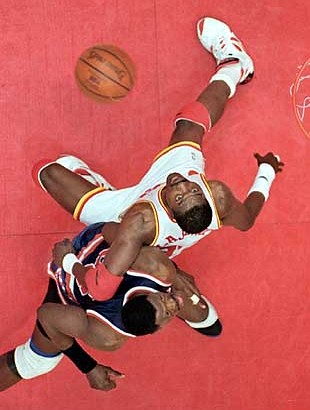
Labels: defense, Hakeem Olajuwon, Houston Rockets, John Starks, NBA Finals, New York Knicks, O.J. Simpson, Patrick Ewing
Usage example: The Pistons are killing the Bulls by using the HPTFZ defense.
Word History: The HPTFZ was invented by Detroit Pistons coach Flip Saunders prior to the 2001-2002 season, when zone defenses became legal in the NBA. Go here for the full story.
Labels: defense, Flip Saunders, Word of the Day
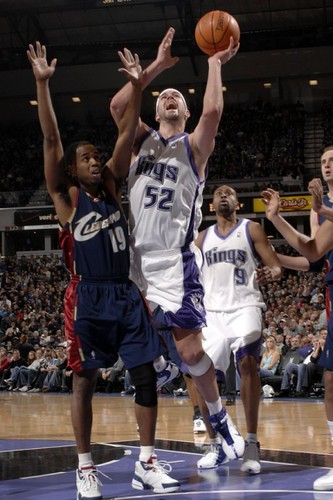
Usage Example: Instead of contesting the shot, Damon Jones just played 7-11 defense.
Word History: The term was coined by Kevin McHale during the 1986-87 season, as chronicled in Home of the Brave: A review of the Celtics' 1986-87 Season (available as part of the Boston Celtics Dynasty Series DVD set). This particular defensive move is typically used for one of the following reasons: either to avoid fouling (or getting called for a foul), or to (hopefully) draw an offensive foul. Sometimes this move is used to disguise a well-aimed body bump, and sometimes a defensive player will adopt the 7-11 stance immediately after fouling someone, as if to say, "Look at me! I'm just standing here! I could't have possibly fouled him!" (It is important to note that no NBA player has actually committed a foul since 1974; referees obviously call fouls either out of spite or to justify their bloated salaries.)
Labels: defense, Word of the Day
An excellent question, which requires an even more excellent answer. A special thanks goes out to reader scoots who -- despite being a mildly embittered Mavericks fan* -- directed me to Steve Nash's NBA.com bio page, which lists the little canuck's most historically significant accomplishments. The best of his best include:
1. During the 2006 playoffs, Nash became just the third player (behind Magic Johnson and John Stockton) to post double figures in assists in seven consecutive playoff games (May 12-26, 2006).
2. During the 2004-05 regular season, he became the only player in NBA history to record double figures in assists in 11 consecutive victories.
3. During the 2004-05 playoffs, he joined Wilt Chamberliain and Michael Jordan as the only players to score 40-plus points in one playoff game and then collect a triple double in the next game.
4. During the 2004-05 playoffs, he became the first (and still only) player in NBA history to record four consecutive games with at least 25 points and 10 assists in the postseason.
So there you have it. Nash can boast accomplishments that are, indeed, as rare as Kobe's recent scoring outbursts. And, most notably, three of the four I've listed were accomplished in the playoffs, versus the best competition. As opposed to, say, lottery teams. Which leads me to the second part of this post.
Whenever I present arguments in favor of Steve Nash, I usually get bombarded by "but" statements. BUT he's a bad defender. BUT he has talented teammates. BUT he's never won a title. BUT his hair is silly. And while these points have varying degrees of validity, they certainly do prove one thing: every player, and every accomplishment, comes with an asterisk. This has been true ever since Wilt Chamberlain dropped 100 on the Knicks (he was playing against undersized centers, it was a blowout, his teammates were fouling to get the ball back) and the Celtics won 11 out of 13 championships (they had the best players, the best coach, and leprechauns). And, in that spirit, Kobe's recent 5-game scoring streak also has a few "buts":
1. Kobe's recent scoring binge has come against five lottery-bound teams with a combined record of 141-209. For those of you who like math, that's a .403 winning percentage. The "best" team in that bunch is the Golden State Warriors, who are ninth in the West and have a slim chance of making the playoffs (but won't). But their 33-38 record is kind of deceiving, since they're 25-10 at home and an abysmal 8-28 on the road. Hey, guess where they were playing when Kobe dropped 43 points on them? Yep: in L.A.
2. The Lakers have won all five games during Kobe's scoring tear. Of course, they've done so by a combined total of 21 points (including a 4-point victory over the Portland Trailblazers in overtime). That's not to take anything away from the victories; a win's a win, period. The point, rather, is that all the games were close (two 2-point games, a 4-point game, a 6-point game, and a 7-point game). The fact that they were close means that Kobe had to stay in the game and continue shooting. There have been plenty of games throughout NBA history where a great player was hot and could have gone for 50 or 60. I know of several Larry Bird game where The Legend had 40+ by the third quarter, then sat out the fourth because it was a blowout. Same for Michael Jordan.
3. Over this 5-game stretch, Kobe has dished 11 assists and committed 15 turnovers (including 0 assists and 7 turnovers in Sunday's game against Golden State). That's a 0.7:1 assist-to-turnover ratio. That's...not good.
Kobe has been on fire, no doubt about it. His scoring has been extremely impressive (historically so), and, most importantly, the Lakers have won the last five games. But let's put things in perspective. The man beat up on a handful of lottery teams with less-than-stellar defenses and little to play for (Golden State's outside shot of making the playoffs notwithstanding). He also had to keep shooting in all five games because the Lakers couldn't pull away in any of them, despite his otherworldly scoring contributions. And that might be because he sacrificed getting his teammates involved because, well, he was too busy filling up the basket.
The thing is, I'm not saying any of this to take anything away from Bryant or his accomplishments. I may not like Kobe as a person, but I genuinely enjoy watching him play. I have repeatedly stated that he's the best scorer in the NBA, and one of the greatest in league history. I even think he's one of the best players in the game today. But I simply don't equate scoring with being The Best Player. That's why, if I was starting a team, I'd take a Magic Johnson over a Jordan, and I'd take a Nash over a Bryant, despite all the "buts" out there.
Now with that said, I admit to being a little tired of discuing Nash/Kobe. So I'll do my best to respond to any outstanding comments to this and past posts. However, going forward I intend to return to the fart and penis jokes that are my hallmark.
* Look, scoots, I feel your pain. It's always traumatizing when a player leaves your team and goes on to do great things. But honestly, Steve had to scale back his game when he played in Dallas. He was usually the second (behind Dirk Nowitzki) or third option (behind Dirk and Michael Finley). He simply filled his role and did what the coaching staff asked him to do. Which is remarkable, when you think about it. He never pouted or made bitter comments to the press about how he could be an MVP if he didn't have to defer to Dirk. He didn't demand a trade or try to get someone else traded. And when he was asked to be "The Man," he just flat out did it. But all that aside, you still have the Mavericks, who are the best team in the league and (in my mind) a lock to win the title this year (or as close to a lock as you can get in today's league).
Labels: defense, Kobe Bryant, Los Angeles Lakers, mustaches, Phoenix Suns, scoring, Steve Nash
*I apologize in advance if this statement has offended any of our mustachioed readers. If you believe your mustache kicks more ass than David's, please send us a picture and we will seriously reconsider our evaluation. Best Mustache Contest winners receive an unautographed t-shirt commemorating Greg Ostertag's career-high 18-point game.
David found my analysis laughable. I, on the other hand, found his analysis of my analysis -- and his mustache -- laughable. One of his sticking points was my contention that Phil Jackson used to hide Michael Jordan on defense during the Bulls' second threepeat:
"Did you actually watch any of the games that you are talking about? Pippen guarded Foster at times when the Bulls went with a small lineup and Pip was at the four spot. I don't think that MJ ever guarded Foster, except on a switch. Far from hiding MJ or Pip (or Kobe), Jackson liked to have them guarding the other team's top threat, the only exception being if they were in foul trouble. MJ and Pip took turns on Magic in the '91 Finals and Jackson loved to put MJ or Pip on Price, Stockton or Mark Jackson during key stretches of playoff games to disrupt the other team's offensive execution."
I own all of those games on either VHS or DVD. In fact, I have a copy of every NBA Finals game (and most other playoff games) on video from 1990 to the present. So yeah, I've watched and rewatched them several times. And honestly, I didn't pay much attention to whom Jordan was guarding back in 1997, but I've spent a lot of time analyzing those series since then. And in the '97 Finals, Jordan guarded Greg Foster whenever he was in the game. Hey, feel free to fly out to Chicago and I'll gladly watch the games with you and your mustache.
It is indeed true that Jordan guarded Magic during parts of the '91 Finals, and he was used as a lock-down defender at various other times in the early 90s (when his defensive prowess was justly recognized). But Jordan was not a great defender early in his career (I can show you plenty of videographic evidence of guys like Danny Ainge simply walking by Jordan on their way to the basket), and Jackson protected him late in his career. Pippen and Rodman were the lock-down guys during the second threepeat. It was Pippen (at times) guarding Mark Jackson and John Stockton in 1998, not Jordan. And Jordan only ever guarded Reggie Miller on switches and, of course, that classic end-of-game situation where Reggie hit a three-pointer over Jordan to lead the Pacers to victory.
"Back to Kobe; the Nash/Kobe defensive numbers that you cited are completely meaningless. Was Nash actually guarding the nominal point guard in the games that you cited or was he guarding someone else? How much help did he get when he was beaten off of the dribble? What do the players that he guarded normally average?"
Thanks to the wonders of NBA League Pass and TiVo, I do catch most of the Suns' games, so I'm accutely aware of whom Nash guards. I even compiled the stats of both starting and backup point guards when the starter got into foul trouble. Mind you, I don't think the numbers are infallible (there are, as you point out, numerous variables to consider). They weren't meant to be. But they're hardly meaningless. They provide a general snapshot of what opposing point guards have been doing against the Suns (in general) and Nash (in particular). The fact is, despite what the Anti-Nashers say, opposing point guards aren't lighting the Suns up on a nightly basis.
Honestly, I don't have the time or inclination to rewatch every Suns game and track every single defensive position. Unlike some people, I don't have a mustache to keep me company and therefore must go out into the world to seek companionship. But at least I'm citing some kind of evidence. All the Kobe Lovers ever seem to do is show up and make blanket statements about how Nash "gives up more points on defense than he produces on offense." Yet, as far as I can tell, there isn't a single shred of evidence that this is the case, other than heresay. How about you, oh great basketball guru? What evidence did you show up with? Other than the ever-insightful "You're Wrong" argument.
"As for Kobe, one of your previous commenters already mentioned that Bryant was not burned one on one by Arenas or Wade or the others in their big games; those guys got their points because the Lakers bigs don't know how to defend the screen and roll."
Well golly gee, if one of previous commenters said it, it must be true! Let me ask a question you keep asking me: Did you watch those games? I know I did. Take the game in which Arenas scored 60. He did, in point of fact fact, burn Kobe one-on-one -- more than once -- which is why Kobe was (rightfully) embarrassed afterward. Bryant then tried to dismiss the scorching by claiming that he just wasn't prepared to defend Gilbert's "bad shots." You might remember this choice Kobe quote: "Some of the shots he took tonight, you miss those, and they're just terrible shots. Awful. You make them and they're unbelievable shots. I don't get a chance to play him much, so I haven't gotten used to that mentality of just chucking it up there. He made some big ones, but I'll be ready next time."
Those last couple sentences sure sound like an admission of guilt to me. And did you watch the Cavs/Lakers game prior to the All Star break? Kobe tried to lock down Lebron James and failed. It wasn't just Lebron's 38 points, either; James controlled that game, and, not coincidentally, the Cavaliers won. In L.A.
It completely amazes me that you have the balls to call my analysis laughable and then simply dismiss Kobe's poor defensive outings as a result of Kwame Brown's and Andrew Bynum's inability to play screen roll. Oh, it's that simple, is it? Kobe's mistakes aren't his mistakes, they're somebody else's mistakes...why didn't I think of that?! You and your mustache truly understand the game of basketball!
If you want to play that way, then let's apply the same logic to Nash on defense. If you've bothered to really watch the Suns play over the last three seasons, you'll know that they employ a team defensive scheme that calls for Nash to sink in and cheat on the opposing teams' big men when the ball goes in the post. This also happens when anyone else gets beat off the dribble. As a result, Nash ends up surrending a lot of open threes and drives to the basket. Yet, according to Seven Seconds Or Less, that's exactly what coach Mike D'Antoni wants him to do. So, if you honestly don't fault Kobe for giving up points on screen rolls (and whatever else you want to blame the Lakers' big men for), you need to go back and subtract every point scored on Nash when he's providing help defense (which is often).
"One more point about Kobe's defense: the All-Defensive Teams are voted on by the coaches, not the media or the fans. When you say that he is getting by on his reputation you are saying that NBA coaches that see Bryant on a nightly basis know less about the defensive capabilities of NBA players than you do."
Wow. I didn't realize that NBA coaches get to watch Kobe Bryant on a nightly basis. That's pretty nice of the team owners to give their coaches time off to watch Kobe play instead of, oh I don't know, coaching their teams. Look, every account I've ever read of NBA coaches (such as in Seven Seconds Or Less and The Pivotal Season) seems to indicate that these men are very busy minding their own team. Coaching in the NBA is more than a full-time job. Somehow I doubt they spend much time breaking down tape and doing in-depth analysis after they get their All Defensive Team ballots in the mail.
This isn't to say they don't know what they're doing, but do you honestly think coaching selections are infallible? The coaches select the reserves for the All Star Game. Do you agree with every selection they've ever made? You're telling me you've never questioned coaching choices for All Star Reserves, All Defensive Team honors, or anything else? Come on, now. Whatever you may think, coaches are not machines churning out flawless analyses of NBA teams and players. There are many reasons, poth personal and political, that they make the choices they do.
And yeah, I do think that players do get by on reputation. It happens all the time. Most people agree that Gary Payton was getting All Defensive honors long after he'd lost six or seven steps on D. And according to Peter May's The Big Three, Kevin McHale himself admitted that his selection to the All Defensive First Team in 1988 was due mostly to reputation. Hell, Larry Bird, whose individual defense has been routinely criticized over the years, made the All Defensive Second Team three straight times. You don't suppose the fact that he was Larry Bird had anything to do with that, do you?
"Hey, Kobe and Nash are both great players. I have Kobe, Dirk and Nash 1-2-3 in that order for MVP. If someone else has them in a different order, fine. But you simply hate Kobe, as you admit, so why don't you just leave it at that rather than throwing out a bunch of spurious, misleading numbers?"
I didn't realize that I'd been hiding the fact that I hate Kobe. I figured the words "Actually, I do hate Kobe" in my last post were pretty obvious. As for my "spurious" and "misleading" numbers, I don't think you have much room to talk. After all, you just wrote an article titled "60 More Reasons That Kobe Bryant is the NBA's Best Player." According to your article, scoring lots of points over the course of a handful of games, and doing so at a high percentage (higher, by far, than his season average, I should point out), is all the evidence we need that Kobe is the best player in the league. Scoring = The Best? Talk about spurious and misleading.
(By the way, do you know who Kobe was guarding last night? Mike Miller. Mikey scored 33 points on 11-16 shooting. But it's okay to give up points as long as you're scoring a lot, right?)
The fact is, there is no one statistic, no two statistics, no ten statistics that prove who's the best. And there's no statistic that, by itself, proves anything at all. Red Auerbach once pooh-poohed scoring averages because the number, by itself, doesn't tell you whether the player scored the most points versus good teams or bad teams, whether the points were scored during the game or in the clutch, and so on. At the end of the day, all you can do is review all the evidence you can, watch the games, and make your decision based on what you see and what you think you know. And I stick by my choice: Nash over Kobe.
Labels: crazy people, defense, Kobe Bryant, Los Angeles Lakers, mustaches, Phoenix Suns, scoring, Steve Nash
However, basketball isn't a one-on-one game (at least, it isn't supposed to be). It's five-on-five, which is why I think if the debate focuses on points, it's important to consider point production rather than points scored. If a player's worth is defined by the points he is responsible for, I think assists should be included in the discussion. Of course, doing so is problematic, since it's difficult (if not impossible) to determine whether an assist led to a two-pointer or a three-pointer, whether a player scored while getting fouled (and made the resulting foul shot), and whether a pass led to a shooting foul (and the subsequent freethrows) without appearing in the box score. It also doesn't account for the relative quality of teammates, the type of offense a teams uses, and so on.
I was simply trying to introduce a slightly modified way of thinking about scoring in the NBA. I'm not a Kobe-Hater. Well, actually, I do hate Kobe Bryant, but not because of the way he plays basketball. I readily concede that he's the best scorer in the league, and incredibly exciting to watch. I just don't think that makes him the de facto best player. One unfortunate byproduct of Michael Jordan's reign is that many people think that the greatest player must necessarily be the most unstoppable scorer, and I don't believe that's the case.
Now, let's talk about what I call "the defensive myth." Most of the people who consistently disagree with me in the Nash-versus-Kobe Debate repeatedly point out how "terrible" Steve Nash is on defense and how great Kobe is. Personally, I think this is a cop out. It's become all too easy to make these blanket statements about the relative defensive abilities of these players. After all, if people say it often enough, it must be true...right?
I said "not so fast," and pointed out in the comments section how well some of the better shooting guards have performed against Kobe this season: Ray Allen had back-to-back 30-plus-point games; Michael Redd dropped 45 on him; Dwayne Wade scored 40 and 35 points; Gilbert Arenas scored half of his 60 points (14 in the fourth quarter, 16 in overtime) after Kobe specifically asked Phil Jackson for the defensive assignment; and Kobe asked to guard Lebron in the last game before the All Star break, and James put up 38 points.
I used these examples because one of the primary arguments that was used against Nash winning the MVP last year was that some of the opposing All Star-caliber point guards had big games against him (most notably Chauncy Billups). But here's the thing: great players are going to score points, no matter who's guarding them. So I don't think it's necessarily reasonable to expect Nash to shut down Billups, or for Bryant to shut down Wade or Lebron. I just figured that I'd use the enemies tactics against them.
In the interest of fairness, however, I decided to take a random sample of how opposing point guards have fared against Steve Nash this season, and how opposing shooting guards have fared against Kobe Bryant. I decided to calculate the opposing players' averages in field goal percentage, points, and assists for the month of January. I chose January because it was after Kobe had recovered from off-season knee surgery and before Steve Nash injured his shoulder.
Steve Nash: Nash played 16 games in January. Opposing point guards shot 36.4 percent (89-244), scored 14.8 PPG, and dished 4.9 APG. The Suns were 15-1.
Kobe Bryant: The Mamba played 15 games in January. Opposing shooting guards shot 45.6 percent (109-239), scored 21.6 PPG, and dished 4.6 APG. The Lakers were 8-7.
So, just by the numbers, Kobe allowed opposing players to score more while shooting a much higher percentage, and they compiled almost as many assists per game. Now, again, this is a very basic statistical analysis. It doesn't take into account team defensive schemes, defensive switches, and alternating defensive assignments. Still, I find it pretty interesting. Not so much that players scored more against Kobe; after all, shooting guards are supposed to shoot the ball. What I find interesting is the descrepancy in shooting percentages. If Nash's defense was so absolutely horrible, would opposing point guards be shooting such a terrible percentage? It's something to consider...
Bottom line: The random sample provides a strong indication that, despite proclamations to the contrary, Nash does not surrender more points than he produces. Is he a great individual defender? No. But he operates very well within the team defensive scheme designed by the Suns' coaching staff. Opposing PGs just aren't lighting him up.
One last note on Kobe's defensive abilities. There's no question that Kobe has they physical and mental capacity to be a great defender (whereas Nash does not). And he has, in times past, put those talents to spectacular use. But capacity does not equate to actuality. I've watched him enough to know that he rarely focuses his abilities on the defensive end (no doubt conserving energy for his offensive duties). Furthermore, Phil Jackson sometimes "hides" Kobe on the defensive end by giving him lesser defensive assignments. (This is a common Phil Jackson tactic; he used to "hide" Jordan as well, particularly during the Bulls' second threepeat. In the 1997 Finals, Jordan's defensive assignment was Greg Foster. In the 1998 Eastern Conference Finals, he guarded the nearly immobile Chris Mullin rather than Reggie Miller, and in the Finals he guarded Jeff Hornacek -- who was partially hobbled by chronic knee pain -- rather than the younger, faster, more athletic Bryon Russell.)
Oh, and for the record, I do consider Magic Johnson to have been a greater player than Michael Jordan. But that's a subject for another day.
Labels: defense, Kobe Bryant, Los Angeles Lakers, Phoenix Suns, points, Steve Nash
February 2005
October 2005
November 2005
December 2005
January 2006
February 2006
March 2006
April 2006
May 2006
June 2006
July 2006
August 2006
September 2006
October 2006
November 2006
December 2006
January 2007
February 2007
March 2007
April 2007
May 2007
June 2007
July 2007
August 2007
September 2007
October 2007
November 2007
December 2007
January 2008
February 2008
March 2008
April 2008
May 2008
June 2008
July 2008
August 2008
September 2008
October 2008
November 2008
December 2008
January 2009
February 2009
March 2009
April 2009
May 2009
June 2009
July 2009
August 2009
September 2009
October 2009
November 2009
December 2009
January 2010
February 2010
March 2010
April 2010
May 2010
June 2010
July 2010
August 2010
September 2010
October 2010
November 2010
December 2010
January 2011
February 2011
March 2011
April 2011
May 2011
June 2011
July 2011
August 2011
September 2011
October 2011
November 2011
December 2011
January 2012
February 2012
March 2012
April 2012
May 2012
June 2012
July 2012
August 2012
September 2012
October 2012
November 2012
December 2012
January 2013
February 2013
March 2013
April 2013
May 2013
June 2013
July 2013
August 2013
September 2013
October 2013
November 2013
December 2013
April 2014
May 2014
June 2014
July 2014
August 2014
June 2018
July 2022