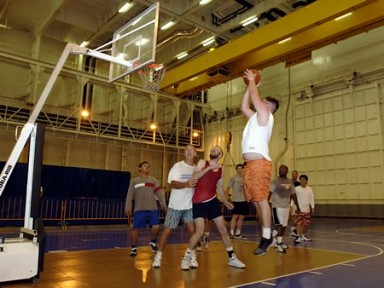
As I mentioned in Defensive Strategies, many pickup ballers live and die by the philosophy that "It's the first team to 11 points, not 11 steals." This means that scoring is king. And for that reason, knowing how to track the score is of vital importance.
Ones and twos: Pickup basketball typically employs a simplified scoring system so that it's easier for players to track the score. If you're an experienced pickup baller, you know that simple math becomes difficult, even impossible, when players are in the heat of battle and on the verge of total fatigue (which for some out-of-shape players is the first trip down the court). For that reason, conventional baskets are worth one point and three-pointers are usually worth two points.
Unfortunately, there are serious drawbacks to making the three-pointer worth double a normal basket. Players are much more likely to bomb away from downtown without regard to common sensibility. After all, hitting 25 percent of your twos is like hitting 50 percent of your ones, right? I promise you that if half-court shots were worth three or four points, people would start chucking from there, too.
This leads to many players shooting the three almost exclusively, and therefore not developing any other tangible on-court skill (like, say, passing the ball). It also creates circumstances under which a team can actually lose a game despite hitting almost twice as many field goals as the opposing team. Nothing is more frustrating than executing a precise and efficient offense and still losing to a bunch of selfish, one-trick gunners.
Time limits: Time limits are not imposed in pickup games. Instead, play ends when one team reaches a predefined total score. Common end-game scores are 7, 11, 15, and 21. The choice of score is usually dictated by how many courts are available and how many people are waiting to play. The more people waiting for next, the lower the winning score will be. Be warned: Some players will arbitrarily decide on their own end-game score, often without informing anyone. I was once involved in a heated contest in which a player yelled out "game" after he scored his team's sixth point. Everybody stood in silent astonishment as he strutted "victoriously" off the court. It's the one and only time in 15 years of playing pickup ball that I ever participated in a game that ended at six.
Win by two: Usually, the winning team must win by at least two points. This rule was probably created by losing teams who wanted an extra and undeserved chance to claim victory. Be careful how this rule is applied. While it's often assumed that a team must win by at least two points, some players will become enraged if you shout out "win by two" after they've seemingly scored the winning bucket (such as, for instance, after the game was tied 14-14). Unless you're playing in a pickup league where the rules are clearly established, you should summarize the scoring rules prior to starting any game. Otherwise, you may end up with an ugly fight on your hands.
Overtimes and dead ends: The "win by two" method inevitably leads to "overtime" games, where the final score for both teams goes several points ahead of the previously arranged end score. When two teams are evenly matched, or equally fatigued, games can go on seemingly forever. To avoid this, a "dead end" or maximum score is usually established. A sample scoring system might be first to 11, win by two, with a max score of 15.
Keeping track: Pickup games operate without the benefit of electronic scoreboards and official scorekeepers. Even if you play in a supervised pickup league, the designated coordinator is usually so poorly paid or disinterested that it's unlikely he or she will keep score for you. This means that the players are responsible for tracking the score. The best way to do this is for one or more players to yell out an updated score after each basket; otherwise, it's easy to lose track of the official score. In most cases, this will cause an argument and the players will grudgingly come to a group consensus as to what the score is. This inevitably leaves individual players and even entire teams feeling as if they've been screwed over.
Point shaving: Careless and unscrupulous players will regularly try to use the lack of an official scorekeeper to their advantage. Unless the score is called out after each hoop, these people will try to manipulate the score, taking a point or two away from the opposing team's total, or adding points to their own. I can't tell you how many times I've been on a team that I thought was comfortably in the lead, only to hear someone on the opposing team shout that the score was tied, or his team was ahead. There are also instances in which someone will claim you're jipping his team, no matter how diligent you've been at calling out the score.
Game point: There is no point as hotly contested as game point. Even the most defenseless players will put a body on you and start blocking out on game point, and even the cleanest games degenerate into hackfests. Some teams or players will even try to shame the opposing team into using the most difficult shot to win. I used to play with a group of guys that required the winning basket to be a driving layup. This, of course, provided them with the chance to maul people on their way to the hoop, thereby extending the game and giving them an "equal chance" at winning. To that end, it's difficult, sometimes completely impossible, to win on a layup. And heaven help the player brave enough to drive...you might as well stick your hand into a shark tank.
It's amazing to watch the psychological shift that occurs on game point. Good players become afraid to shoot, bad players become brave, everybody starts scrambling and diving for loose balls. Almost every call or non-call turns into an argument. Friends start screaming at each other, and sometimes won't speak for days if the final score is in dispute.
Labels: pickup basketball, scoring
You know, a lot of people have forgotten -- or maybe never really knew -- just how good Larry Bird was back in the day. I think these same people assume that Bird, while generally a better rebounder and passer, couldn't keep up with Jordan in the scoring department. Wrong. Unlike Jordan, Bird didn't care about winning the scoring title. And, with teamates like Kevin McHale and Robert Parish, he didn't have to.
Make no mistake, though: Bird could put the ball in the hoop. Casual fans only remember the Larry Bird of the early 90s. By that time, his back was injured so badly he was practically a cripple (and, indeed, he spent time in traction between games during the 1991 playoffs). Of course, he still averaged 20/9/7 a game during his final two seasons, which is pretty impressive considering that -- as M.L. Carr put it in Unfinished Business -- he was playing without a back.
But it's interesting to look back at the Bird/Jordan duels of the 1986-87 and 1987-88 campaigns. Those were Bird's last two healthy years, and they were also the seasons that Jordan was at his most statistically dominant (37/5/4 in '87 and 35/5/5 in '88).
In 1986-87, Bird averaged 34 PPG (on 56 percent shooting) against the Bulls; Jordan averaged 29 PPG (on 42 percent shooting) against the Celtics. Bird outscored Jordan in four out of six games, and two of those times it wasn't even close: On March 27, 1987 Bird hit for 41 (17-29) compared to Jordan's 22 (9-23); on April 17, 1987 Bird netted 38 (17-29 again) and Jordan had only 17 (5-15).
In 1987-88, Bird averaged 34 PPG (on 59 percent shooting) against the Bulls (although he missed two of the games due to injury), while Jordan scorched the Celtics for 39 PPG (on 55 percent shooting), including one 50-point outburst. Bird outscored Jordan twice in the games they played against each other: 33 (14-21) to 26 (10-18) and 44 to 39 (as noted above). They had another great shootout on January 12, 1988: Jordan won the scoring war 42 (19-35) to 38 (18-31), but the Celtics won the game 104-97, despite the fact that they had to start Dirk Minniefield (who??) in place of the injured Dennis Johnson.
The point (no pun intended) of all this should be clear: When healthy, Bird could score with Jordan whenever he was inclined to do so. While many people just matter-of-factly declare Jordan as the GOAT, everyone should be aware that Larry Bird, healthy and in his prime, was as good as Jordan...even better in some areas (such as rebounding and passing). Although, admittedly, he was never as good of an individual defender as Jordan, but he wasn't quite as bad as everyone seems to think (again, most fans only remember the nearly immobile Bird from the end of his career).
For the record: The Celtics were 6-0 against the Bulls in 1986-87, and they were 3-3 against them in 1987-88. Of course, Bird missed two of the games in 87-88 (and Kevin McHale also missed one of those games); the C's were 3-1 with Bird in the lineup and 0-2 without him. Jordan finished second (to Magic Johnson) in MVP voting in 1987, while Bird finished third. Jordan won it (somewhat dubiously) in 1988, and Bird finished second.
Labels: classic duels, Larry Bird Michael Jordan, scoring
An excellent question, which requires an even more excellent answer. A special thanks goes out to reader scoots who -- despite being a mildly embittered Mavericks fan* -- directed me to Steve Nash's NBA.com bio page, which lists the little canuck's most historically significant accomplishments. The best of his best include:
1. During the 2006 playoffs, Nash became just the third player (behind Magic Johnson and John Stockton) to post double figures in assists in seven consecutive playoff games (May 12-26, 2006).
2. During the 2004-05 regular season, he became the only player in NBA history to record double figures in assists in 11 consecutive victories.
3. During the 2004-05 playoffs, he joined Wilt Chamberliain and Michael Jordan as the only players to score 40-plus points in one playoff game and then collect a triple double in the next game.
4. During the 2004-05 playoffs, he became the first (and still only) player in NBA history to record four consecutive games with at least 25 points and 10 assists in the postseason.
So there you have it. Nash can boast accomplishments that are, indeed, as rare as Kobe's recent scoring outbursts. And, most notably, three of the four I've listed were accomplished in the playoffs, versus the best competition. As opposed to, say, lottery teams. Which leads me to the second part of this post.
Whenever I present arguments in favor of Steve Nash, I usually get bombarded by "but" statements. BUT he's a bad defender. BUT he has talented teammates. BUT he's never won a title. BUT his hair is silly. And while these points have varying degrees of validity, they certainly do prove one thing: every player, and every accomplishment, comes with an asterisk. This has been true ever since Wilt Chamberlain dropped 100 on the Knicks (he was playing against undersized centers, it was a blowout, his teammates were fouling to get the ball back) and the Celtics won 11 out of 13 championships (they had the best players, the best coach, and leprechauns). And, in that spirit, Kobe's recent 5-game scoring streak also has a few "buts":
1. Kobe's recent scoring binge has come against five lottery-bound teams with a combined record of 141-209. For those of you who like math, that's a .403 winning percentage. The "best" team in that bunch is the Golden State Warriors, who are ninth in the West and have a slim chance of making the playoffs (but won't). But their 33-38 record is kind of deceiving, since they're 25-10 at home and an abysmal 8-28 on the road. Hey, guess where they were playing when Kobe dropped 43 points on them? Yep: in L.A.
2. The Lakers have won all five games during Kobe's scoring tear. Of course, they've done so by a combined total of 21 points (including a 4-point victory over the Portland Trailblazers in overtime). That's not to take anything away from the victories; a win's a win, period. The point, rather, is that all the games were close (two 2-point games, a 4-point game, a 6-point game, and a 7-point game). The fact that they were close means that Kobe had to stay in the game and continue shooting. There have been plenty of games throughout NBA history where a great player was hot and could have gone for 50 or 60. I know of several Larry Bird game where The Legend had 40+ by the third quarter, then sat out the fourth because it was a blowout. Same for Michael Jordan.
3. Over this 5-game stretch, Kobe has dished 11 assists and committed 15 turnovers (including 0 assists and 7 turnovers in Sunday's game against Golden State). That's a 0.7:1 assist-to-turnover ratio. That's...not good.
Kobe has been on fire, no doubt about it. His scoring has been extremely impressive (historically so), and, most importantly, the Lakers have won the last five games. But let's put things in perspective. The man beat up on a handful of lottery teams with less-than-stellar defenses and little to play for (Golden State's outside shot of making the playoffs notwithstanding). He also had to keep shooting in all five games because the Lakers couldn't pull away in any of them, despite his otherworldly scoring contributions. And that might be because he sacrificed getting his teammates involved because, well, he was too busy filling up the basket.
The thing is, I'm not saying any of this to take anything away from Bryant or his accomplishments. I may not like Kobe as a person, but I genuinely enjoy watching him play. I have repeatedly stated that he's the best scorer in the NBA, and one of the greatest in league history. I even think he's one of the best players in the game today. But I simply don't equate scoring with being The Best Player. That's why, if I was starting a team, I'd take a Magic Johnson over a Jordan, and I'd take a Nash over a Bryant, despite all the "buts" out there.
Now with that said, I admit to being a little tired of discuing Nash/Kobe. So I'll do my best to respond to any outstanding comments to this and past posts. However, going forward I intend to return to the fart and penis jokes that are my hallmark.
* Look, scoots, I feel your pain. It's always traumatizing when a player leaves your team and goes on to do great things. But honestly, Steve had to scale back his game when he played in Dallas. He was usually the second (behind Dirk Nowitzki) or third option (behind Dirk and Michael Finley). He simply filled his role and did what the coaching staff asked him to do. Which is remarkable, when you think about it. He never pouted or made bitter comments to the press about how he could be an MVP if he didn't have to defer to Dirk. He didn't demand a trade or try to get someone else traded. And when he was asked to be "The Man," he just flat out did it. But all that aside, you still have the Mavericks, who are the best team in the league and (in my mind) a lock to win the title this year (or as close to a lock as you can get in today's league).
Labels: defense, Kobe Bryant, Los Angeles Lakers, mustaches, Phoenix Suns, scoring, Steve Nash
*I apologize in advance if this statement has offended any of our mustachioed readers. If you believe your mustache kicks more ass than David's, please send us a picture and we will seriously reconsider our evaluation. Best Mustache Contest winners receive an unautographed t-shirt commemorating Greg Ostertag's career-high 18-point game.
David found my analysis laughable. I, on the other hand, found his analysis of my analysis -- and his mustache -- laughable. One of his sticking points was my contention that Phil Jackson used to hide Michael Jordan on defense during the Bulls' second threepeat:
"Did you actually watch any of the games that you are talking about? Pippen guarded Foster at times when the Bulls went with a small lineup and Pip was at the four spot. I don't think that MJ ever guarded Foster, except on a switch. Far from hiding MJ or Pip (or Kobe), Jackson liked to have them guarding the other team's top threat, the only exception being if they were in foul trouble. MJ and Pip took turns on Magic in the '91 Finals and Jackson loved to put MJ or Pip on Price, Stockton or Mark Jackson during key stretches of playoff games to disrupt the other team's offensive execution."
I own all of those games on either VHS or DVD. In fact, I have a copy of every NBA Finals game (and most other playoff games) on video from 1990 to the present. So yeah, I've watched and rewatched them several times. And honestly, I didn't pay much attention to whom Jordan was guarding back in 1997, but I've spent a lot of time analyzing those series since then. And in the '97 Finals, Jordan guarded Greg Foster whenever he was in the game. Hey, feel free to fly out to Chicago and I'll gladly watch the games with you and your mustache.
It is indeed true that Jordan guarded Magic during parts of the '91 Finals, and he was used as a lock-down defender at various other times in the early 90s (when his defensive prowess was justly recognized). But Jordan was not a great defender early in his career (I can show you plenty of videographic evidence of guys like Danny Ainge simply walking by Jordan on their way to the basket), and Jackson protected him late in his career. Pippen and Rodman were the lock-down guys during the second threepeat. It was Pippen (at times) guarding Mark Jackson and John Stockton in 1998, not Jordan. And Jordan only ever guarded Reggie Miller on switches and, of course, that classic end-of-game situation where Reggie hit a three-pointer over Jordan to lead the Pacers to victory.
"Back to Kobe; the Nash/Kobe defensive numbers that you cited are completely meaningless. Was Nash actually guarding the nominal point guard in the games that you cited or was he guarding someone else? How much help did he get when he was beaten off of the dribble? What do the players that he guarded normally average?"
Thanks to the wonders of NBA League Pass and TiVo, I do catch most of the Suns' games, so I'm accutely aware of whom Nash guards. I even compiled the stats of both starting and backup point guards when the starter got into foul trouble. Mind you, I don't think the numbers are infallible (there are, as you point out, numerous variables to consider). They weren't meant to be. But they're hardly meaningless. They provide a general snapshot of what opposing point guards have been doing against the Suns (in general) and Nash (in particular). The fact is, despite what the Anti-Nashers say, opposing point guards aren't lighting the Suns up on a nightly basis.
Honestly, I don't have the time or inclination to rewatch every Suns game and track every single defensive position. Unlike some people, I don't have a mustache to keep me company and therefore must go out into the world to seek companionship. But at least I'm citing some kind of evidence. All the Kobe Lovers ever seem to do is show up and make blanket statements about how Nash "gives up more points on defense than he produces on offense." Yet, as far as I can tell, there isn't a single shred of evidence that this is the case, other than heresay. How about you, oh great basketball guru? What evidence did you show up with? Other than the ever-insightful "You're Wrong" argument.
"As for Kobe, one of your previous commenters already mentioned that Bryant was not burned one on one by Arenas or Wade or the others in their big games; those guys got their points because the Lakers bigs don't know how to defend the screen and roll."
Well golly gee, if one of previous commenters said it, it must be true! Let me ask a question you keep asking me: Did you watch those games? I know I did. Take the game in which Arenas scored 60. He did, in point of fact fact, burn Kobe one-on-one -- more than once -- which is why Kobe was (rightfully) embarrassed afterward. Bryant then tried to dismiss the scorching by claiming that he just wasn't prepared to defend Gilbert's "bad shots." You might remember this choice Kobe quote: "Some of the shots he took tonight, you miss those, and they're just terrible shots. Awful. You make them and they're unbelievable shots. I don't get a chance to play him much, so I haven't gotten used to that mentality of just chucking it up there. He made some big ones, but I'll be ready next time."
Those last couple sentences sure sound like an admission of guilt to me. And did you watch the Cavs/Lakers game prior to the All Star break? Kobe tried to lock down Lebron James and failed. It wasn't just Lebron's 38 points, either; James controlled that game, and, not coincidentally, the Cavaliers won. In L.A.
It completely amazes me that you have the balls to call my analysis laughable and then simply dismiss Kobe's poor defensive outings as a result of Kwame Brown's and Andrew Bynum's inability to play screen roll. Oh, it's that simple, is it? Kobe's mistakes aren't his mistakes, they're somebody else's mistakes...why didn't I think of that?! You and your mustache truly understand the game of basketball!
If you want to play that way, then let's apply the same logic to Nash on defense. If you've bothered to really watch the Suns play over the last three seasons, you'll know that they employ a team defensive scheme that calls for Nash to sink in and cheat on the opposing teams' big men when the ball goes in the post. This also happens when anyone else gets beat off the dribble. As a result, Nash ends up surrending a lot of open threes and drives to the basket. Yet, according to Seven Seconds Or Less, that's exactly what coach Mike D'Antoni wants him to do. So, if you honestly don't fault Kobe for giving up points on screen rolls (and whatever else you want to blame the Lakers' big men for), you need to go back and subtract every point scored on Nash when he's providing help defense (which is often).
"One more point about Kobe's defense: the All-Defensive Teams are voted on by the coaches, not the media or the fans. When you say that he is getting by on his reputation you are saying that NBA coaches that see Bryant on a nightly basis know less about the defensive capabilities of NBA players than you do."
Wow. I didn't realize that NBA coaches get to watch Kobe Bryant on a nightly basis. That's pretty nice of the team owners to give their coaches time off to watch Kobe play instead of, oh I don't know, coaching their teams. Look, every account I've ever read of NBA coaches (such as in Seven Seconds Or Less and The Pivotal Season) seems to indicate that these men are very busy minding their own team. Coaching in the NBA is more than a full-time job. Somehow I doubt they spend much time breaking down tape and doing in-depth analysis after they get their All Defensive Team ballots in the mail.
This isn't to say they don't know what they're doing, but do you honestly think coaching selections are infallible? The coaches select the reserves for the All Star Game. Do you agree with every selection they've ever made? You're telling me you've never questioned coaching choices for All Star Reserves, All Defensive Team honors, or anything else? Come on, now. Whatever you may think, coaches are not machines churning out flawless analyses of NBA teams and players. There are many reasons, poth personal and political, that they make the choices they do.
And yeah, I do think that players do get by on reputation. It happens all the time. Most people agree that Gary Payton was getting All Defensive honors long after he'd lost six or seven steps on D. And according to Peter May's The Big Three, Kevin McHale himself admitted that his selection to the All Defensive First Team in 1988 was due mostly to reputation. Hell, Larry Bird, whose individual defense has been routinely criticized over the years, made the All Defensive Second Team three straight times. You don't suppose the fact that he was Larry Bird had anything to do with that, do you?
"Hey, Kobe and Nash are both great players. I have Kobe, Dirk and Nash 1-2-3 in that order for MVP. If someone else has them in a different order, fine. But you simply hate Kobe, as you admit, so why don't you just leave it at that rather than throwing out a bunch of spurious, misleading numbers?"
I didn't realize that I'd been hiding the fact that I hate Kobe. I figured the words "Actually, I do hate Kobe" in my last post were pretty obvious. As for my "spurious" and "misleading" numbers, I don't think you have much room to talk. After all, you just wrote an article titled "60 More Reasons That Kobe Bryant is the NBA's Best Player." According to your article, scoring lots of points over the course of a handful of games, and doing so at a high percentage (higher, by far, than his season average, I should point out), is all the evidence we need that Kobe is the best player in the league. Scoring = The Best? Talk about spurious and misleading.
(By the way, do you know who Kobe was guarding last night? Mike Miller. Mikey scored 33 points on 11-16 shooting. But it's okay to give up points as long as you're scoring a lot, right?)
The fact is, there is no one statistic, no two statistics, no ten statistics that prove who's the best. And there's no statistic that, by itself, proves anything at all. Red Auerbach once pooh-poohed scoring averages because the number, by itself, doesn't tell you whether the player scored the most points versus good teams or bad teams, whether the points were scored during the game or in the clutch, and so on. At the end of the day, all you can do is review all the evidence you can, watch the games, and make your decision based on what you see and what you think you know. And I stick by my choice: Nash over Kobe.
Labels: crazy people, defense, Kobe Bryant, Los Angeles Lakers, mustaches, Phoenix Suns, scoring, Steve Nash
February 2005
October 2005
November 2005
December 2005
January 2006
February 2006
March 2006
April 2006
May 2006
June 2006
July 2006
August 2006
September 2006
October 2006
November 2006
December 2006
January 2007
February 2007
March 2007
April 2007
May 2007
June 2007
July 2007
August 2007
September 2007
October 2007
November 2007
December 2007
January 2008
February 2008
March 2008
April 2008
May 2008
June 2008
July 2008
August 2008
September 2008
October 2008
November 2008
December 2008
January 2009
February 2009
March 2009
April 2009
May 2009
June 2009
July 2009
August 2009
September 2009
October 2009
November 2009
December 2009
January 2010
February 2010
March 2010
April 2010
May 2010
June 2010
July 2010
August 2010
September 2010
October 2010
November 2010
December 2010
January 2011
February 2011
March 2011
April 2011
May 2011
June 2011
July 2011
August 2011
September 2011
October 2011
November 2011
December 2011
January 2012
February 2012
March 2012
April 2012
May 2012
June 2012
July 2012
August 2012
September 2012
October 2012
November 2012
December 2012
January 2013
February 2013
March 2013
April 2013
May 2013
June 2013
July 2013
August 2013
September 2013
October 2013
November 2013
December 2013
April 2014
May 2014
June 2014
July 2014
August 2014
June 2018
July 2022