Afterward, David Stern issued the following statement:
The events at last night’s game were shocking, repulsive and inexcusable -- a humiliation for everyone associated with the NBA. This demonstrates why our players must not enter the stands whatever the provocation or poisonous behavior of people attending the games. Our investigation is ongoing and I expect it to be completed by tomorrow evening.The final talley was 146 games worth of suspensions (86 for Artest), which cost the players more than $11 million in salary (almost $5 million for Artest). The brawl -- which was lovingly nicknamed "The Malice at The Palace" -- went on to provide NBA experts and fans with the ultimate example of players behaving badly.
The NBA has taken the following actions, effective immediately:
1. Indiana players Ron Artest, Stephen Jackson and Jermaine O’Neal are suspended indefinitely, the length to be determined upon completion of the investigation.
2. Detroit player Ben Wallace is suspended indefinitely, the length to be determined upon completion of the investigation.
3. Review of rules and procedures relating to altercations and security have been undertaken so that fans can continue to attend our games unthreatened by events such as the ones that occurred last night.
And yet...this stuff used to happen without setting off a complete media firestorm. Last February, I posted about how Cedric "Cornbread" Maxwell once went after a fan during Game 6 of one of the greatest playoff series of all time. Maxwell was fined $2,500 but didn't get suspended for a single game. He wasn't even ejected from that game.
Want another example you've probably never heard about? Of course you do.
On May 8, 1987, Kevin McHale -- with less than a half-minute left in overtime of Game 3 of the Bucks-Celtics semifinal playoff series -- charged into the Milwaukee crowd and confronted a courtside spectator. In full view of Oprah Winfrey no less! And by "confronted" I mean he grabbed the dude by his tie, after which the cream puff fell down. Then a ruckus ensued.
Here's the video. The action starts around the 20-second mark:
Surprisingly enough, the world did not wobble off its axis and fall into the sun. There were no earthquakes or natural disasters. Fans didn't freak out and the media didn't go berserk with 24/7 coverage of McHale's brutal attack. And McHale wasn't suspended. He played in Game 4 -- in the same arena, in front of the same fans -- and the Celtics won 138-137. Yes, that was the actual score.
On May 9, 1987, this was how the Boston Globe described the incident:
The fight began with 24 seconds left in overtime. The Bucks, who had blown a chance to win the game in regulation time, had climbed back to a 121-118 lead. McHale had fouled out by whacking the Bucks' Paul Pressey. The crowd had hooted because McHale is not exactly a favorite here, being viewed as a man who is accorded great basketball freedom by the referees while local tall timbers Jack Sikma, Paul Mokeski and Randy Breuer are called for simple jawalking and littering.And, in all honesty, "they" -- meaning the world at large -- barely took notice of this incident. Relatively speaking. Only McHale didn't realize it at the time.
Upon reaching the bench, McHale was heckled by the familiar heckler.
"I'd been hearing him all game," McHale said. "He'd been cursing and cursing and cursing. Usually. I'm playing most of the game here, so I never hear the guy. Tonight I was on the bench and the guy would not shut up.
"Rrrrrrrrrrrrrr...how much are you going to take?"
Enough was enough and McHale stepped over the low seats that serve as the Boston bench and confronted the heckler. The trouble broke out like chicken pox. Fred Roberts was over the bench and equipment guy Joe Quatato was over and the rest of the Celtics followed. The heckler wound up lying on the gaily- painted Mecca floor wiyh a security guard's foot on his neck. The crowd wound up in a dither.
"It wasn't exactly the smartest thing I've ever did, but how much are you going to take?" McHale said. "Awww, in hockey they wouldn't even notice something like this."
The following story didn't run until the May 10 edition of the Boston Globe, almost two days after the incident:
MILWAUKEE - The morning newspapers had the pictures and they were something to see. Here was Boston Celtics forward Kevin McHale and there was assistant coach Jimmy Rodgers and here were the rest of the players on the Celtics bench and there were the policemen and...funny.And that was it. I couldn't track down any other significant details about this incident. Hell, I never even found out how much McHale was fined (or if he was). At that point, the incident basically disappeared from living memory. What's more, I watched that game live and didn't even remember McHale going after that fan until I ran across the YouTube video during an unrelated search.
Twelve hours later the craziness of Friday night mostly seemed funny.
"My wife called me early," McHale said yesterday morning as he sat a few feet from the spot where the grand hoo-ha had happened in the closing moments of the Celtics' 126-121 overtime loss to the Milwaukee Bucks.
"The first thing she wanted to know was how much this was going to cost. I told her, 'Do you know that fishing boat I want to buy this summer? I think we'll be buying two of them, only one will be for the NBA office.' "
Funny.
Passion became slapstick in the morning sunlight. What did Kevin McHale do with 24 seconds left in the game? He stepped over the Celtics bench and collared some heckler who had been blabbing obscenities for the entire night? He grabbed the guy and then other people grabbed other people and suddenly there was this full-scale dance on the designer-patterned Mecca floor? The logic of the moment somehow had been transformed into the punch line of today. Clint Eastwood became Joe Piscopo.
"I was really mad," McHale said. "The guy was just saying terrible things. The security people told me that Moses Malone and Tree Rollins both had gone after him earlier this year. He's sitting there and he has a 4-year-old kid next to him and he's just saying the rottenest swear words and I just went for him.
"As soon as I did, the guy just got the weasliest look on his face, though. It's like if you're going to slap a kid and he gets that look of terror on his face and you just stop. I just wanted to turn around and go back to the bench, but by that time of course it was too late. All kinds of people were involved."
Funny.
"I just saw Kevin going in there and I went to pull him back," coach K.C. Jones said. "By the time I got there, though, everybody was grabbing everybody."
"Oprah Winfrey was sitting about four rows from where the whole thing happened," equipment assistant Joe Quatato said. "She was watching the game with her boyfriend. Maybe Kevin was just going back to meet Oprah Winfrey."
Oprah Winfrey? Funny.
The bench collapsed. The original big mouth found himself wrestled to the floor by security people, his face pressed against the three-point line as someone kept a foot on his neck. Someone said the guy simply was pulled there by his yellow necktie. Whomp. The beer began to fly. Forward Fred Roberts seemed to be looking for certain antagonists.
The entire scene resembled the finish of one of those movies -- "Animal House" and "Revenge of the Nerds" come to mind -- that have all the characters involved in some wacky finale, custard pies everywhere. What next?
"I've been going to the Bruins' training room every day for treatments since I hurt my ankle," McHale said. "Maybe that's what did it. I sat next to Nevin Markwart and his spirit took over. Don Warden, the therapist, was saying the other day that when the hockey players have fights, even if the guy gets killed, blood all over his face, everyone will say to him in the locker room, 'How to mix it up in there.' I was going to give Don a call today and see if he'd say it to me."
Funny.
McHale said he was reminded of the time the Bruins climbed into the stands at Madison Square Garden. Remember that? Remember one of the Bruins whomping at the guy with the guy's own shoe? Wasn't Brad Park doing the whomping?
"I don't think so," a reporter said. "I think it was Mike Milbury."
"Milbury!" McHale said. "I was talking with him just the other day in the trainer's room. Maybe that was it."
The craziest part of all is that the characters in Friday night's production will be brought back to the same place this afternoon at 1 o'clock. The Celtics...the Bucks...the mascot, "Bango The Buck"...the band with Ricky Pierce's wife as vocalist...McHale...the crowd.
Most of the crowd.
"The security guards told me they won't let the guy back in that seat today," Kevin McHale said. "He'll be back next year, though, and that's the one thing that bugs me. I'll be paying a fine and he'll be back yelling at people next year and someone probably will pop him and the guy will sue. It's not right."
Mind you, this incident was pretty high profile for the time. The Celtics were the defending champs, and McHale had played so well that season he finished fourth in MVP voting (behind Magic Johnson, Michael Jordan and Larry Bird). And this was the playoffs! It's a pretty safe bet the entire NBA world was watching that game.
The incident happened, it passed quickly and everybody survived. End of story.
Shouldn't it still be that way? Don't get me wrong. I'm not saying that players should be allowed to go after fans. That's definitely not okay. But the level of freakout that happens in reaction to these incidents has gotten entirely out of hand. And that probably includes me. For instance, I get pretty heated when somebody like Dwight Howard maims somebody with an elbow when I should probably just say, "Wow, what a douchebag," and move on.
I wonder: What's the appropriate amount of attention and concern that should be given to events like these? Was there too little in the 1980s? Is there too much now?
Labels: Boston Celtics, fights, Kevin McHale, Milwaukee Bucks
Cherry red and roughly the size of a small ocean liner, the Fury -- which I named "The Red Baron" -- was a one-way ticket to freedom. I could now go wherever I wanted, whenever I wanted. You know, as long as my mom was cool with it and it was before curfew.
I purchased the Fury on a Friday night in early July. If I recall correctly, it cost around $800, which seemed both like a small fortune and a ridiculously tiny price to pay for virtual independence. The bad news: I didn't have my license yet. I had actually failed my first driver's test a couple weeks prior.
This still pisses me off. I was kicking ass on the test and then, at the very end, right outside the DMV, the woman administering the test asked me to parallel park. I nailed that too, and I naturally assumed I'd passed with flying colors. However, she failed me. When I asked why, she said it was because, while turning left onto Markland Avenue -- one of the main streets in Kokomo -- my left tire had passed ever-so-slightly through the opposite lane and cut over the front edge of the yellow line separating the two sides of the street.
"If there had been a car there, you would have hit it," she said.
"But there wasn't a car there," I replied.
"True, but there could have been."
"But...but...people do that all the time," I said.
"Yes, but new drivers shouldn't," she answered. "I think having to retake the test will break you of that bad habit, don't you?"
Seriously, I could have choked a bitch.
The Tuesday after buying the Fury, I went in to retake my test. I got the same instructor, and yes, she remembered me. She literally had me drive a circle around the DMV and passed me.
"I trust you learned your lesson?" she said.
The only lesson my 16-year-old self learned was that people in a position of power can and probably will screw with you. But at least I was now a licensed driver.
Now, I had taken the test in my mom's car -- a 1987 Buick Somerset -- because it was much smaller than the Fury and therefore easier to drive under testing conditions (that is, if I needed to parallel park again). When I got home, the first thing I did was jump into the Fury. Jammed in the key. Turned the ignition.
Nothing but a dry cough-like sound.
See, on Friday night, shortly after getting my new car home, my buddy Greg had come over and -- since I couldn't actually drive us anywhere yet -- we had spent the night sitting in the car listening to the tape deck...which was wired directly to the battery. That meant the radio could be on and running even when the key wasn't in the ignition. Sure enough, I'd left it running and the battery was now deader than Shaq's bathroom scale. Dead and so old, in fact, that jumping it only blew a little rust off the connectors.
One battery replacement later, I was finally on the road.
But I wasn't taking too many joy rides. Not at first anyway. About the only places I drove to were my friends' houses -- it kind of rankled them at first that I wouldn't drive us to the mall or the local cruising strip -- and my "home court." This was a little basketball court behind Boulevard School, my old elementary school, which just so happened to be about two blocks away from my high school, Kokomo High School.
The Boulevard court had some definite downsides. The backboards were made of the creakiest wood imaginable, and the rims were composed of the clangiest iron in the known universe. The blacktop surface of the court was covered in dead spots and shallow, nearly imperceptible depressions that tended to collect water. Oh, and it was surrounded on three sides by nothing but corn fields. This meant that a) there was no protection from the burning summer sun (so I often had no choice but to shoot toward the sun from one angle or another) and b) there was no protection from the wind.
And, if you've ever played outdoors, you know the wind can be a real problem.
That said, the Boulevard court was also relatively private. Nobody liked to play there for the reasons outlined above and the fact that there was no three-point line. As a result, I could practice for hours upon end without being interrupted or even seen. And I was definitely in Learning the Game mode. And for that, I wanted privacy.
Since I didn't have any actual coaching, I decided to make Larry Bird my coach. I re-read Bird's autobiography, Drive. I re-watched Larry Bird: A Basketball Legend as well as every old Celtics game I had on tape. I went to Kokomo's only major bookstore -- Walden Books -- and found a copy of Bird's instructional manual Bird on Basketball: How-to Strategies From The Great Celtics Champion. (Still available used from Amazon.com!)
I read. I watched. I read and watched some more. I digested. And then I tried to incorporate Bird's concepts into my budding game.
Which brings us to...
The Pickup Rules
In case you haven't seen Zombieland yet -- and I highly encourage you to do so immediately if you haven't -- the main character, Columbus, is a painfully awkward nerd who managed to survive the zombie apocalypse by strictly adhering to a series of zombie-specific survival rules. For instance:
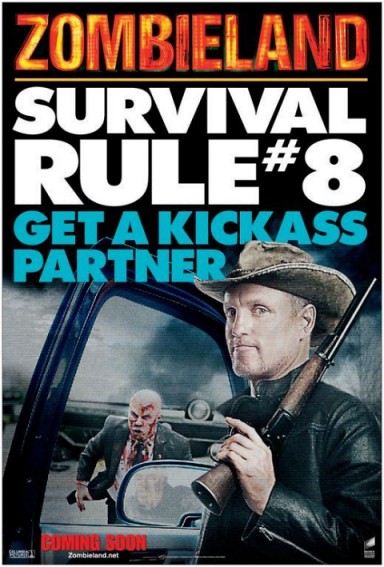
But long before Jesse Eisenberg was unintentionally (one assumes) fooling people into thinking he was Michael Cera -- they're entirely different people, I swear -- I was inventing the rules necessary for my survival in pickup basketball. I will be describing these rules throughout The Pickup Diaries.
Now...despite his reputation as a fearsome outside shooter, Bird's arsenal also included a wide variety of drives, dunks, layups, hooks and scoops. He also had some killer low post moves. That's why his career field goal percentage was just a shade under .500, and he probably would have finished above .500 if he hadn't limped through his final four seasons with bad back.
Just for kicks, here's Bird beating the Portland Trail Blazers left-handed. I'm not kidding. You might have heard or read about this one: Bird told teammates beforehand that being so great was boring him...and he he vowed to shoot left-handed all game. He didn't, but Bird still ending up scoring 22 of his 47 points using his left hand. I know. Awesome.
At any rate, Bird's shooting philosophy became the basis for my very first rule regarding pickup hoops:
Pickup Rule #1: Always take the highest percentage shot available.
Sounds obvious, right? So simple...but so very hard. I mean, you'd think everybody would do this. But take LeBron James and Kobe Bryant for example. They're probably the two best basketball players in the NBA, but they take an unbelievable number of crap shots. At times, it seems like they're stuck in permanent heat check mode. And they aren't alone. Lesser players do it (think Monta Ellis). Hell, even lousy players do it (for further reading, please refer to the collected works of Hughes, Larry).
Mind you, Bird wasn't without sin. He had the blood of a hundred bastard field goal attempts on his mangled hands. But in general, Bird tried to always get -- for himself or his teammates -- the highest percentage shot available. And for Larry Legend, that meant close to the hoop.
When Bird retired, he was perhaps the greatest three-point shooter in league history. Even today, he's considered the one of the all-time greats, in part due to his dramatic victories in the NBA's first three Long Distance Shootouts (1986, 1987 and 1988).
But in many ways, Larry hated the three and decried its use. This was because a) he felt it was a low percentage shot (which it is) and b) that if a team had a two-point lead at the end of the game, that team should never lose to a last-second shot. Which is kind of ironic, considering Bird won several games on last-second treys during his career.
However, despite this slight contradiction in philosophy and behavior, Bird's word was Basketball Law to me. For this reason, I never practiced threes. Never even attempted them while goofing around. To me, it was a waste of time that could be spent practicing shots I could actually use in a game. (For this same reason, I've never attempted a half court shot or developed any trick shots for HORSE, unless you consider a three-pointer from NBA range to be a trick shot.)
Therefore, all my shots were attempted from 15 feet and in. After all, I had almost grown to my full height of 6'3" -- I've often wondered whether I would have grown even taller had I not spent much of my childhood malnourished -- which made me a "big man" in pickup basketball terms. This meant that my game should be close to and going toward the basket.
I worked on every variety of layup I could think of. (Although it was quite a while before I realized the value of trying to develop my left hand...in fact, I'm still working on that.) I used my mental chalk to draw a 15-foot arc around the hoop and practiced shots from every angle. (However, due to dead spots and funky rims, I often avoided baseline shots, which would haunt me later.) And I worked on my inside moves.
Fortunately, I was a natural in the post due to decent footwork, a long wingspan (or, as my college roommate BadDave called them, my Gorilla Arms), and a soft touch. Plus, I had spent my formative years following the Bird-era Celtics. This meant hours upon hours of watch Kevin McHale put opponents into his torture chamber.
McHale -- yes, my last name is also McHale, no Kevin and I are not related -- had a seemingly endless array of low post moves. This wasn't exactly true. He had a set number of moves, but the moves had so many subtle variations that they seemed endless. These moves are actually described in stunning detail in The Book of Basketball by Bill Simmons, which makes the book a must-read for anybody who wants to became a killer post player in pickup ball.
And that was my life for the next two months. Endless, tireless practice. I practiced in the morning, the afternoon, and at night. I played in the sun, the wind, and in the rain. By the end of that period, I was knocking down a fairly high percentage of my shots, which made me feel pretty good about myself. After all, I had only just picked up the sport.
What I didn't (and couldn't) understand at the time was this: A large part of my early "success" was due to the fact that I had focused on a very specific and therefore very limited number of shots. Not to mention that every shot had been attempted against no defense. But these things don't matter when you don't know any better. I was confident. A little cocky even. And with the new school year fast approaching...
...it was time to take my game on the road.
Labels: Kevin McHale, Larry Bird, pickup basketball, The Pickup Diaries, The Pickup Rules, Zombieland

(via Andy Gray's SI Vault)
Oh, this is such a great time. NBA Finals Game 7 is tonight, and even if I get my heart broken, I can still look forward to both the rest of the weekend's coverage of the US Open at Pebble Beach, plus I'm going on vacation next week. When I tune into the game tonight, I'll be disappointed (as I always am) when I hear the generic as hell music ABC is using for its "ESPN on ABC" coverage of the NBA. I still naturally long for the NBA on NBC music (Otherwise known as proof that Hell has frozen over at least once in the past, since John Tesh wrote an amazing piece of music). I always got excited just from watching the brief 30 second intro to the game coverage, like this one from the '98 Finals. But at least we don't have to listen to this. (h/t Chris) Meanwhile, in another link passed along by Chris, ESPN's Page 2 is celebrating the end of professional basketball in Louisville, so now I'm just really emotionally confused.
NBA trade news: Dalembert is off to Sacramento. In exchange, the
Good news everyone! Here is your latest NBA Jam for Wii update: NBA Legends characters! Yes, you will be able to play this old school style game with some old school style players if you so desire. Though I'm not sure why you'd want to play as Kevin McHale. It's not like you can actually take advantage of his sweet post moves in this game.
As posted on Deadspin, you absolutely need to behold this piece of NBA apparel -- a chinchilla fur jacket covered with crocodile skin NBA logos. I'm not really sure exactly who is the target market for such an item, but considering it's size XXL, that sort of limits the choices. If it was available in XXXL, Shaq would totally wear one.
You may remember the Name of the Year brackets that started right around the same time as March Madness. As of this month, they have finally named the winner... and the final two choices were kind of a letdown in my opinion. The strongest names in the field got voted out by some remarkably dull ones. (I was rooting for Nohjay Nimpson, God's Power Offor, and Spontaneous Gordon.)
Some brief Footbawful: a Tim Tebow statue? Really? There aren't enough facepalm pictures on the Internet...
And finally, here's a random awful jersey.
Worst of Game 6 in Pictures:
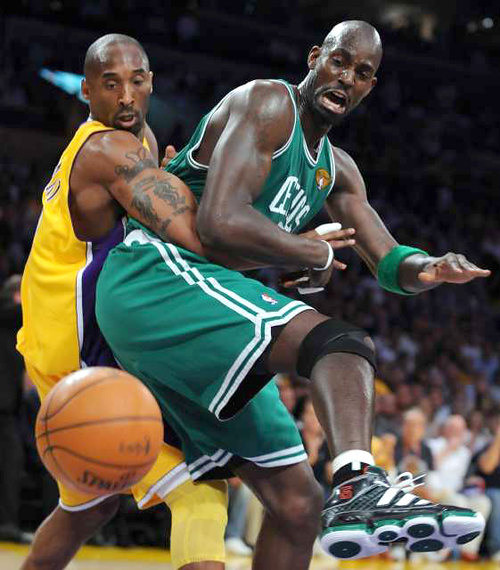
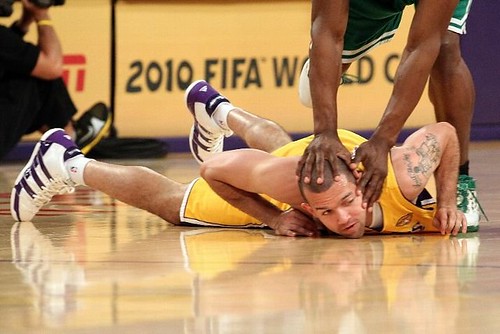
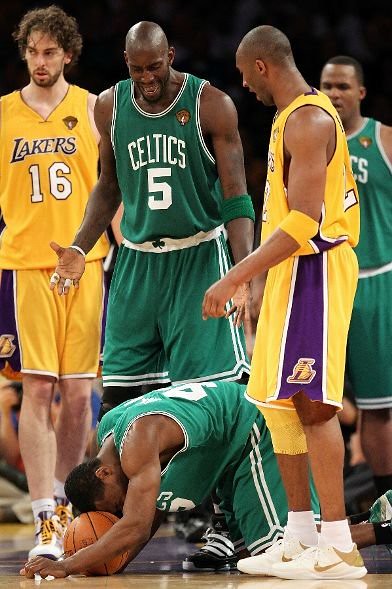
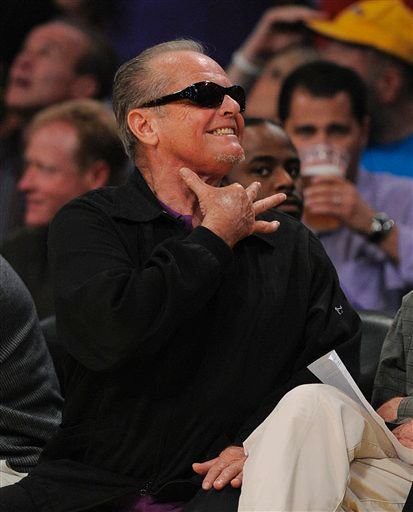
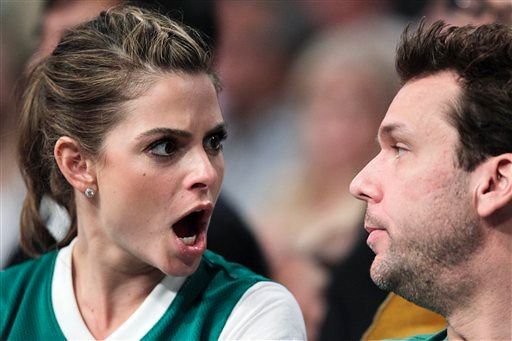
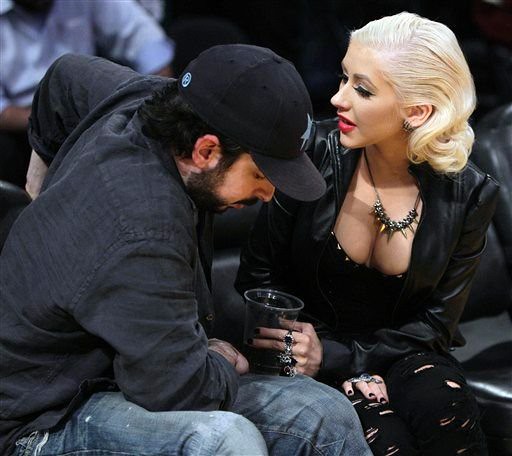
NBA Finals - Game 7:
Celtics at Lakers - ABC, 9:00pm
Series tied 3-3
Can't type... Too nervous... Ugh... I will simply link my fellow Celtics fans to this reassuring post from Jonah Keri (which also features the McHale/Rambis clothesline picture I already had chosen to lead today's BAD post!) that gives us some historical proof that the Celtics still have a shot. ("So you're telling me there's a chance... Yeah!")
Labels: 2010 NBA Finals, Bawful After Dark, Boston Celtics, Kevin McHale, Los Angeles Lakers

It's official: McHale's 1.5-decade reign of consistent bawfulness -- which was occasionally interrupted by periods of solid mediocrity -- is finally and mercifully over. Why? Said McHale: [Timberwolves new president of basketball operations David Kahn] didn't really give me any reasons other than the fact he wanted to make a change." Reality check: The change Kahn wants is to go from "not winning" to "winning," Kevin. I'm just sayin'.
The kicker? Kevin Love broke the news via Twitter. Classy.
In those 15 years of McFailure, the Timberwolves amassed a 568-630 record, suffered eight non-winning seasons (which included four 20-win campaigns and two 30-winners) and lost in the first round of the playoffs seven times in a row. Did I mention he had one of the NBA's all-time greats for 12 of those seasons? Yeah.
Other highlights include: Trading Ray Allen for Stephon Marbury; a secret agreement with Joe Smith that cost the franchise Smith, three first round draft picks and $3.5 million; drafting one of the great all-time busts in Ndubi Ebim (which was Minny's first first-rounder after the Smith debacle); offering Latrell Sprewell a three-year, $21 million contract extension (which, fortunately for McHale, Spree turned down, stating that "Why would I want to help them win a title? They're not doing anything for me. I'm at risk. I have a lot of risk here. I got my family to feed."); trading Sam Cassell AND a first-round lottery pick to the Los Angeles Clippers for Marko Jaric; selecting Brandon Roy with the sixth overall pick in the 2006 NBA Draft and then trading him for Randy Foye, whom the Portland Trail Blazers selected seventh (Roy went on to win Rookie of the Year while Foye missed most of the season due to injury); signing Mike "Contract Year" James to a four-year contract; and, of course, giving his old team the gift of Kevin Garnett (and an instant championship).
Labels: glorious firings, Kevin Love, Kevin McHale
[Spits morning coffee all over the computer screen]
Great googly moogly! Seeing the floor? Passing?! This seems like a good time to point out that McHale was dubbed The Black Hole by his teammates and that McHale himself once described his shooting philosophy as: "If there are three guys on me, shoot. If there are four guys on me, pass."
Just watch the following video, in which Danny Ainge, Dennis Johnson and Robert Parish describe McHale's penchant for ball-hoggery. The best quote comes from D.J., who said: "You stand there for a while just hopin', but from the bench you here the coaches sayin' 'Hey, cut Dennis, cut, because you aren't gonna get it back.'"
Here's another video that shows off why Kevin was so reluctant to give up the rock.
Labels: 80s Celtics, black hole, Danny Ainge, Dennis Johnson, fan submissions, Kevin McHale, Robert Parish, Sports Illustrated
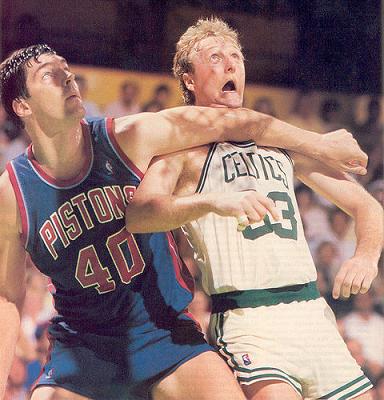
thug (thuhg) 1. verb, -ged, -ging. The act of committing an unnecessarily hard foul or fouls; this includes both those that are called and those that are either missed or ignored by the referees. 2. noun. One who commits an act of thuggery.
Usage example: Long before Bruce "Lee" Bowen was roaming the hardwood, Bill Laimbeer was the undisputed master of thugging.
Word trivia: We really do love the 80s, don't we? The 2008 Playoffs have been filled with so much acrimony and so many hard fouls that somewhere out there Kurt Rambis' neck is tingling...while Kevin McHale is smiling wistfully. And David Stern -- The Iron Boot responsible for stomping out physical play in The League -- must be okay with it, because the commish has been uncharacteristically forgiving through it all, from the near death of Jannero Pargo...
...to the extra little shove Hedo Turkoglu gave Chris Bosh...
...to Kevin Garnett's throwdown with Zaza Pachulia...
...to Brendan Haywood sending LeBron into the crowd...
...to DeShawn Stevenson headhunting Lebron...
...to Darius Songaila's "accidental" punch to LeBron's mug. Update! Oops. Wrong. Songaila got suspended.
Note that three of these examples involve somebody thumping Lebron James, which is less Rambis versus McHale and more Bad Boy Pistons versus Michael Jordan. This goes way beyond hombre-ism and straight into the realm of cheap-shotery. And you know what? I love it. I never realized much I enjoyed this kind of tooth-rattling, bone-jarring it's-okay-to-hate-your-opponents intensity until -- all of a sudden, out of nowhere -- it was back. Tell the truth: Doesn't this make the playoffs way more interesting? The word you're searching for is: Yes.
Thugtastic extra: No thug post would be complete without a Bill Laimbeer mix, now would it?
Labels: Bill Laimbeer, Brendan Haywood, Bruce Bowen, DeShawn Stevenson, Kevin McHale, Kurt Rambis, Lebron James, Word of the Day
I think the immediate answer you'd get from most NBA analysts would be Dirk Nowitzki. This is because the league is in the midst of a versatility movement, and Dirk is certainly more versatile, offensively speaking, than McHale was. He's a legitimate seven footer who can rebound, run the floor, stick the three at a high percentage, and score with efficiency from almost anywhere (except in the low post). He can also handle the ball better than McHale did. In NBA parlance, he's the more "talented" of the two players.
Whereas Dirk can do a little bit of everything on the offensive end, McHale was a specialist. But while McHale's skill set may have been more limited, it was also more refined. He had the best low post moves in NBA history, which made him virtually unstoppable. In his prime, McHale was an automatic basket from 15 feet and in, unless he was immediately double or triple-teamed. And make no mistake: McHale was a tenacious rebounder. His career average may be "only" 7.3, but you have to keep a few things in mind. First of all, he was the Celtics' Sixth Man for eight of his 13 seasons. He averaged 31 MPG or less for seven seasons, and he played more than 35 MPG only three times (and for the record, his Per 40 Minute rebounding average was 9.5). He also played with two other guys -- Larry Bird and Robert Parish -- who were averaging around 10 RPG. Think about that for a minute: Most teams are lucky if they have one guy averaging close to 10 RPG, and the 80s Celtics had three of them.
Anyway, one of the knocks on McHale is that he was a black hole who never passed the ball. But again, this is misleading. The Celtics didn't run their offense through McHale the way the Mavericks run theirs through Dirk. McHale was a scoring specialist who was expected to shoot the ball every time he touched it. Bird himself put it best when he said, "Everyone cries that [McHale] can't get the ball out to the open man when he's double or triple-teamed. But you gotta understand something: We wouldn't have thrown the ball to Kevin if we didn't want him to shoot it." [quote from Peter May's The Big Three] And once again, McHale was usually the sixth man, which affected his numbers. McHale averaged 2.4 APG during the five seasons in which he was a starter, which isn't too far off Dirk's career average of 2.6.
There's another very important distinction between the two players: Defense. McHale was on the All-Defensive first or second team six times, whereas you won't see Dirk on an All-Defensive team any time soon, and for good reason. Moreover, McHale wasn't just a good defender at his position; he could defend any frontcourt player from Patrick Ewing to Charles Barkley to Dominque Wilkins (before he started getting injured, anyway). In fact, McHale was usually responsible for defending the opposing team's best frontcourt scorer, whether he was a center, power forward, or small forward. The Mavericks have to hide Dirk on the defensive end; the Celtics used McHale as a stopper.
In some ways, it's hard to compare the two players, because, unlike Dirk, McHale never got a chance to be The Man on his team. We'll never really know how good McHale could have been had a team been built around his skills and abilities. But McHale was certainly tougher than Dirk, both mentally and physically. After all, McHale was the team's leading scorer (25 PPG) in the 1986 NBA Finals, despite going up againsts the Houston Rockets' Twin Towers tandem of Ralph Sampson and Hakeem (then Akeem) Olajuwon (a 12-time All-Defensive Team member, and two-time Defensive Player of the Year). And remember, McHale played through the 1987 Playoffs with a broken foot, yet he still managed to average 21 PPG and 9 RPG while shooting 58 percent against teams like the Bad Boys Pistons and the Showtime Lakers. Compare that to how Dirk basically wimped out in the 2006 Finals and last year's first round series against the Warriors, and you can hardly question who you'd want to go to war with.
My last point. Even while playing limited minutes and acting as the Robin to Larry Bird's Batman, McHale's game is very similar to that of another current NBA superstar: Tim Duncan. They can both score at will down low and command immediate double teams. They are both top-notch defenders who rebound and block shots with aplomb. They may not play every phase of the game -- ball handling, three-point shooting, etc. -- but they have nonetheless mastered every phase of the game they do play. And let's face it: Eight of the last nine NBA championship teams have been built around a low post player (Shaq and Duncan). So for all the thrilling perimeter exploits of the Kobe Bryants and Dirk Nowitzkis of the league, building around a dominant post player has proven itself to be the best method for success.
I take Kevin over Dirk.
Labels: Boston Celtics, Dallas Mavericks, Dirk Nowitzki, Kevin McHale, Larry Bird, Robert Parish, Tim Duncan
That is how I want to remember McHale. Not as the lousy GM who couldn't build a team around Kevin Garnett and then traded K.G. to his old team for pennies on the dollar, but as a fierce, talented competitor who was the absolute and undisputed master of inside scoring. The dude has forgotten more low post moves than most guys in today's NBA will ever know. He was also a fantastic defender -- three times All-Defensive First Team, three times All-Defensive Second Team -- who perfected the art of the "soft blocked shot" (where you lightly tap it to yourself or a nearby teammate).
One last note on McHale. Everybody talks about that mythical 50/40/90 benchmark, where a player shoots 50 percent from the field, 40 from three, and 90 from the line. There are only five or six guys who have ever done that. Well, there's only one person in NBA history who has ever shot 60 percent from the field and 80 percent from the line. It was McHale, and he did it twice (in '87 and '88).
Labels: Boston Celtics, Kevin McHale, Minnesota Timberwolves
Worst shoe:Magic Johnson's yellow and purple abomination. People in the 80s were not ready for something so hideous.
Best performer: Bernard King was the only guy in the commercial that had a semblance of rhythm and didn't sound like he was rapping straight off a cue card.
Most questionable appearance: Every player in this group at one time or another placed in the top 4 in MVP voting...except Mark Aguirre.
Best moment: When Kevin McHale sets his shoe on Isiah Thomas' head. Note the utter disdain in McHale's withering glance.
Best line: Larry's "You already know what they did for me...I walked away with the MVP," delivered in that odd drawl that only Bird could pull off. Note his rather strange pronunciation of MVP.
Labels: Bernard King, fake Magic Johnson, Isiah Thomas, Kevin McHale, Larry Bird, Mark Aguirre, NBA, shoe commercials
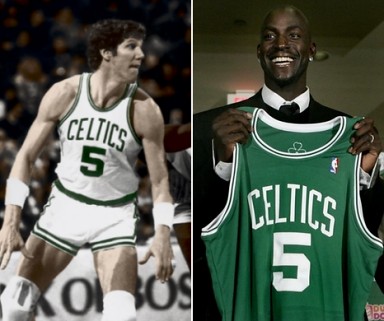
I was absolutely stunned to find out that Kevin Garnett will be wearing number 5* for the Celtics. I know things have been bad in Beantown for the last several years, but I didn't realize the problems with the Boston franchise extended to the equipment managers! Giving away Bill Walton's jersey number...what were they thinking?! That's like removing the Pope's hat and dress and giving them to some begger on the street: It's a travesty of Biblical proportions.
*Apparently, KG's first choices were numbers 21, 1, and 2. However, those numbers are already retired: Bill Sharman wore 21 and numbers 1 and 2 were retired to honor Walter Brown (the team's first and greatest owner) and Red Auerbach (the team's third and greatest coach).
Some people are claiming that Garnett feels Celtic Pride. KG himself said, "The Celtics have had a proud tradition and now I hope that we can add to the legacy." Shame on you, Kevin Garnett! That may be the most heinous lie in the history of man's wickedness. If Garnett really understood the deep and complex mythos of the Celtics, he wouldn't tarnish Walton's accomplishments by sullying the big man's number. Why stop there, Kevin? Why not pull down a few of those championship banners and wipe your ass with them?
By making this decision, Garnett lost money, he lost some self-respect, and he lost legitimacy in the eyes of future hall of fame coach Doc Rivers. Okay, Rivers probably won't get into the NBA Hall of Fame, but he's in the Hall of Fame of Life. Sadly, I doubt Doc has the authority to redress this numeric injustice, and with Red Auerbach dead and buried, the Celtics have no one left who can restore order to the universe.
The raping of Bill Walton's Celtic number is one of the worst defilements, not just in basketball, or in America, but in the history of Western Civilization. What a pathetic move by a pathetic human being. Boston fans everywhere are throwing up their hands in exasperated dismay. All I can do is shake my head and ask what has happened to that once beautiful team.
Bill Walton's Top 13 Celtic Moments
Did Walton deserve to have his jersey retired, and thus keep it out of the clutches of glory-hogging sneak-thieves like Kevin Garnett? You're damned right he did! Here's a brief list of Walton's greatest Celtic moments as he led them to banner number 16.
1. October 25, 1985: Bill played 19 minutes, scored four points, committed five fouls, and turned the ball over seven times. The Celtics, not surprisingly, lost 113-109 in overtime. While his performance was appalling, his post-game quote was comedy gold: "I was a total disgrace to the game of basketball." Thanks largely to Walton's humble admission, the Celtics would go on to win their next nine games.
2. Date unknown: In his autobiography Nothing But Net, Walton recounts the bullying and verbal abuse he suffered at the hands of teammate Kevin McHale. Eventually, Big Bill decided enough was enough, and in Karate Kid-like fashion, Walton challenged McHale to a game of one-on-one in front of the entire team and coaching staff. Despite the fact that McHale was younger, healthier, and -- at that stage of his career -- better than Walton, Big Bill kicked his tormentor's butt, then limped out of practice with his head held high.
3. December 30, 1985: Walton faced his former team, the Los Angeles Clippers, and showed them what they were missing en route to leading the Celtics to a 125-103 win. The redhead contributed nine points, 13 rebounds, and a blocked shot in just 17 minutes of action.
4. January 10, 1986: The Celtics were facing the Hawks on the road, and Atlanta bolted out to a 70-47 halftime lead. Infuriated by the trashtalking of Eddie Johnson and some other Hawks players, Walton came out of halftime on a personal mission. He would go on to play a season-high 28 minutes and finished with 11 points, eight rebounds, and four blocked shots. Moreover, he was instrumental after the Celtics managed for force overtime, breaking the game's final tie with a tip-in and then blocking Eddie Johnson's shot on the Hawk's next possession. Bill's leadership was responsible for the Celtics' 115-108 overtime win...and the team's biggest comeback of the season.
5. January 22, 1986: Before wisely agreeing to help form what Bob Costas once described as "the best single-season team ever," Walton briefly considered joining the hated Lakers. But Jerry West, mindful of Walton's history of foot and ankle injuries, spurned him. Said West: "Thanks for the interest, Bill, but I've seen the X-rays of your foot." Walton correctly believed the Lakers had made a mistake, and he was determined to make them regret it. He did just that when the teams faced off at the Boston Garden. Walton racked up 11 points (on 5-of-6 shooting), eight rebounds, four assists, and seven blocked shots in only 16 minuts of playing time. Thanks to his inspired effort, the Celtics crushed the Lakers 110-95.
6. January 26, 1986: The rival 76ers were in town, and Larry Bird (9-of-25) wasn't up to the challenge. Fortunately, Bill Walton was. Walton scored 19 points, grabbed 12 rebounds, and blocked two shots in a mere 25 minutes, leading his team to a very satisfying 105-103 victory.
7. February 5, 1986: Going into this game against the Washington Bullets, the Celtics were missing McHale, who was the team's third best player (behind Walton and Bird). It didn't matter, though, because Big Bill once again stepped up his game, notching 13 points and a season-high 17 rebounds while tying his season-high of 28 minutes. Thanks to him, the Celtics destroyed the Bullets 103-88.
8. February 16, 1986: On the road and facing the Lakers, the team that wouldn't give him a chance, Walton once again showed his legendary promise, earning 10 points, seven rebounds, and one blocked shot in 26 pulse-pounding minutes. But it was more than just the numbers; Walton shut down James Worthy in key stretches and held Kareem Abdul-Jabbar -- the NBA's all-time leading scorer -- to a mere two points in the fourth quarter. Another great Walton game, another big win for the Celtics.
9. March 24, 1986: During a March 14 game against the Atlanta Hawks, Big Bill broke his nose, and then he fractured the navicular bone in his right wrist while blocking a Tree Rollins shot. But Walton had come too far to let a few broken bones stop him. He continued to play through pain, and then, when Robert Parish missed a game against the Houston Rockets, Walton got his first start of the season. During warmups, Bird walked up to Walton and said, "I know what you're thinking. Forget about it. Those [Parish's] shots are my shots. You just get on the weak side and rebound." The two men shared a laugh, because they knew who the real leader of the team was. And true to form, Walton delivered: 20 points (on 8-of-10 shooting) and 12 rebounds in a comfy-cozy 116-97 victory.
10. April 8, 1986: At this point, Walton's dominance was pretty obvious. He made his second start of the season against Milwaukee and again keyed a Celtics win by scoring a season-high 22 points and grabbing 12 rebounds in just 28 minutes.
11. May 29, 1986: Prior to Game 2 of the Finals, Walton was awarded the NBA's Sixth Man Award. Although he probably deserved the MVP, Walton was both humble and grateful. Buoyed by this joyous event, the Celtics hammered the Rockets 117-95.
12. June 3, 1986: Celtics coach K.C. Jones, trying to turn back a Rockets surge, turned to Bill Walton in crunch time, and Walton again came through for his team. With the game tied at 101 with just over two minutes to go, Walton worked a brilliant inside-out feed to Bird, who hit a three-pointer off of Walton's clever assist to give the Celtics a 104-101 lead. The Rockets scored on their next possession to pull within 104-103, and when a Dennis Johnson miss clanked off the rim, Walton swooped in from the right, evaded Hakeem Olajuwon, grabbed the rebound, and put up a backhanded layup that gave the Celtics a 106-103 win and a 3-1 series lead.
13. Date unknown: Walton, along with teammates Kevin McHale and Robert Parish, posed for the following picture. More work of art than mere photograph, the aptly titled "Big Men, Little Court" has gone on to win several international awards and inspired an entire generation of photo journalists. This is the kind of world-changing accomplishment that won't show up in any record books, but nonetheless is an integral component of the Bill Walton Legacy.
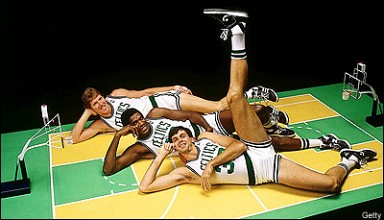
Greatest Miscarriage of Justice...Ever?
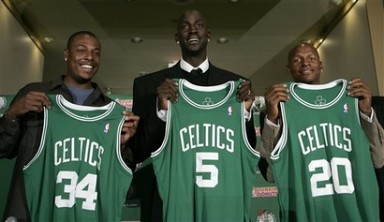
Not only did KG bogart Walton's number, but Paul Pierce continues to wear Kevin Gamble's number, and it looks like Ray Allen has filched Sherman Douglas' old cipher. I'm too disgusted for words.
Labels: Bill Walton, Boston Celtics, Kevin Garnett, Kevin McHale, Larry Bird, Robert Parish

By Basketbawful and Evil Ted
After enduring several years of constant "Where's KG going to end up?" speculation*, we finally have the definitive answer: The Boston Celtics.
* Sorry, Kobe. But not really.
This is a great move for the Celtics, even if it doesn't take them directly to the Promised Land. For the past five seasons, the team has been a laughingstock, mired in mediocrity (at best) and disgrace (at worst). They haven't appeared on national TV since Zeus knows when -- and rightfully so. Two blockbuster trades later and they're suddenly relevant for the first time since Larry Legend's final season* and a legitimate contender in the East. If Lebron and the Lebronettes were good enough to make it to the Finals last year, why not a potent Garnett / Paul Pierce / Ray Allen combination this year? There's no reason to think they won't do well in a conference where the other contenders -- Chicago, Cleveland, Detroit, Miami, and New Jersey -- pretty much stuck with the status quo**.
* Despite the fact that Larry Bird, Kevin McHale, and Dee Brown missed a combined 114 games, the 1991-92 Celtics still managed to win 51 games and capture the Atlantic Division title. They finished the season on a 15-1 tear -- even winning their final eight games without The Basketball Jesus -- and then went 5-1 in the playoffs before Bird returned from a late-season back injury and screwed up the team's chemistry. The Celtics ended up losing to the Cavaliers in a tough seven-game series that turned irrevocably in Game 4 when a rusty Bird missed not one but two game-winning shots. And thus ended the Bird Era.
** Except Miami, who got significantly worse; their best shooter (Jason Kapono) walked, they lost out on the Mo Williams Sweepstakes, and they and signed Smush Parker, a.k.a. "the worst point guard in the NBA." Pat Riley's failure is now complete.
If you think about it, the trade is nothing short of a miracle, not only because Ainge pulled it off with what he had to offer (the promise of Al Jefferson's future greatness), but also because he managed to hold on to both Pierce and the recently-acquired Allen. It flies in the face of all the "inside the box" thinking he'd become infamous for. All the talk of "potential" and "youth" has been going on too long with the Celtics, and it was way past time to shake things up. So rather than gamble on the Utah Jazz formula for success -- young, hard-nosed, character guys + tenacious defense + two or three plays run to perfection -- he's going the Miami Heat route: A core of hungry, All-Star veterans surrounded by a handful of decent role players. Garnett, Pierce, and Allen all have something to prove*, and here's hoping that together they can prove it. Garnett is the inside presence, Pierce is the slasher, Allen is the shooter...that combination could work out quite nicely. The C's still need some frontcourt depth and a steady point guard, but with a new Big Three in town, they don't necessarily need Tony Parker bringing the ball down court.

* Perhaps the most fascinating subplot in the trade is that Garnett finally gets to prove whether he can win when surrounded by a talented supporting cast. Is he a winner or just a numbers guy? Time to find out.
No, the Celtics won't be deep, but neither were the Celtics of the 80's*. With only five players on a court at once, basketball is a sport where one superstar player can make the difference -- just ask the Heat. No, Garnett, Pierce and Allen aren't Bird, Parish and McHale -- who, as Rick Pitino would point out, still aren't coming through that door -- but I'll be damned if this team won't be a thousand times more exciting to watch than they have been since, well, forever. No, the window isn't huge -- 3 or 4 years, tops -- but better a small window than the brick wall the Celtics have been banging their heads into since, well, forever.
* As noted, the 1986-87 Celtics quite possibly had the worst bench of all time. The 1987-88 Celtics weren't much better off. Go back and watch Game 7 of the 1988 Eastern Conference Semifinals, also known as Larry's duel with Dominque. Coach K.C. Jones was forced to play a group of white stiffs comprised of Brad Lohaus, Fred Roberts, Jim Paxson, and Mark Acres. Their best reserve, Reggie Lewis, was a rookie and played only three minutes. Ugly.
Maybe Danny isn't a genius. Maybe he's just taking advantage of his relationship to Kevin McHale. But I don't particularly care how he did it, just like I don't particularly care who Red Auerbach beat up in a dark alley when he traded for McHale and Parish*. Let the next chapter for the Celtics begin.
* Sorry, Joe Barry Carroll. But not really.
Labels: blockbuster trades, Boston Celtics, Danny Ainge, Kevin Garnett, Kevin McHale, Larry Bird, Paul Pierce, Ray Allen, Robert Parish
The following is part one of a timeline that describes the rotten luck and bad decisions that have turned the league's most storied franchise into a yearly embarrassment:
1986-87: Len Bias dies. Scott Wedman has off-season heal surgery and plays only six games. Bill Walton breaks his foot riding a stationary bike during the off-season and plays only 10 games. Kevin McHale has an MVP-caliber season before breaking his foot in March; he continues to play but is never again the same player. Robert Parish repeatedly sprains both ankles and suffers from tendonitis in his right elbow that's so bad he can't even make a fist. Larry Bird's back and right elbow continue to bother him. Dennis Johnson ages 17 years during the off-season. The Celtics' "bench" is reduced to Jerry Sichting and Greg Kite. Seriously. The Celtics finish with a record of 59-23, failing to win 60 games for the first time since 1982-83 and for only the second time in the Bird Era. They reach the NBA Finals by playing their starters 40 minutes per game, but ultimately surrender their title to the Lakers.
1987-88: Kevin McHale misses 19 games as he recovers from off-season foot surgery. Larry Bird injures both Achilles tendons only seven games into the season and never fully recovers. Bird also fractures his zygomatic arch, which causes his eye to pop out in the shower after the game in which the injury occurred. Dennis Johnson ages another eight years during the off-season. The "bench" features such stalwarts as the Mark Acres, Darren Daye, Brad Lohaus, and Fred Roberts. Things get so bad that the Celtics sign the now-ancient Artis Gilmore and trade for Jim Paxson (about four years past his "sell by" date). Reggie Lewis is a promising rookie, but K.C. Jones refuses to play him. Bird carries the team by playing 40 MPG and scoring 29.9 PPG on 53 percent shooting. The C’s win 57 games but fall to the Pistons in the Eastern Conference Finals because their starters are exhausted*. K.C. Jones "retires."
*The Celtics held 4th quarter leads in all four games they lost.
1988-89: Jimmy Rogers becomes head coach. Larry Bird plays only six games before having season-ending surgery to remove bone spurs from both Achilles tendons. Dennis Johnson is officially running on fumes. Danny Ainge is traded for "Easy" Ed Pinckney and Joe "The Human Victory Cigar" Kleine. The Celtics win 42 games and sneak into the playoffs before getting swept in the first round by the eventual champion Detroit Pistons.
1989-90: The Celtics draft Michael Smith instead of Tim Hardaway, Shawn Kemp, B.J. Armstrong, Vlade Divac, Sherman Douglas (whom they will later trade for), or Cliff Robinson. Brian Shaw stages a contract holdout and leaves the Celtics to play with the Itialian team, Il Messaggero Roma. Larry Bird returns from his dual-Achilles surgery, but he injures his back when Michael Jordan undercuts and then falls on him in the Kenny Rogers Charity Basketball Tournament in Kentucky*. Dennis Johnson's corpse is now running (or, rather, walking) the Celtics' offense. Jimmy Rodgers tries to implement a "spread the wealth" offense and seemingly feuds with Bird (although both deny it). The team wins 52 games but fails to win the Atlantic Division. They are upset by the New York Knicks in the first round. Jimmy Rogers is fired.
*According to his second autobiography, Bird Watching: On Playing and Coaching The Game I Love, Bird said: "We were in the final minutes of this charity basketball game when I went up for a rebound and came down a little sideways. Michael Jordan was going for the ball too, and he landed on my back. Right away I knew I was in trouble. I had torn additional portions of the disc wall, and my back was really traumatized. I didn't know it then, all the way back in 1989, but that was the beginning of the end…I never came all the way back." Yet another reason I hate Michael Jordan.
1990-91: Dave Gavitt is named the Celtics' new CEO. Gavitt hires Chris Ford as coach and remakes the team by cutting Dennis Johnson (who then "retires"), persuading Brian Shaw to leave Italy and return to the Celtics, and convincing Red Auerbach to draft Dee Brown instead of Dwayne Schintzius (although the C's do pass up guys like Elden Campbell, Cedric Ceballos, and Antonio Davis). The Celtics blast out of the gates en route to a 29-5 start. But then Bird's back goes out and he misses 22 games. Shortly after Bird returns, McHale badly sprains an ankle and misses 14 games. Neither player ever fully recovers. The Celtics do manage to win 56 games, but they get pushed hard in the first round by the Indiana Pacers and then fall to the Pistons in the Eastern Conference Semifinals.
1991-92: Larry Bird undergoes off-season back surgery. Dee Brown injures his knee and misses 51 games. Brian Shaw undercuts Bird in practice, re-injuring the Legend's troublesome back and causing him to miss 37 games. Ten games later, Shaw is traded to the Miami Heat for Sherman Douglas, who, as it turns out, sucks. McHale tears a calf muscle and misses 26 games. The Celtics' point guard situation becomes so dire that John Bagley becomes the starter. Somehow the team manages to win 51 games and take the Atlantic Division title away from the Knicks. They sweep the pacers in round one but fall to the Cleveland Cavaliers in the conference semifinals.
1992-93: Larry Bird retires. The Celtics sign Xavier McDaniel and find out that the X-Man does not equal Larry Bird. Kevin McHale ages dramatically. Reggie Lewis discovers it's a lot harder to be The Man than he ever could have imagined. However, the team remains relatively healthy and manages to win 48 games. Then Reggie Lewis collapses on the court during Game 1 of the Celtics' first round series against the Charlotte Hornets. Without Lewis, the Celtics lose the next three games despite a couple "turn back the clock" performances by McHale. The Hornets win their first ever playoff series...against the Celtics.
1993-94: Kevin McHale retires. Reggie Lewis dies. The Celtics draft Acie Earl to replace McHale and eventually succeed Robert Parish. In the process they fail to draft players such as Sam Cassell, Nick Van Exel, and Bryon Russell. They even could have had Gheorghe Muresan. The team finishes 32-50 and fails to qualify for the playoffs for the first time since 1978-79...the year before Larry Bird’s rookie season.
1994-95: The Celtics fire Dave Gavitt and M.L. Carr becomes the Celtics' General Manager. He drafts Eric Montross to replace Acie Earl, who, as it turns out, sucks. In doing so, he passes up Eddie Jones, Jalen Rose, Yinka Dare (kidding!!), and Voshon Lenard. To make matters worse, he chooses to let Robert Parish leave the team as a free agent in order to sign a washed up Dominique Wilkins and "Never Nervous" Pervis Ellison. The team finishes with a record of 35-47 yet somehow qualifies for the playoffs, where they are pounded into submission by Shaq and the NBA Finals-bound Orlando Magic.
1995-96: The Celtics adopt the Fleet Center as their new home and the Boston Garden is razed. M.L. Carr fires Chris Ford and names himself the new head coach. He then drafts Eric Williams instead of Theo Ratliff, Michael Finley, Travis Best, or Greg Ostertag (kidding...sort of). The Celtics feature a starting lineup of Rick Fox, Dino Radja, Eric Montross, Dana Barros, and David Wesley. The one bright spot is that Radja develops into an "almost 20/10" guy by averaging 19.7 PPG and 9.8 RPG while shooting over 50 percent. However, the team wins win only 33 games and fails to make the playoffs.
1996-97: The Celtics draft "Employee Number 8" Antoine Walker, passing up Kobe Bryant, Steve Nash, and Jermaine O’Neal. Dino Radja suffers a mysterious ankle injury, misses 57 games, and never plays for the Celtics again. Walker shows some promise but the team is comprised of -- at best -- a group of secondary players: Eric Williams, Rick "I will one day get bitchslapped by Doug Christie" Fox, David Wesley, and Todd Day. They finish 15-67 -- the worst record in team history -- to become the front-runner in the "Tim Duncan Sweepstakes."
1997-98: M.L. Carr "steps aside" as the Celtics break the bank to hire legendary college coach Rick Pitino, who is named Front Office Manager and Head Coach. Pitino even steals the title of "Team President" away from Red Auerbach, who becomes the "Vice Chairman of the Board." Thanks to their worst-in-the-league record and a trade that sent Eric Montross to Dallas in exchange for the Mavericks’ first round pick, the Celtics have not one but two lottery picks. However, San Antonio (who finished the previous season with only 20 wins) gets the number one pick and happily drafts Tim Duncan. The painfully disappointed Celtics draft Chauncy Billups and Ron Mercer with the third and sixth picks in what turns out to be a very thin draft. However, the future all-star and NBA Finals MVP Billups plays in only 51 games before being traded to the Toronto Raptors. David Wesley and Rick Fox are released, and Eric Williams is traded to the Denver Nuggets. Antoine Walker goes off for 22 and 10 a game, but the team wins only 36 games and once again fails to make the playoffs.
Next: Part 2.
Labels: Antoine Walker, Boston Celtics, Dennis Johnson, Destrucity, Kevin McHale, Larry Bird, Rick Pitino, various Celtics players
Usage example: Steve Nash scored on a sweet up-and-under against Jason Terry. Speaking of which:
Most famous up-and-underer ever: With all due respect to guys like Kareem Abdul-Jabbar, Arvydas Sabonis, and Tim Duncan, Kevin McHale was, without question, the foremost master of the up-and-under move. He probably scored off that move at least four or five times a game. It helped that McHale had long, spindly arms that looked more like wriggling snakes than human appendages. It also helped that McHale's defenders knew he was going to shoot the ball pretty much every time he touched it (hence his nickname The Black Hole). According to Peter May's The Big Three, McHale had a simple philosophy with regards to shot selection: "When there's a double-team, shoot. When there's a triple-team, pass." And that philosophy was often on display as McHale used the up-and-under against two and (despite what he said) sometimes three defenders. Unfortunately, I couldn't find a clip on YouTube of McHale scoring on an up-and-under. I did, however, find a video of McHale going up-and-under on Kurt Rambis' head...
Labels: basketball moves, Kevin McHale, Word of the Day
February 2005
October 2005
November 2005
December 2005
January 2006
February 2006
March 2006
April 2006
May 2006
June 2006
July 2006
August 2006
September 2006
October 2006
November 2006
December 2006
January 2007
February 2007
March 2007
April 2007
May 2007
June 2007
July 2007
August 2007
September 2007
October 2007
November 2007
December 2007
January 2008
February 2008
March 2008
April 2008
May 2008
June 2008
July 2008
August 2008
September 2008
October 2008
November 2008
December 2008
January 2009
February 2009
March 2009
April 2009
May 2009
June 2009
July 2009
August 2009
September 2009
October 2009
November 2009
December 2009
January 2010
February 2010
March 2010
April 2010
May 2010
June 2010
July 2010
August 2010
September 2010
October 2010
November 2010
December 2010
January 2011
February 2011
March 2011
April 2011
May 2011
June 2011
July 2011
August 2011
September 2011
October 2011
November 2011
December 2011
January 2012
February 2012
March 2012
April 2012
May 2012
June 2012
July 2012
August 2012
September 2012
October 2012
November 2012
December 2012
January 2013
February 2013
March 2013
April 2013
May 2013
June 2013
July 2013
August 2013
September 2013
October 2013
November 2013
December 2013
April 2014
May 2014
June 2014
July 2014
August 2014
June 2018
July 2022