Yeah, I probably shouldn't love that, but I do. If anybody ever had it coming, it was Laimbeer.
All that said, I'm starting to think Parish has lost his nut a little. And not just because he recently said: "I think Shaq will definitely bring a defensive presence along with Garnett. He's going to cause a lot of havoc defensively."
I'll concede that was pretty crazy -- Shaq causing defensive havok? In what universe? -- but here's what's eat-your-grandmother's-wig crazy: Parish thinks Paul Pierce is a better offensive player than Larry Bird:
"I think Paul Pierce, the way he manufactures points is the best player the Celtics have seen thus far. That's saying a lot because you are talking about John Havlicek, [who] was the best offensive player that the Celtics had, the way he manufactures points. But Paul Pierce has them all beat. He’s got the Sam Joneses, the (Don) Nelsons, the Tommy Heinsohns, Jones, Havlicek, (Larry) Bird, (Kevin) McHale, myself. Paul Pierce is the best offensive player the Celtics have seen thus far."That statement is stunning. No, really. I'm stunned. Parish played with Larry Bird. And I'm going to go ahead and assumed he's watched Pierce play at least a few times.
How could Parish be so wrong? Then again, Chief once had two ounces of wacky weed shipped directly to his house via FedEx. So I guess you could say his decision-making has, at times, been a wee bit questionable.
But still, I'm not sure what Parish could have possibly smoked enough of to make him think that Pierce is a better offensive player than Bird. Don't get me wrong. Pierce is pretty darn good. He can nail the three, has a solid mid-range game, and perfected that sweet move where he spins right and pulls up for a jumper. Paul also has a nice head fake, can get to the basket, and either finish or draw fouls.
Of course, Bird could do all of that and more. He could shoot either either hand. He could post up. He had a hook shot going righty or lefty. Heck, Bird once got so bored with being so awesome he tried to spend an entire game shooting left-handed (and finished with 47 points, 14 rebounds and 11 assists...the night after going off for 35/15/11 in Seattle).
I mean, have you ever seen Pierce do something like this:
Or hit buzzer beaters like this:
And how 'bout the passing:
To be fair, Pierce has hit some buzzer-beaters of his own and has generated his fair share of highlights.
But c'mon...really?
Don't take my word for it, though. If my progressive series of Larry Bird tattoos is any indication, I can't think clearly when it comes to The Legend. So let's consult the stats.
Note: Bird played 897 career games. Pierce has played 884 so far. Also, where appropriate, I have included the all-time rank next to the stat.
Career Stats: Raw NumbersAs you can see, the raw numbers all favor Larry Legend. Some other random facts:
Larry Bird
PPG: 24.3 (16)
FPG: .496
3P%: 376 (92)
FTP: 88.6 (10)
APG: 6.3 (41)
ORB: 2.0
Paul Pierce
PPG: 22.5 (29)
FPG: .445
3P%: .369
FTP: .802
APG: 3.8
ORB: 1.0
Bird ranked in the top 10 in PPG six times. Pierce has done it five times.
Bird shot 50 percent or better five times and barely missed 50 percent two other times (.496 in 1985-86 and .492 in 1983-84). Pierce has never shot better than .472. Bird's career worst FGP of .454 (which happened during his injury-ravaged 1990-91 season) eclipsed six of Pierce's seasons and equalled his 2000-01 campaign.
Bird ranked in the top 10 in three-point percentage seven times and shot better than 40 percent six times. Pierce has never been a top 10 three-point shooter and has hit 40 percent or better three times. It's true that there are more and better three-point marksmen today than there were in the 1980s, but this shows how Bird measured up to his contemporaries.
Bird ranked in the top 10 in free throw percentage 11 times and led the league four times. Pierce has never ranked in the top 10 in this category.
Pierce has 19 career games in which he scored 40 or more points.
Bird had 27 games with 40-plus points from 1986-87 through 1991-92. That included one six-game season (1988-89) and his final two injury-ravaged seasons (1990-91 and 1991-92). It also doesn't include any of his three MVP seasons. (Man, I wish Basketball-Reference would get box scores going back to before Bird's career.)
Bird ranks fifth all-time with 59 career triple-doubles. Pierce has six.
But hey, maybe the raw numbers lie. Let's take a look at the advanced stats that are supposed to take various confounders (pace, era, quality of teammates) into account.
Career Stats: AdvancedPierce has a very slight edge in True Shooting Percentage...and that's it. All the other advanced stats go Larry's way. Some other random facts:
Larry Bird
TS%: .564 (95)
eFG%: .514 (94)
ORB%: 5.9
AST%: 24.7
TOV%: 12.7
ORtg: 115 (50)
OWS: 86.8 (28)
Paul Pierce
TS%: .565 (91)
eFG%: .495
ORB%: 3.1
AST%: 19.3
TOV%: 13.1
ORtg: 109
OWS: 68.3 (48)
Bird has three top 10 finishes in Offensive Rating. Pierce has none.
Bird has six top 10 finishes in Offensive Win Shares, including a first place finish in 1984-85. Pierce's best finish was 10th in 2004-05.
Look, Pierce is one of the great scorers of his era. Bird is one of the great scorers of all-time. The only reasonable conclusion I can come to -- and Zach Lowe of CelticsHub agrees -- is that The Legend was clearly a better offensive player than The Truth.
Sorry, Chief.
Labels: Larry Bird, Paul Pierce, Robert Parish
[Spits morning coffee all over the computer screen]
Great googly moogly! Seeing the floor? Passing?! This seems like a good time to point out that McHale was dubbed The Black Hole by his teammates and that McHale himself once described his shooting philosophy as: "If there are three guys on me, shoot. If there are four guys on me, pass."
Just watch the following video, in which Danny Ainge, Dennis Johnson and Robert Parish describe McHale's penchant for ball-hoggery. The best quote comes from D.J., who said: "You stand there for a while just hopin', but from the bench you here the coaches sayin' 'Hey, cut Dennis, cut, because you aren't gonna get it back.'"
Here's another video that shows off why Kevin was so reluctant to give up the rock.
Labels: 80s Celtics, black hole, Danny Ainge, Dennis Johnson, fan submissions, Kevin McHale, Robert Parish, Sports Illustrated
I think the immediate answer you'd get from most NBA analysts would be Dirk Nowitzki. This is because the league is in the midst of a versatility movement, and Dirk is certainly more versatile, offensively speaking, than McHale was. He's a legitimate seven footer who can rebound, run the floor, stick the three at a high percentage, and score with efficiency from almost anywhere (except in the low post). He can also handle the ball better than McHale did. In NBA parlance, he's the more "talented" of the two players.
Whereas Dirk can do a little bit of everything on the offensive end, McHale was a specialist. But while McHale's skill set may have been more limited, it was also more refined. He had the best low post moves in NBA history, which made him virtually unstoppable. In his prime, McHale was an automatic basket from 15 feet and in, unless he was immediately double or triple-teamed. And make no mistake: McHale was a tenacious rebounder. His career average may be "only" 7.3, but you have to keep a few things in mind. First of all, he was the Celtics' Sixth Man for eight of his 13 seasons. He averaged 31 MPG or less for seven seasons, and he played more than 35 MPG only three times (and for the record, his Per 40 Minute rebounding average was 9.5). He also played with two other guys -- Larry Bird and Robert Parish -- who were averaging around 10 RPG. Think about that for a minute: Most teams are lucky if they have one guy averaging close to 10 RPG, and the 80s Celtics had three of them.
Anyway, one of the knocks on McHale is that he was a black hole who never passed the ball. But again, this is misleading. The Celtics didn't run their offense through McHale the way the Mavericks run theirs through Dirk. McHale was a scoring specialist who was expected to shoot the ball every time he touched it. Bird himself put it best when he said, "Everyone cries that [McHale] can't get the ball out to the open man when he's double or triple-teamed. But you gotta understand something: We wouldn't have thrown the ball to Kevin if we didn't want him to shoot it." [quote from Peter May's The Big Three] And once again, McHale was usually the sixth man, which affected his numbers. McHale averaged 2.4 APG during the five seasons in which he was a starter, which isn't too far off Dirk's career average of 2.6.
There's another very important distinction between the two players: Defense. McHale was on the All-Defensive first or second team six times, whereas you won't see Dirk on an All-Defensive team any time soon, and for good reason. Moreover, McHale wasn't just a good defender at his position; he could defend any frontcourt player from Patrick Ewing to Charles Barkley to Dominque Wilkins (before he started getting injured, anyway). In fact, McHale was usually responsible for defending the opposing team's best frontcourt scorer, whether he was a center, power forward, or small forward. The Mavericks have to hide Dirk on the defensive end; the Celtics used McHale as a stopper.
In some ways, it's hard to compare the two players, because, unlike Dirk, McHale never got a chance to be The Man on his team. We'll never really know how good McHale could have been had a team been built around his skills and abilities. But McHale was certainly tougher than Dirk, both mentally and physically. After all, McHale was the team's leading scorer (25 PPG) in the 1986 NBA Finals, despite going up againsts the Houston Rockets' Twin Towers tandem of Ralph Sampson and Hakeem (then Akeem) Olajuwon (a 12-time All-Defensive Team member, and two-time Defensive Player of the Year). And remember, McHale played through the 1987 Playoffs with a broken foot, yet he still managed to average 21 PPG and 9 RPG while shooting 58 percent against teams like the Bad Boys Pistons and the Showtime Lakers. Compare that to how Dirk basically wimped out in the 2006 Finals and last year's first round series against the Warriors, and you can hardly question who you'd want to go to war with.
My last point. Even while playing limited minutes and acting as the Robin to Larry Bird's Batman, McHale's game is very similar to that of another current NBA superstar: Tim Duncan. They can both score at will down low and command immediate double teams. They are both top-notch defenders who rebound and block shots with aplomb. They may not play every phase of the game -- ball handling, three-point shooting, etc. -- but they have nonetheless mastered every phase of the game they do play. And let's face it: Eight of the last nine NBA championship teams have been built around a low post player (Shaq and Duncan). So for all the thrilling perimeter exploits of the Kobe Bryants and Dirk Nowitzkis of the league, building around a dominant post player has proven itself to be the best method for success.
I take Kevin over Dirk.
Labels: Boston Celtics, Dallas Mavericks, Dirk Nowitzki, Kevin McHale, Larry Bird, Robert Parish, Tim Duncan
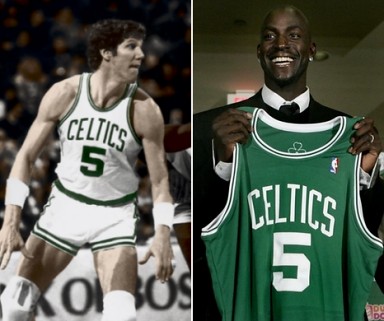
I was absolutely stunned to find out that Kevin Garnett will be wearing number 5* for the Celtics. I know things have been bad in Beantown for the last several years, but I didn't realize the problems with the Boston franchise extended to the equipment managers! Giving away Bill Walton's jersey number...what were they thinking?! That's like removing the Pope's hat and dress and giving them to some begger on the street: It's a travesty of Biblical proportions.
*Apparently, KG's first choices were numbers 21, 1, and 2. However, those numbers are already retired: Bill Sharman wore 21 and numbers 1 and 2 were retired to honor Walter Brown (the team's first and greatest owner) and Red Auerbach (the team's third and greatest coach).
Some people are claiming that Garnett feels Celtic Pride. KG himself said, "The Celtics have had a proud tradition and now I hope that we can add to the legacy." Shame on you, Kevin Garnett! That may be the most heinous lie in the history of man's wickedness. If Garnett really understood the deep and complex mythos of the Celtics, he wouldn't tarnish Walton's accomplishments by sullying the big man's number. Why stop there, Kevin? Why not pull down a few of those championship banners and wipe your ass with them?
By making this decision, Garnett lost money, he lost some self-respect, and he lost legitimacy in the eyes of future hall of fame coach Doc Rivers. Okay, Rivers probably won't get into the NBA Hall of Fame, but he's in the Hall of Fame of Life. Sadly, I doubt Doc has the authority to redress this numeric injustice, and with Red Auerbach dead and buried, the Celtics have no one left who can restore order to the universe.
The raping of Bill Walton's Celtic number is one of the worst defilements, not just in basketball, or in America, but in the history of Western Civilization. What a pathetic move by a pathetic human being. Boston fans everywhere are throwing up their hands in exasperated dismay. All I can do is shake my head and ask what has happened to that once beautiful team.
Bill Walton's Top 13 Celtic Moments
Did Walton deserve to have his jersey retired, and thus keep it out of the clutches of glory-hogging sneak-thieves like Kevin Garnett? You're damned right he did! Here's a brief list of Walton's greatest Celtic moments as he led them to banner number 16.
1. October 25, 1985: Bill played 19 minutes, scored four points, committed five fouls, and turned the ball over seven times. The Celtics, not surprisingly, lost 113-109 in overtime. While his performance was appalling, his post-game quote was comedy gold: "I was a total disgrace to the game of basketball." Thanks largely to Walton's humble admission, the Celtics would go on to win their next nine games.
2. Date unknown: In his autobiography Nothing But Net, Walton recounts the bullying and verbal abuse he suffered at the hands of teammate Kevin McHale. Eventually, Big Bill decided enough was enough, and in Karate Kid-like fashion, Walton challenged McHale to a game of one-on-one in front of the entire team and coaching staff. Despite the fact that McHale was younger, healthier, and -- at that stage of his career -- better than Walton, Big Bill kicked his tormentor's butt, then limped out of practice with his head held high.
3. December 30, 1985: Walton faced his former team, the Los Angeles Clippers, and showed them what they were missing en route to leading the Celtics to a 125-103 win. The redhead contributed nine points, 13 rebounds, and a blocked shot in just 17 minutes of action.
4. January 10, 1986: The Celtics were facing the Hawks on the road, and Atlanta bolted out to a 70-47 halftime lead. Infuriated by the trashtalking of Eddie Johnson and some other Hawks players, Walton came out of halftime on a personal mission. He would go on to play a season-high 28 minutes and finished with 11 points, eight rebounds, and four blocked shots. Moreover, he was instrumental after the Celtics managed for force overtime, breaking the game's final tie with a tip-in and then blocking Eddie Johnson's shot on the Hawk's next possession. Bill's leadership was responsible for the Celtics' 115-108 overtime win...and the team's biggest comeback of the season.
5. January 22, 1986: Before wisely agreeing to help form what Bob Costas once described as "the best single-season team ever," Walton briefly considered joining the hated Lakers. But Jerry West, mindful of Walton's history of foot and ankle injuries, spurned him. Said West: "Thanks for the interest, Bill, but I've seen the X-rays of your foot." Walton correctly believed the Lakers had made a mistake, and he was determined to make them regret it. He did just that when the teams faced off at the Boston Garden. Walton racked up 11 points (on 5-of-6 shooting), eight rebounds, four assists, and seven blocked shots in only 16 minuts of playing time. Thanks to his inspired effort, the Celtics crushed the Lakers 110-95.
6. January 26, 1986: The rival 76ers were in town, and Larry Bird (9-of-25) wasn't up to the challenge. Fortunately, Bill Walton was. Walton scored 19 points, grabbed 12 rebounds, and blocked two shots in a mere 25 minutes, leading his team to a very satisfying 105-103 victory.
7. February 5, 1986: Going into this game against the Washington Bullets, the Celtics were missing McHale, who was the team's third best player (behind Walton and Bird). It didn't matter, though, because Big Bill once again stepped up his game, notching 13 points and a season-high 17 rebounds while tying his season-high of 28 minutes. Thanks to him, the Celtics destroyed the Bullets 103-88.
8. February 16, 1986: On the road and facing the Lakers, the team that wouldn't give him a chance, Walton once again showed his legendary promise, earning 10 points, seven rebounds, and one blocked shot in 26 pulse-pounding minutes. But it was more than just the numbers; Walton shut down James Worthy in key stretches and held Kareem Abdul-Jabbar -- the NBA's all-time leading scorer -- to a mere two points in the fourth quarter. Another great Walton game, another big win for the Celtics.
9. March 24, 1986: During a March 14 game against the Atlanta Hawks, Big Bill broke his nose, and then he fractured the navicular bone in his right wrist while blocking a Tree Rollins shot. But Walton had come too far to let a few broken bones stop him. He continued to play through pain, and then, when Robert Parish missed a game against the Houston Rockets, Walton got his first start of the season. During warmups, Bird walked up to Walton and said, "I know what you're thinking. Forget about it. Those [Parish's] shots are my shots. You just get on the weak side and rebound." The two men shared a laugh, because they knew who the real leader of the team was. And true to form, Walton delivered: 20 points (on 8-of-10 shooting) and 12 rebounds in a comfy-cozy 116-97 victory.
10. April 8, 1986: At this point, Walton's dominance was pretty obvious. He made his second start of the season against Milwaukee and again keyed a Celtics win by scoring a season-high 22 points and grabbing 12 rebounds in just 28 minutes.
11. May 29, 1986: Prior to Game 2 of the Finals, Walton was awarded the NBA's Sixth Man Award. Although he probably deserved the MVP, Walton was both humble and grateful. Buoyed by this joyous event, the Celtics hammered the Rockets 117-95.
12. June 3, 1986: Celtics coach K.C. Jones, trying to turn back a Rockets surge, turned to Bill Walton in crunch time, and Walton again came through for his team. With the game tied at 101 with just over two minutes to go, Walton worked a brilliant inside-out feed to Bird, who hit a three-pointer off of Walton's clever assist to give the Celtics a 104-101 lead. The Rockets scored on their next possession to pull within 104-103, and when a Dennis Johnson miss clanked off the rim, Walton swooped in from the right, evaded Hakeem Olajuwon, grabbed the rebound, and put up a backhanded layup that gave the Celtics a 106-103 win and a 3-1 series lead.
13. Date unknown: Walton, along with teammates Kevin McHale and Robert Parish, posed for the following picture. More work of art than mere photograph, the aptly titled "Big Men, Little Court" has gone on to win several international awards and inspired an entire generation of photo journalists. This is the kind of world-changing accomplishment that won't show up in any record books, but nonetheless is an integral component of the Bill Walton Legacy.
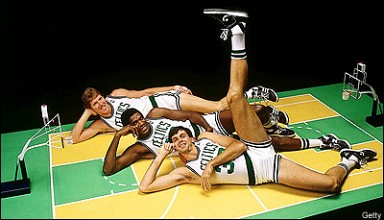
Greatest Miscarriage of Justice...Ever?
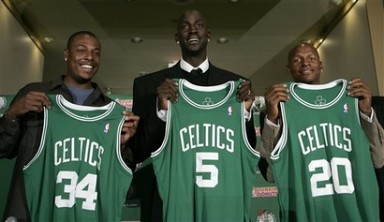
Not only did KG bogart Walton's number, but Paul Pierce continues to wear Kevin Gamble's number, and it looks like Ray Allen has filched Sherman Douglas' old cipher. I'm too disgusted for words.
Labels: Bill Walton, Boston Celtics, Kevin Garnett, Kevin McHale, Larry Bird, Robert Parish

By Basketbawful and Evil Ted
After enduring several years of constant "Where's KG going to end up?" speculation*, we finally have the definitive answer: The Boston Celtics.
* Sorry, Kobe. But not really.
This is a great move for the Celtics, even if it doesn't take them directly to the Promised Land. For the past five seasons, the team has been a laughingstock, mired in mediocrity (at best) and disgrace (at worst). They haven't appeared on national TV since Zeus knows when -- and rightfully so. Two blockbuster trades later and they're suddenly relevant for the first time since Larry Legend's final season* and a legitimate contender in the East. If Lebron and the Lebronettes were good enough to make it to the Finals last year, why not a potent Garnett / Paul Pierce / Ray Allen combination this year? There's no reason to think they won't do well in a conference where the other contenders -- Chicago, Cleveland, Detroit, Miami, and New Jersey -- pretty much stuck with the status quo**.
* Despite the fact that Larry Bird, Kevin McHale, and Dee Brown missed a combined 114 games, the 1991-92 Celtics still managed to win 51 games and capture the Atlantic Division title. They finished the season on a 15-1 tear -- even winning their final eight games without The Basketball Jesus -- and then went 5-1 in the playoffs before Bird returned from a late-season back injury and screwed up the team's chemistry. The Celtics ended up losing to the Cavaliers in a tough seven-game series that turned irrevocably in Game 4 when a rusty Bird missed not one but two game-winning shots. And thus ended the Bird Era.
** Except Miami, who got significantly worse; their best shooter (Jason Kapono) walked, they lost out on the Mo Williams Sweepstakes, and they and signed Smush Parker, a.k.a. "the worst point guard in the NBA." Pat Riley's failure is now complete.
If you think about it, the trade is nothing short of a miracle, not only because Ainge pulled it off with what he had to offer (the promise of Al Jefferson's future greatness), but also because he managed to hold on to both Pierce and the recently-acquired Allen. It flies in the face of all the "inside the box" thinking he'd become infamous for. All the talk of "potential" and "youth" has been going on too long with the Celtics, and it was way past time to shake things up. So rather than gamble on the Utah Jazz formula for success -- young, hard-nosed, character guys + tenacious defense + two or three plays run to perfection -- he's going the Miami Heat route: A core of hungry, All-Star veterans surrounded by a handful of decent role players. Garnett, Pierce, and Allen all have something to prove*, and here's hoping that together they can prove it. Garnett is the inside presence, Pierce is the slasher, Allen is the shooter...that combination could work out quite nicely. The C's still need some frontcourt depth and a steady point guard, but with a new Big Three in town, they don't necessarily need Tony Parker bringing the ball down court.

* Perhaps the most fascinating subplot in the trade is that Garnett finally gets to prove whether he can win when surrounded by a talented supporting cast. Is he a winner or just a numbers guy? Time to find out.
No, the Celtics won't be deep, but neither were the Celtics of the 80's*. With only five players on a court at once, basketball is a sport where one superstar player can make the difference -- just ask the Heat. No, Garnett, Pierce and Allen aren't Bird, Parish and McHale -- who, as Rick Pitino would point out, still aren't coming through that door -- but I'll be damned if this team won't be a thousand times more exciting to watch than they have been since, well, forever. No, the window isn't huge -- 3 or 4 years, tops -- but better a small window than the brick wall the Celtics have been banging their heads into since, well, forever.
* As noted, the 1986-87 Celtics quite possibly had the worst bench of all time. The 1987-88 Celtics weren't much better off. Go back and watch Game 7 of the 1988 Eastern Conference Semifinals, also known as Larry's duel with Dominque. Coach K.C. Jones was forced to play a group of white stiffs comprised of Brad Lohaus, Fred Roberts, Jim Paxson, and Mark Acres. Their best reserve, Reggie Lewis, was a rookie and played only three minutes. Ugly.
Maybe Danny isn't a genius. Maybe he's just taking advantage of his relationship to Kevin McHale. But I don't particularly care how he did it, just like I don't particularly care who Red Auerbach beat up in a dark alley when he traded for McHale and Parish*. Let the next chapter for the Celtics begin.
* Sorry, Joe Barry Carroll. But not really.
Labels: blockbuster trades, Boston Celtics, Danny Ainge, Kevin Garnett, Kevin McHale, Larry Bird, Paul Pierce, Ray Allen, Robert Parish
February 2005
October 2005
November 2005
December 2005
January 2006
February 2006
March 2006
April 2006
May 2006
June 2006
July 2006
August 2006
September 2006
October 2006
November 2006
December 2006
January 2007
February 2007
March 2007
April 2007
May 2007
June 2007
July 2007
August 2007
September 2007
October 2007
November 2007
December 2007
January 2008
February 2008
March 2008
April 2008
May 2008
June 2008
July 2008
August 2008
September 2008
October 2008
November 2008
December 2008
January 2009
February 2009
March 2009
April 2009
May 2009
June 2009
July 2009
August 2009
September 2009
October 2009
November 2009
December 2009
January 2010
February 2010
March 2010
April 2010
May 2010
June 2010
July 2010
August 2010
September 2010
October 2010
November 2010
December 2010
January 2011
February 2011
March 2011
April 2011
May 2011
June 2011
July 2011
August 2011
September 2011
October 2011
November 2011
December 2011
January 2012
February 2012
March 2012
April 2012
May 2012
June 2012
July 2012
August 2012
September 2012
October 2012
November 2012
December 2012
January 2013
February 2013
March 2013
April 2013
May 2013
June 2013
July 2013
August 2013
September 2013
October 2013
November 2013
December 2013
April 2014
May 2014
June 2014
July 2014
August 2014
June 2018
July 2022