Walton's foot (wolt'-uhnz foot) noun. A damning vulnerability or fatal flaw that can (and often does) doom an otherwise talented player or team.
Usage example: Allen Iverson's "I'm gonna do things my way and my way only" attitude has always been his Walton's foot.
Word history: I coined this term some time in the last couple years because I got tired of using the phrase Achilles' heel. As you probably know, that term originates from the mortal weakness of Achilles, a Greek hero of the Trojan War and the central character of Homer's Iliad.
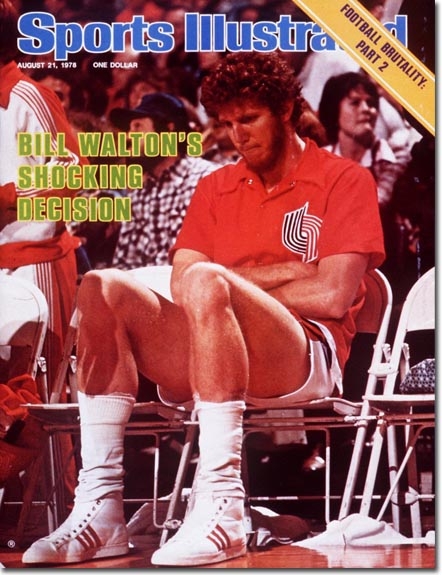
How good was Bill Walton? Well, he won the MVP during a season (1977-78) in which he played only 58 games. Something like that had never happened before...and it hasn't happened since. But a better question is: how good would Walton have been if he'd been born with normal human feet? Many people have said that, in his early years, Walton was the best center on the planet when healthy. Unfortunately, he was never healthy.
Walton's basketball life was plagued by legendary foot problems, which were made worse by an insistence on playing through injuries and his use of prescription medication to mask the pain associated with them. The Big Redhead appeared in only 468 games during his 10-year career. That's the equivalent of about five-and-a-half seasons. Take away his magical 1985-86 season with the Boston Celtics -- during which he hobbled through a career-best 80 games -- and Walton never played more than 67 games in a single season. And those 67 games were for the 1984-85 L.A. Clippers, which is kind of like saying they never happened at all. For the record, that was the Clippers' first season in Los Angeles. They won only 31 games. Even back then, they were who we would later think they were.
Walton is best known for his days with the Portland Trail Blazers -- during which he won an NBA title and Finals MVP (in 1977) and that regular season MVP -- but he missed 119 games over his four seasons with the Blazers...and things ended badly. From the SI.com vault:
Last Friday evening, as reports began circulating that he might miss more than half of the coming season, Bill Walton left a Portland, Ore. clinic with a cast on his left leg. With the addition of the cast, the puzzle of what had happened to Walton, what had made him demand to be traded from the Trail Blazers, grew even more complicated. The sudden move left some friendships strained. It also left the city's basketball fans stunned. Just 14 months before, Walton was leading a raucous victory parade through the streets of downtown Portland after the Trail Blazers had won the National Basketball Association championship.Walton eventually filed both a malpractice lawsuit and a contract grievance against the Trail Blazers, and he got what he seemingly wanted: a one-way ticket out of Portland.
The initial shock came after a secret meeting in Chicago on Aug. 1 when Walton, who was voted the league's MVP last season, demanded that the Blazers trade him as soon as possible to a team of his choosing, which, late Sunday night, he announced was the Golden State Warriors.
Even more unsettling was the announcement from the Portland club that it "will attempt to abide by his request." And what made the whole thing a mystery was the addendum to which both sides agreed, at Walton's insistence: not to discuss the whys and wherefores of the strange affair.
Last week, however, Walton's reasons for demanding the trade became clearer. He believed that his latest injury -- a fractured bone in his left foot, which was diagnosed after he had appeared in a playoff game on April 21 -- might have been avoided if the Trail Blazers had provided him with proper medical advice and care. Walton also charged the team with the misuse of the pain-modifying drugs Xylocaine and Marcaine, and the anti-inflammatory drugs Butazolidin (phenylbutazone) and Decadron (dexamethasone).
But what Walton really wanted was his health back. He never really got it. Even his one "healthy" season in Boston was tainted by a broken nose (which happened twice) and a broken bone in his wrist. Walton concealed the wrist injury because he felt the '86 Celtics were a special team (they were) and he wanted to finish the season (he did). But it was still Classic Walton. And the next summer, he broke a finger playing one-on-one against Robert Parish. While he was recovering from that injury, he tried to keep in shape by riding a stationary bike for hours on end. In doing so, he broke a bone in his "healthy" foot. That was more or less the end of his career, save for a few token appearances during the season and in the 1987 playoffs.
Before concluding, I want to make something perfectly clear: I have a lot of respect and admiration for Bill Walton. I am not mocking him. But he is a tragic figure who, like Achilles, was cut down by a natural weakness that was not his fault. This is simply my tribute to that fact.
Labels: Bill Walton, Word of the Day
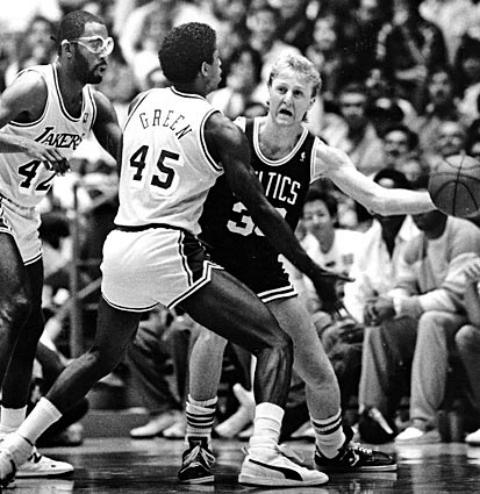
This is Part 9 -- the final chapter -- of our The Worst of Celtics-Lakers series. This should have been the greatest championship series of the 1980s -- maybe ever -- but instead it turned into the most lopsided Larry-Magic Finals. For various reasons, which I will bitterly complain about below.
1987 NBA Finals
Expectations: The 1985-86 Celtics were really freaking good. They won 67 games and would have won 70 for sure if Larry Bird hadn't played the first 30 or so games with a debilitating back injury. They stormed through the regular season and the playoffs in such overwhelming fashion that many people thought they would become the first repeat champions since the 1968-69 Celtics. Which led to this (probably) unintentionally hilarious music video (hat tip to Ball Don't Lie and The Commission) called "First Time Since '69" (and no, it's not a porn video...no Rick Rolling here).
Len Bias: After the Celtics won the championship in 1984, Red Auerbach shipped Gerald Henderson to Seattle for the Sonics' first-round draft pick in 1986 (and thus the drafted player would be available for the 1986-87 season). This move backfired somewhat in 1985, when Boston's bench failed them in the Finals. But when the Sonics got the second overall pick in the '86 draft, it appeared to be another Auerbachian master stroke. Boston gleefully selected Len Bias -- Brad Daugherty was selected first by the Cleveland Cavaliers -- and it looked like the Green Reign would last for the rest of the decade. After all, the Celtics had just won the NBA championship with one of the best teams of all time, and now they were adding a player who was drawing favorable comparisons to Michael Jordan (although, in retrospect, he was more like an early Vince Carter prototype, only with balls). Said Bird: "He would have been one of the greatest ever. I thought we had won another championship on draft day."
But joy and celebration were soon replaced by shock and grief. On June 19 -- 1986, less than 48 hours after the Celtics had drafted him -- Bias died of a cocaine overdose. It was a crippling blow from which the Celtics never really recovered (until this season, I suppose). For the sake of perspective, here are some of the players that Boston passed over for Bias: Ron Harber, John Salley, Mark Price, Dennis Rodman, Jeff Hornacek, Drazen Petrovic and Kevin Duckworth (sorry, couldn't help myself).
Bill Walton's foot: One of the primary reasons that the 1985-86 Celtics were so great was the presence of Bill Walton, who that season was the NBA's Sixth Man of the Year and the best backup center (to Robert Parish) of all time. Walton's entire career had been dogged by injury, but he appeared in a career-high 80 games during that one miracle season in Boston (his previous best was 67). Boston looked like a mortal lock to repeat for the first time since 1969...as long as Walton could remain healthy. But, of course, he could not.
A week before training camp, Walton and Robert Parish met at the Celtics training facility at Hellenic College to play one-on-one. While trying to block one of Parish's shots, Walton jammed the pinky finger on his right hand against the Chief's elbow. The finger broke, and Walton was encouraged (read that: forced) to sit out until it healed. But Walton was so intent on maintaining his conditioning during the layoff that he began riding his stationary bike at home for as many as eight hours a day (I am being completely serious). Soon, Walton began feeling pain in his ankle and foot. The ankle injury was diagnosed as "an inflammation of the outside joint of the right ankle." But further bone scans revealed yet another stress fracture in his troublesome foot. When the injury didn't respond to therapy and rest, Walton underwent surgery with the hopes of being ready and available for the playoffs. But other than a few token postseason appearances -- during which he was an awkward, shambling ghost of his former self -- Walton's career was effectively over.
Worse even than the loss of Walton was the devastating psychological effect his "maybe he'll be back, maybe he won't" status had on the team. Every time it looked like Bill might be ready to suit up, the Celtics would get excited. Then, when Bill couldn't go, their spirits would be deflated. And this happened over and over again during the season. As Bird put it: "Having Bill here was like a time bomb."
Illness and injuries: Walton was the first Celtic to go down, and then the rest of them started falling like dominos. Danny Ainge missed the first 11 games of the season with a bad back, and he struggled throughout the playoffs with knee and hamstring injuries. Larry Bird missed eight games with back, ankle and Achilles tendon injuries. Robert Parish played in 80 games, but he was suffering from tendonitis in both arms -- when he belted Bill Laimbeer in Game 5 of the 1987 Eastern Conference Finals, he said his one regret was that the tendonitis wouldn't allow him to make a fist -- and chronic sprains in both ankles. Scott Wedman was limited to six games due to an ongoing left heal injury, for which he had a surgery in January of '87 that basically ended his career. Jerry Sichting was hampered all season by a nagging intestinal virus. Hell, even coach K.C. Jones missed four games with strep throat. It was just that kind of year. But the worst injury of all might have been to...
Kevin McHale's foot: The losses of Walton and Wedman coupled with the impairment of Sichting meant that the Celtic "bench" was effectively reduced to Fred Roberts, Darren Daye and Greg Kite. In other words: Worst bench ever. For this reason, Boston's starters were forced to log heavy minutes night after night (Bird led the league in Minutes Per Game at 40.6). As any personal trainer will tell you, chronic fatigue will lead to injuries. The rest of the Celtics were suffering from them. And soon it was McHale's turn.
Mind you, McHale was having the best season of his career: He averaged 26.1 PPG, 9.9 RPG and 2.2 BPG. He shot over 60 percent from the field and better than 80 percent from the line, which is the only time anyone in NBA history has done that. He was named to the All-NBA First Team and All-NBA Defensive First Team. There was even talk about McHale possibly winning the MVP award (he eventually finished fourth in MVP voting, just behind Bird).
Unfortunately for Kevin and the Celtics, everything came undone on March 11, 1987, when Larry Nance (then with the Phoenix Suns) stepped on McHale's foot and caused a hairline fracture. Boston's medical team failed to correctly diagnose the injury and McHale continued to suffer for it...and he couldn't understand why. Said McHale: "People kept telling me, 'It's in your head.' I said, 'No, it's not. It hurts all the time. It hurts at night, during the day, all the time.' At the time, our medical staff would say, 'Ice it and forget about it.' But that was not going to work. I had played on it so long. I shouldn't have. In the Detroit series [the Eastern Conference Finals], it fractured all the way through. I went to turn on it and it felt like someone stuck a poker in my foot. It was white hot. I should have stopped then."
But he didn't. Then, during the first round of the playoffs, the Chicago Bulls team physician Dr. John Hefferon took a look at X-rays of McHale's foot. Having dealt with Michael Jordan's broken foot the year before, he knew exactly what he was looking for. Once the Celtics had been informed of the nature of McHale's injury, they allowed him to decide whether or not he should continue to play (which was and still is ridiculous). McHale didn't want to let down his teammates. He wanted to win. So he kept playing. Even after the navicular bone in his foot split like a piece of firewood.
McHale's performance in the postseason was nothing short of astounding. Forget all that crap about Jordan's "flu game" or even Willis Reed playing a few minutes in Game 7 of the 1970 NBA Finals. Kevin McHale played the entirety of the 1987 playoffs with a broken freaking foot. Think about that. And he still averaged 21.1 points (on 58 percent shooting) and 9.2 rebounds in 39 minutes per game. As McHale put it: "I never knew how good I was until I had to play on one foot. I'd still get 20 points and eight or nine rebounds. I said to myself, 'Damn, if there was a league for one-footed players, I'd be All-Pro.'"
Sadly, McHale's bravery has been all but forgotten because the Celtics didn't win the title. But it should be. However, despite his solid offensive numbers, McHale's defense was hampered. He didn't have the same mobility, which had a very serious effect in the Finals (more on that later).
Given all the injury problems and the emergence of the Detroit Pistons as an Eastern Conference powerhouse, it's amazing that the Celtics even made the Finals in '87. But they did. And they got to play the sacrificial lamb to the best Lakers team of the decade.
The Celtics in Game 1: Larry Bird scored 28 points and, at one point, hit 11 straight shots...but it didn't matter. L.A. bolted out to 21-point second-quarter lead -- they had 35 fast break points in the first half alone -- and answered every Celtics run with a run of their own. The Lakers shot 56 percent and dominated the boards (51-40). McHale's wobbly wheel wouldn't allow him to stay in front of James Worthy (33 points, 16-for-23) and Magic Johnson (29 points, 13 assists) destroyed Dennis Johnson (7 points, 3-for-7). The Purple and Gold won 126-112, but it wasn't really that close.
The Celtics in Game 2: Things did not improve for Boston in the second game. Only this time Larry was the victim. Michael Cooper made a mockery of Bird's "defense" in the second quarter by orchestrating a 20-point Lakers run during which he accounted for every point by scoring or dishing. In that quarter, he tied the NBA Finals record for assists (8) and hit 6-for-7 from three-point range. The Lakers continued to run the Celtics into the ground, outscoring Boston 36-2 in fastbreak points in the first half. It got even worse in the second half. During the third period, Magic tied Cooper's tie by dishing for 8 assists of his own and the Lakers eventually won 141-122, setting an NBA Finals record by shooting nearly 62 percent for the game. Bill Walton played 5 minutes, contributing 1 rebound, 1 turnover and 2 fouls.
The Lakers in Game 3: After getting blasted in the first two games, Larry Bird was asked whether the Lakers might sweep his Celtics. Said Bird: "Nah. We're just too good a team to be swept." And he was right. But here's the crazy thing: Boston got huge games out of Bird (30 points, 12 rebounds), D.J. (26 points, 7 boards), McHale (21 points, 10 rebounds, 5 assists) and Parish (16 points, 6-for-7), but the Celtic who beat the Lakers was...Greg Kite! The Chief got into foul trouble in the second quarter, and in came Kite. He didn't score a single point, but he grabbed 9 rebounds, blocked a Magic layup and put his huge, clumsy body all over Kareem. The Celtics caught fire (17-for-21) and outscored L.A. 30-17 for the rest of the quarter. Thanks to Kite's inspiration, they won 109-102.
The Celtics in Game 4: They were pretty relieved after finally getting a win. So relieved that Bird said: "[Game 3] was the most important game of the series for us. If we lost, it might've been tough to get up for Game 4. Now it's going to be easy." He was sort of right. The Celtics led 70-55 in the third quarter and were still up 103-95 with less than four minutes left. Then everything came undone. The Lakers went on a 9-0 run as Bird, D.J. and the Chief all coughed up the ball. Bird escaped James Worthy -- who had a fistful of Larry's jersey -- to nail a three-pointer that gave the Celtics a 106-104 lead, but Kareem got fouled on the next possession. He missed his second foul shot, but McHale (who was being jostled by Mychal Thompson) bobbled the ball out of bounds. That gave the Lakers another chance, and, of course, Magic hit his "junior, junior skyhook" over The Big Three to give L.A. the win. Note, though, that McHale -- broken foot and all -- was guarding Magic on that play. He clearly didn't have the mobility to stay with Magic on that play. And thus did McHale's injury doom the Celtics again. And Bird was upset. "You expect to lose on a skyhook. You don't expect it to be from Magic. We turned the ball over twice. We missed a rebound after a freethrow. We really can't blame anybody but ourselves. A lot happened in the last minute-and-a-half. Robert gets the ball taken away from him. I throw the ball at Kevin's feet. They miss a free throw, and we don't get the rebound. How many chances do you need to win a game?" I guess they needed, like, one more.
The Lakers in Game 5: I'm not saying they didn't try...okay, that's exactly what I'm saying. Before the game, Bird told the rest of the Celtics "If they want to celebrate, let's not let them do it on the parquet." The Lakers seemingly had other ideas -- their staff iced down several cases of champagne for their "inevitable" win, reminiscent of Jack Kent Cooke's grand faux pas in Game 7 of the 1969 NBA Finals -- but they went down rather quietly. James Worthy shot 6-for-19, Kareem was 8-for-21 and Byron Scott was 3-for-10. Meanwhile, Boston shot 52 percent and all five starters scored at least 20 points. The Celtics' comfy-cozy 123-106 win was basically their consolation prize for the Finals.
The Lakers in the first half of Game 6: Kareem showed up with a shaved head and, early on, it looked like he had jinxed his team. The Celtics started strong, held Magic to only 4 points through the first two quarters, and led 56-51 at the half. It actually looked like Boston might force a Game 7...
The Celtics in the second half of Game 6: But they didn't. The Leprechauns shot 26 percent in the third quarter. Robert Parish also picked up his fifth foul in that quarter and was exiled to the bench. The Lakers built a 19-point lead and the Celtics never again got any closer than 12 points. Bird scored only 16 points on 6-for-16 shooting and committed 4 turnovers. Danny Ainge was 1-for-9. Parish got embarrassed yet again by Kareem (32 points, 13-for-18) before fouling out. And Boston bowed out with a whimper, 106-93. And that was their last shot at an NBA title...
...until now.
Sources: NBA.com, Wikipedia, Basketball-reference.com, Ever Green by Dan Shaughnessy, Drive: The Story of My Life by Larry Bird and Bob Ryan, The Big Three and The Last Banner by Peter May, Larry Bird: The Making of an American Sports Legend by Lee Daniel Levine, and this awesome Web site that has box scores for every NBA Finals through 2003.
Labels: bench play, Bill Walton, Boston Celtics, Larry Bird, Los Angeles Lakers, Worst of Celtics-Lakers
In 1989, Reebok unveiled The Reebok Pump, but they used a somewhat different marketing approach. Instead of signing one of world's premier athletic talents (ala Michael Jordan), Reebok chose a broken-down, retired basketball player that nobody really liked anymore. They chose Bill Walton.
Walton was an especially ironic selection, since by the time this commerical aired his feet were composed entirely of chicken wire and tissue paper. Big Bill even drew attention to that fact by saying, "Pump, where were you when I needed you?!" Walton followed up that mournful rebuke with "If I could play today, I'd pump up for support, protection, and a custom fit." It's as if Bill wants us to believe that some air and a little extra rubber would have prevented his brittle feet from breaking into thousands of tiny pieces.
Sadly, this Utopian world in which foot injuries were completely eradicated by the Reebok Pump never came to be. Maybe that's because the Pump was so damn expensive: $180 on its initial release. And that was in 1989 dollars. In today's marketplace, that would be, like, a $10,000 shoe. Believe me, nobody's going to buy a $10,000 shoe endorsed by an injury-prone has-been. After all, how many pairs of Shaq's Dunkman game shoes do you own? Yeah, that's what I thought.
So if you're ever wondering why Reebok failed to overtake Nike in the Great Shoe Wars of the 1990s, it's because they tried to sell what was, at the time, the most expensive athletic shoe ever based on the recommendation of a man who could barely walk. It also didn't help that their tagline -- Pump Up and Air Out -- sounded like the flatulent result of a late-night Taco Bell run.
Labels: Bill Walton, celebrity endorsements, Nike, Reeboke, Shaq, shoe commercials
Labels: Bill Walton, NBA, tributes
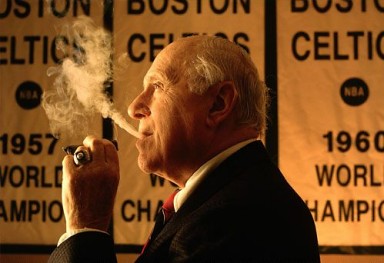
I know this sounds strange, but Greg Oden's season-ending injury isn't just a heaping helping of poop gumbo for the Portland Trailblazers. It's a clear sign from God that the Boston Celtics' Curse has been lifted.
Think about it. Had the Celtics won the draft lottery and gotten the number one pick -- as they'd hoped, wanted, and tanked for -- Danny Ainge would have selected Oden and kept everything else pretty much the same. Which would have meant that, once Oden's knee spontaneously disintegrated, the Celtics would have fielded the same craptastic team that won only 24 games and had an 18-game losing streak last season. That would have been as catastrophic to the Celtics and their fans as Oden's health has been to Oden's career.
Speaking of which, isn't it ironic that the Trailblazers won the draft lottery and selected the one player that, while it's probably still too early to tell for sure, is starting to look like the new century's Bill Walton, the team's last number one overall pick? Seriously. Like Oden, Walton had unlimited potential and could have become one of the greatest centers ever, but injury after strange injury limited him to five and a half season's worth of games over a 10-year career. In Walton's first two seasons alone, he broke his nose, foot, wrist, and leg. He once broke his foot (for the umpteenth time) while riding an exercise bike -- which is better than breaking your knee sitting on a couch, but still. Even in his great MVP season of 1977-78, he played only 58 games due to injury (imagine how the blogosphere would erupt if something like that happened today).
Although, truth be told, Oden's case is even worse than Walton's. At least Big Bill had four reasonably healthy seasons at UCLA, during which he was one of the best college players of all time. Oden didn't have a single healthy season at Ohio State; he had wrist surgery before his freshman year even started. He still played very well for the Buckeyes (15.7 PPG and 9.6 RPG), but certainly not great (which everyone blamed on the fact that he wasn't fully recovered from his wrist injury). Then he missed most of the summer league because he had his tonsils out, and now he's not even going to play his rookie season because of microfracture surgery on his knee. And that kind of surgery means that he might not ever be as good as he possibly could have been. The final book on Oden is far from written, but...wow.
The poor Trailblazers sure have had some rotten luck over the years. You can put this tragedy right up there with their failure to defend the title in '78 (thanks, of course, to a Walton injury), drafting Sam Bowie instead of Michael Jordan in the '84 draft, Clyde Drexler's evisceration (by Jordan) in the '92 Finals, and of course the infamous 2000 Western Conference Finals meltdown.
Everybody's talking about how fortunate the Supersonics are for getting Durant instead of Oden. And they are. But the Celtics are the real winners here. Instead of a relatively unproven, seemingly injury-prone center with a huge question mark hanging ominously over his career, they dealt for Ray Allen and Kevin Garnett. Which, as I pointed out, means the curse is officially over. If it wasn't, the Celtics would have won the lottery, selected Oden, and everybody would be comparing this to Boston's many doomed draft picks (Len Bias, Michael Smith, Acie Earl, etc.). I'm telling you, Red Auerbach's ghost is behind this. He sacrificed himself to break the jinx. I will always believe that.
As a final note, Evil Ted just came by my cube and said: "I hope you're writing about Greg Oden." After I told him I was, he said, "Good. Tell everybody we were right. That dude's 40 years old if he's a day. Microfracture surgery at 19? Yeah, right. The man is middle-aged, and this is what happens to middle-aged men who play professional basketball."
Labels: Bill Walton, Boston Celtics, curses, Greg Oden, Keven Garnett, Kevin Durant, Len Bias, Portland Trailblazers, Ray Allen, Red Auerbach, Seattle Supersonics
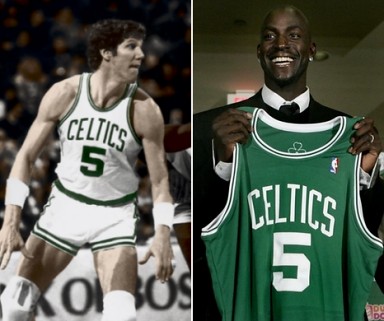
I was absolutely stunned to find out that Kevin Garnett will be wearing number 5* for the Celtics. I know things have been bad in Beantown for the last several years, but I didn't realize the problems with the Boston franchise extended to the equipment managers! Giving away Bill Walton's jersey number...what were they thinking?! That's like removing the Pope's hat and dress and giving them to some begger on the street: It's a travesty of Biblical proportions.
*Apparently, KG's first choices were numbers 21, 1, and 2. However, those numbers are already retired: Bill Sharman wore 21 and numbers 1 and 2 were retired to honor Walter Brown (the team's first and greatest owner) and Red Auerbach (the team's third and greatest coach).
Some people are claiming that Garnett feels Celtic Pride. KG himself said, "The Celtics have had a proud tradition and now I hope that we can add to the legacy." Shame on you, Kevin Garnett! That may be the most heinous lie in the history of man's wickedness. If Garnett really understood the deep and complex mythos of the Celtics, he wouldn't tarnish Walton's accomplishments by sullying the big man's number. Why stop there, Kevin? Why not pull down a few of those championship banners and wipe your ass with them?
By making this decision, Garnett lost money, he lost some self-respect, and he lost legitimacy in the eyes of future hall of fame coach Doc Rivers. Okay, Rivers probably won't get into the NBA Hall of Fame, but he's in the Hall of Fame of Life. Sadly, I doubt Doc has the authority to redress this numeric injustice, and with Red Auerbach dead and buried, the Celtics have no one left who can restore order to the universe.
The raping of Bill Walton's Celtic number is one of the worst defilements, not just in basketball, or in America, but in the history of Western Civilization. What a pathetic move by a pathetic human being. Boston fans everywhere are throwing up their hands in exasperated dismay. All I can do is shake my head and ask what has happened to that once beautiful team.
Bill Walton's Top 13 Celtic Moments
Did Walton deserve to have his jersey retired, and thus keep it out of the clutches of glory-hogging sneak-thieves like Kevin Garnett? You're damned right he did! Here's a brief list of Walton's greatest Celtic moments as he led them to banner number 16.
1. October 25, 1985: Bill played 19 minutes, scored four points, committed five fouls, and turned the ball over seven times. The Celtics, not surprisingly, lost 113-109 in overtime. While his performance was appalling, his post-game quote was comedy gold: "I was a total disgrace to the game of basketball." Thanks largely to Walton's humble admission, the Celtics would go on to win their next nine games.
2. Date unknown: In his autobiography Nothing But Net, Walton recounts the bullying and verbal abuse he suffered at the hands of teammate Kevin McHale. Eventually, Big Bill decided enough was enough, and in Karate Kid-like fashion, Walton challenged McHale to a game of one-on-one in front of the entire team and coaching staff. Despite the fact that McHale was younger, healthier, and -- at that stage of his career -- better than Walton, Big Bill kicked his tormentor's butt, then limped out of practice with his head held high.
3. December 30, 1985: Walton faced his former team, the Los Angeles Clippers, and showed them what they were missing en route to leading the Celtics to a 125-103 win. The redhead contributed nine points, 13 rebounds, and a blocked shot in just 17 minutes of action.
4. January 10, 1986: The Celtics were facing the Hawks on the road, and Atlanta bolted out to a 70-47 halftime lead. Infuriated by the trashtalking of Eddie Johnson and some other Hawks players, Walton came out of halftime on a personal mission. He would go on to play a season-high 28 minutes and finished with 11 points, eight rebounds, and four blocked shots. Moreover, he was instrumental after the Celtics managed for force overtime, breaking the game's final tie with a tip-in and then blocking Eddie Johnson's shot on the Hawk's next possession. Bill's leadership was responsible for the Celtics' 115-108 overtime win...and the team's biggest comeback of the season.
5. January 22, 1986: Before wisely agreeing to help form what Bob Costas once described as "the best single-season team ever," Walton briefly considered joining the hated Lakers. But Jerry West, mindful of Walton's history of foot and ankle injuries, spurned him. Said West: "Thanks for the interest, Bill, but I've seen the X-rays of your foot." Walton correctly believed the Lakers had made a mistake, and he was determined to make them regret it. He did just that when the teams faced off at the Boston Garden. Walton racked up 11 points (on 5-of-6 shooting), eight rebounds, four assists, and seven blocked shots in only 16 minuts of playing time. Thanks to his inspired effort, the Celtics crushed the Lakers 110-95.
6. January 26, 1986: The rival 76ers were in town, and Larry Bird (9-of-25) wasn't up to the challenge. Fortunately, Bill Walton was. Walton scored 19 points, grabbed 12 rebounds, and blocked two shots in a mere 25 minutes, leading his team to a very satisfying 105-103 victory.
7. February 5, 1986: Going into this game against the Washington Bullets, the Celtics were missing McHale, who was the team's third best player (behind Walton and Bird). It didn't matter, though, because Big Bill once again stepped up his game, notching 13 points and a season-high 17 rebounds while tying his season-high of 28 minutes. Thanks to him, the Celtics destroyed the Bullets 103-88.
8. February 16, 1986: On the road and facing the Lakers, the team that wouldn't give him a chance, Walton once again showed his legendary promise, earning 10 points, seven rebounds, and one blocked shot in 26 pulse-pounding minutes. But it was more than just the numbers; Walton shut down James Worthy in key stretches and held Kareem Abdul-Jabbar -- the NBA's all-time leading scorer -- to a mere two points in the fourth quarter. Another great Walton game, another big win for the Celtics.
9. March 24, 1986: During a March 14 game against the Atlanta Hawks, Big Bill broke his nose, and then he fractured the navicular bone in his right wrist while blocking a Tree Rollins shot. But Walton had come too far to let a few broken bones stop him. He continued to play through pain, and then, when Robert Parish missed a game against the Houston Rockets, Walton got his first start of the season. During warmups, Bird walked up to Walton and said, "I know what you're thinking. Forget about it. Those [Parish's] shots are my shots. You just get on the weak side and rebound." The two men shared a laugh, because they knew who the real leader of the team was. And true to form, Walton delivered: 20 points (on 8-of-10 shooting) and 12 rebounds in a comfy-cozy 116-97 victory.
10. April 8, 1986: At this point, Walton's dominance was pretty obvious. He made his second start of the season against Milwaukee and again keyed a Celtics win by scoring a season-high 22 points and grabbing 12 rebounds in just 28 minutes.
11. May 29, 1986: Prior to Game 2 of the Finals, Walton was awarded the NBA's Sixth Man Award. Although he probably deserved the MVP, Walton was both humble and grateful. Buoyed by this joyous event, the Celtics hammered the Rockets 117-95.
12. June 3, 1986: Celtics coach K.C. Jones, trying to turn back a Rockets surge, turned to Bill Walton in crunch time, and Walton again came through for his team. With the game tied at 101 with just over two minutes to go, Walton worked a brilliant inside-out feed to Bird, who hit a three-pointer off of Walton's clever assist to give the Celtics a 104-101 lead. The Rockets scored on their next possession to pull within 104-103, and when a Dennis Johnson miss clanked off the rim, Walton swooped in from the right, evaded Hakeem Olajuwon, grabbed the rebound, and put up a backhanded layup that gave the Celtics a 106-103 win and a 3-1 series lead.
13. Date unknown: Walton, along with teammates Kevin McHale and Robert Parish, posed for the following picture. More work of art than mere photograph, the aptly titled "Big Men, Little Court" has gone on to win several international awards and inspired an entire generation of photo journalists. This is the kind of world-changing accomplishment that won't show up in any record books, but nonetheless is an integral component of the Bill Walton Legacy.
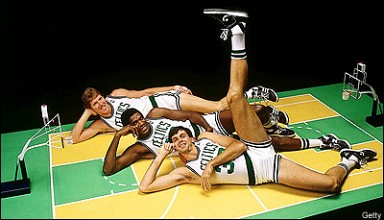
Greatest Miscarriage of Justice...Ever?
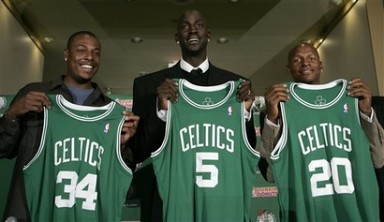
Not only did KG bogart Walton's number, but Paul Pierce continues to wear Kevin Gamble's number, and it looks like Ray Allen has filched Sherman Douglas' old cipher. I'm too disgusted for words.
Labels: Bill Walton, Boston Celtics, Kevin Garnett, Kevin McHale, Larry Bird, Robert Parish
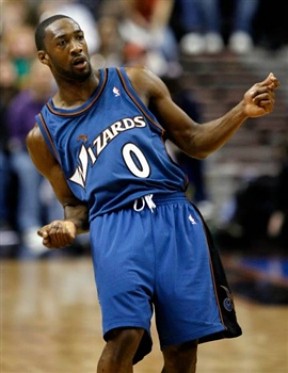
As WTF moments go, that one was up there. How do you even gauge something like that? Is there some kind of NBA preseason combine where the players get together for squatting competitions? And mind you, Anthony didn't say that Gil has the strongest legs for a guard, or even for a player his size...Greg thinks Arenas has stronger legs than any other NBA player. Stronger than Lebron's, stronger even than Shaq's. Apparently, Gilbert could crush all of the world's evil into a watery paste with his mighty shanks. And after he retires from basketball, that's exactly what I expect him to do.
All discussions of crimefighting aside, why do experts, analysts, and even fans feel the need to constantly make superlative declarations? I understand the need to classify and organize people, places, and things. It's human nature, and an integral part of how we come to understand the world around us. But is it really necessary to take it to this degree? Where, in order to compliment an above average play by a very good player, we have to put his legs at the top of a "Best Of" list?
It happens all the time too, and it's getting wackier by the year. A sample statement would be something like this: "Shane Battier is the best in game at coming off blind-side picks to play help defense against opposing big men in the high post." Or maybe, "Michael Redd is better than anybody at catching the ball in the deep left-hand corner, making one or two quick moves, faking right, and then getting off a high-percentage shot." Seriously, tell me you haven't heard comments like that during a typical NBA telecast.
It would be easy to blame Bill Walton, whose Waltonisms have become poplular NBA fodder, for ushering in this Era of Ridiculous Exaggeration. But Walton, for all his faults, usually has a tongue planted firmly in his cheek when he says something like "Tracy McGrady is doing things we've never seen from anybody...from any planet!" It's part of his onscreen persona, and he's only ever half-serious (as far as I can tell, anyway). Not so for guys like Greg Anthony. They are 100 percent serious, at least when the statement is made. I'd guess that, if given the chance to consider his remark, Anthony would probably take it back, or at least clarify it somehow. But that doesn't change the fact that he, and many (if not most) other analysts, will continue to state the outrageous with a straight face at every opportunity. Which to me, is one of the greatest abominations, not just of today, but in the history of Western Civilization.
Labels: Bill Walton, Gilbert Arenas, Greg Anthony, NBA Fast Break, strong legs, Waltonism
February 2005
October 2005
November 2005
December 2005
January 2006
February 2006
March 2006
April 2006
May 2006
June 2006
July 2006
August 2006
September 2006
October 2006
November 2006
December 2006
January 2007
February 2007
March 2007
April 2007
May 2007
June 2007
July 2007
August 2007
September 2007
October 2007
November 2007
December 2007
January 2008
February 2008
March 2008
April 2008
May 2008
June 2008
July 2008
August 2008
September 2008
October 2008
November 2008
December 2008
January 2009
February 2009
March 2009
April 2009
May 2009
June 2009
July 2009
August 2009
September 2009
October 2009
November 2009
December 2009
January 2010
February 2010
March 2010
April 2010
May 2010
June 2010
July 2010
August 2010
September 2010
October 2010
November 2010
December 2010
January 2011
February 2011
March 2011
April 2011
May 2011
June 2011
July 2011
August 2011
September 2011
October 2011
November 2011
December 2011
January 2012
February 2012
March 2012
April 2012
May 2012
June 2012
July 2012
August 2012
September 2012
October 2012
November 2012
December 2012
January 2013
February 2013
March 2013
April 2013
May 2013
June 2013
July 2013
August 2013
September 2013
October 2013
November 2013
December 2013
April 2014
May 2014
June 2014
July 2014
August 2014
June 2018
July 2022