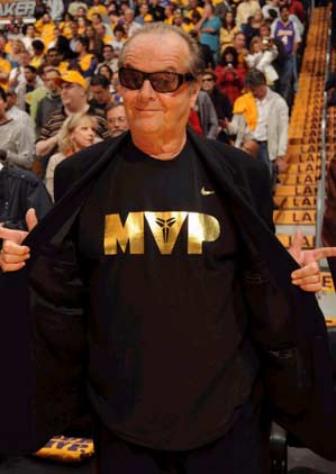
Jack: I know I'm not the first person to comment on this, and I'm sure I won't be the last, but...what happened to Jack Nicholson? Seeing him these days just makes me sad. It used to feel so cool to see Jack courtside at Lakers games, but now he just looks like a pervy old man who doesn't quite realize how old and pervy he looks.
Now, one could argue that he doesn't care, but this is the same guy who freaked out when Heath Ledger was cast to play the Joker in the new Batman movie. If Jack really thinks that he's fit to play the Joker again -- and he's pretty clearly not -- then there's little doubt he genuinely believes that he's as suave and sexy as he's ever been. But in reality, he has officially become That Guy. A rich, famous, and rather untouchable That Guy, but That Guy nonetheless.
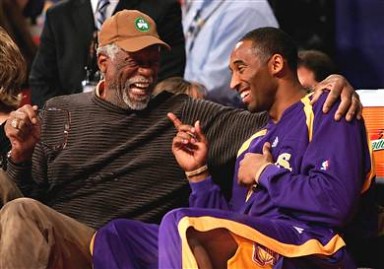
I posted this same picture on my NBA Closer column and got some pretty funny comments:
schtickless: Jack Nicholson is starting to look like Diane Keaton.
RachelRayIsTheDevil: He's starting to resemble Dyan Cannon too.
Weed Against Speed: It was quite the coincidence when Jack Nicholson showed up wearing his "More Viagra Please" t-shirt the same night Kobe was presented his MVP award.
UkraineNotWeak: I was thinking Medically Vitalized Penis.
Arriaga_II: After being in the Staples Center and the Departed, Jack's the man if you want a lifetime achievement award.
MattinglysSideburns: It's nice to see Skeletor was momentarily able to abandon his pursuit of Castle Greyskull in order to attend a basketball game.
Weed Against Speed: "Who sticks his index fingers and thumbs out like pistols, does whatever he wants whenever he wants, snorts assloads of coke and bangs women 1/3 his age? This guy!!"
Sh!tShow: "When asked to comment, Nicholson said, "Good times. Noodle salad."
UkraineNotWeak: "I am the fucken shore patrol."
(Note that last comment apparently refers to a t-shirt Penny Marshall was seen wearing at a Clippers game earlier this season.)
Chamomiles Davis: He eats breakfast 300 yards away from 14 Mexicans who are paid to do his landscaping.
Alonzo Mosely: Were the NBA, and David Stern, a little too fucking giddy in their showering of praise over an anal rapist? Fuck LA, fuck Bill Simmons, and fuck that guy who played a werewolf in some fucking lousy movie, you fucks.
Kobe's MVP: I've gotten several comments and e-mails from people who are disappointed that I didn't blow an O-Ring over Kobe's Lifetime Achievement Award. But what can I say? It didn't bother me nearly as much as it would have at any other time during his career. Mostly because -- other than for the first few weeks of the season and another handful of notable exceptions here and there -- he was playing basketball the way it's supposed to be played.
Of course, Kobe has almost always played at an amazingly high level...after his first couple seasons, anyway. He just hasn't been able to be both the selfless facilitator and scoring assassin at the same time consistently without subtly (and not-so-subtly) disparaging his teammates, coaches, GMs, owners, etc. He actually managed to do that for almost 80 percent of this season. I really didn't think he had it in him.
And for those of you who have been saying, "All Kobe needed was good teammates," I call shenanigans. He had those in spades during his first several years in L.A. and he was still a selfish, brooding superstar who seemed more concerned with being The Man than winning. Wait. That's not quite right. He was concerned with being The Man and winning, and he was willing to shake the Lakers franchise to its very foundations to make that happen.
Well, he did it. And now, years later, it finally paid off. He's The Man, and the MVP, and his team is a front-runner to win the championship. His team and the entire basketball world is finally revolving around Kobe Bean Bryant. That, apparently, was all it took to bring out the best in him.
My thoughts on it? KG should have won, hands down. And then, for my money, CP3 should have come in second. I still feel the Lakers basically got better around Kobe. They brought in Fisher, who's been more of a calming, veteran leader than Kobe. Then guys like Andrew Bynum, Jordan Farmar and Sasha Vujacic blossomed. By the numbers, they have the best bench in the league. And when Bynum went down, Kobe was handed an established All-Star in Pau Gasol. Note, too, that Odom was at his best this season only after the Gasol trade, so one could argue that Pau's presence made Lamar better, not Kobe. Oh, and there's also the little matter of L.A.'s Hall of Fame coach and that fantastic offensive system known as the Triangle.
Meanwhile, Chris Paul made David West an All-Star and he almost did the same thing with Tyson Chandler too. He revived basketball in New Orleans without a bench and transformed Byron Scott into the Coach of the Year. Kobe's been great, better tan he's ever been. But I'll always believe that Chris Paul was more valuable. This season, anyway.
But props to Kobe. He's transformed himself. And while I may not necessarily think he deserved it, I certainly think he earned it.
Mike D'Antoni: It looks like Mikey is in contention to become the head coach of the Chicago Bulls or possibly the New York Knicks. Trust me, his first choice is going to be the Bulls. If he gets offered both positions, he's taking the Chicago job. Say what you will about his run-and-fun offense in Phoenix, but it relied on both focus and discipline. Do you really think he's going to get those two things out of the guys on the Knicks' roster? Hardly. By contrast, the Bulls players showed a high degree of those characteristics until the milk went sour under Scott Skiles. I bet D'Antoni believes he can revive that.
Evil Ted recently asked me what I think about D'Antoni as Bulls coach, because we both live in Chicago and therefore follow the Bulls pretty closely. Honestly, I'm cool with it. Very cool with it, even. I think it'll breath life into a group of players who have become increasingly lifeless over the last season(ish). The Bulls have a bunch of young gunners who are probably dying for a little freedom and offensive creativity, which is exactly what they didn't get under Skiles and then Jim Boylan (who was too paralyzed by a desire to keep the head job to really shake things up).
Seven Seconds or Less will never be as successful in Chicago as it was in Phoenix because Kirk Hinrich is no Steve Nash. He's not even a homeless person's Steve Nash. But there are fresh legs and three-point shooters galore here. So while I doubt that bringing in D'Antoni will help the Bulls overtake the Cavaliers, Celtics, Magic or Pistons, well, it'll be a lot more fun watching them score 100+ points and lose than it has been watching them score 80+ points and lose.
Labels: Chicago Bulls, Jack Nicholson, Kobe Bryant, Mike D'Antoni, MVP
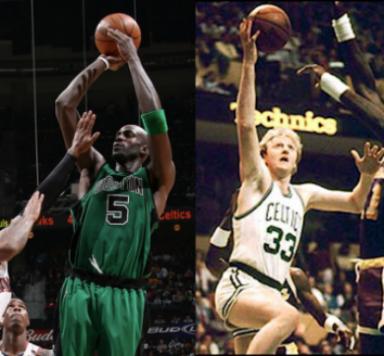
For the most part, I've been trying to stay out of the MVP debate. What's the point? I mean, it sure seems like the field has been effectively narrowed down to Chris Paul and Kobe Bryant, with the edge going to the player whose team finishes on top of the Western Conference dogpile. I could make a reasonably educated bargument for or against either player, but regardless of the outcome, I won't dispute the final results. After all, CP3 and Mamba are (more or less) equally deserving.
Of course, neither of them is really the league MVP.
NBA experts and fans who think otherwise are either delusional or kidding themselves. The Most Valuable Player -- with an emphasis on the word "Valuable" -- of the 2007-08 NBA regular season was, is, and will always be Kevin Garnett. And frankly, it shouldn't even be in question.
The Boston Celtics have won 65 games so far this season. They won 24 last year. For those who enjoy simple math, that's a 41-game turnaround. Think about that for a minute: 41 games. Go take a look at the current standings: 15 teams -- a full half of the league -- haven't won 41 games this season. If that doesn't boggle your mind, then you, my friend, are truly unboggleable.
But this is more than just a one-season renaissance. It has been the complete and total rebirth of the proudest franchise in league history. It's not like the Celtics have merely suffered a couple sub-par seasons -- like, say, the Lakers -- they've been bad for a while. In fact, the Celtics have suffered more than any other team in the past 20 years. No, seriously.
KG changed the culture of the franchise. He made them winners again. That's not to demean the contributions of Paul Pierce, Ray Allen, or the rest of the team (especially Rajon Rondo, who spent the preseason being compared to Matt Maloney). But seriously, look at the facts. Allen has been good (17.6 PPG, 3.7 RPG, 3.1 APG), but not great (44 percent shooting from the field, 39 percent from three). Likewise for Pierce. But forget the numbers. Look at the way they've been playing defense. Critics of the Ray Allen trade -- and I was one of them -- cited Ray-Ray's biggest defensive liability: Namely, that he didn't play any. Not so this season. And Pierce has been going balls-out on D, too. All the Celtics have. And this is an absolute certainty: That intensity begins and ends with Garnett.
Say what you will about his inability to score in the clutch or his history of playoff frustration in Minnesota. I don't care, because that's all in the past. His spirit, his drive, his electrifying presence have revitalized a franchise that's been dead for the better part of two decades. Why aren't people freaking out about this? Why is "the greatest single-season turnaround in NBA history" not enough?
Honestly? Probably because the Celtics were the exciting early-season story, and the Western Conference Playoff Race* has been the dominant late-season story. Hey, our society has an incurable case of Attention Deficit Disorder. But you know, this isn't the first time this has happened. It's not even the first time it's happened to a Celtic.
*Don't give me the "West is Best" argument, either. The Celtics were 25-5 against Western Conference teams this season, including season sweeps of the Lakers, Mavericks, Rockets and Spurs. And three of those losses -- to the Nuggets, Warriors, and Suns -- came right after KG returned from injury and the team was trying to readjust to his presence.
Let's go back to those golden days of 1980. Larry Bird had revived a Boston team that had won 29 games the previous season, and only 32 games the season before that. At the time, that was the worst two-year stretch the Celtics had suffered since the pre-Auerbach days. Worse, Celtic Pride has sunk to an all-time low, thanks to the malignant presence of locker room cancers like Bob McAdoo, Curtis Rowe, and Marvin Barnes.
Bird changed all that, and he did it largely by himself (with some help from new coach Bill Fitch). After all, this was basically the same team from the previous season (Robert Parish was still a Golden State Warrior, and Kevin McHale was a Minnesota Golden Gopher). Bird breathed new life into vets like Dave Cowens and Tiny Archibald, both of whom a lot of experts thought were finished. The Celtics won 61 games that season, the most in the league. That 32-game improvement was, at the time, the greatest turnaround in league history. Yet he finished fourth in MVP voting behind Kareem Abdul-Jabbar, Julius Erving and George Gervin.
It was and still is preposterous. The Lakers had won 60 games, but that was only a 13-game improvement from the previous season, and they had added Magic Johnson. And Kareem's numbers were only marginally better than Bird's: 24.8 PPG to 21.3, 10.8 RPG to 10.4, and they both averaged 4.5 APG. But the number that should have counted most went Larry's way: Franchises saved (1).
Dr. J's Sixers improved from 47 to 59 games, but they were an established team that had been to the NBA Finals in 1977. And anyway, they lost the Atlantic Division race to Bird's back-from-the-dead Celtics. Meanwhile, the Iceman led the league in scoring (33.1 PPG), but his Spurs won only 41 games...a seven-game dropoff from the previous season.
Bird was the most valuable player in 1980, just like Garnett is the most valuable player in 2008. Kobe might win the hardware, or maybe it'll be Chris Paul. And they've earned it. But not more than KG.
Sidenote: I probably should have mentioned this above, but as Wild Yams correctly points out, KG would probably be a shoe-in if he hadn't won the MVP in 2004. But there's a sense among the media and fans that he already "got his," where as the other candidates -- Kobe, Paul, and maybe even LeBron -- are still without hardware. Yams is right when he says, for good or ill, that plays a factor in the MVP voting.
Labels: Boston Celtics, Chris Paul, Dr. J, George Gervin, Kareem Abdul-Jabbar, Kevin Garnett, Kobe Bryant, Larry Bird, Los Angeles Lakers, MVP, New Orleans Hornets
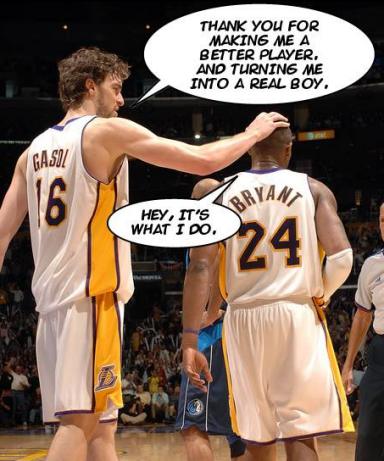
Are you tired of the same old boring, repetitive formula in these stupid "Worst of the Night" posts? We know we are. So we've kidnapped Basketbawful and locked him in a room where he's being forced -- Clockwork Orange-style -- to watch highlights of the greatest player to ever come into contact with a round ball covered in dead cow skin: Kobe Bean Bryant. So, for one day at least, you won't have to put up with the mindless hate and jealousy this guy pukes forth day after day after day after day. And you'll get some real basketball insight from somebody who actually watches NBA games instead of sitting around in his parent's basement defiling Kobe Bryant bobblehead dolls with his dark voodoo arts.
The Golden State Warriors: The Warriors are currently the eighth seed in the Western Conference. This means that, if the playoffs started in April, they'd have to play the number one seed...the Los Angeles Lakers! Do you think a leaderless team that gets their butts handed to them by the Charlotte Bobcats has a snowflake's chance in a pottery kiln against a team that's guided by one of history's greatest leaders? Here's the answer: No way, Jose! You know what else I hate about this team? They're named after that stupid movie Shaq's always quoting. Well, Shaq, now that you're a Phoenix Sun and they suck bunghole, CAN YOU DIG IT?!
Fun fact: Here's a short list of history's most distinguished leaders, from great to greatest: Pope John Paul II, Kobe Bryant (1996-97 through 1998-99), Franklin Roosevelt, Kobe Bryant (1999-00 through 2002-03), Ho Chi Minh, Kobe Bryant (2003-04 through 2006-07), Mohandas Gandhi, and Kobe Bryant (2007-08).
Marco Belinelli and C.J. Watson: These "Warriors" each played 42 seconds and didn't do a single thing except take up space and waste perfectly breathable oxygen that should have been saved for someone more deserving, like, say, DJ Mbenga or Coby Karl. Do you think that Kobe would ever be blanked, even if he played less than a minute? That would never happen! You'd better believe that Kobe would find a way to drop 30 in that 42 seconds. We're talking about a man who would rip out his own intestines with a fork to win, and anybody who could perform evisceration on himself with an eating utensil could do anything.
The Washington Wizards: They lost by 30 at home to the Orlando Magic. Man, they weren't even trying to win. You'd better believe Kobe wouldn't put up with that crap if he was on that team. If you suit up in the same locker room with Kobe, you'd better bring it or he'll get your ass traded, like Shaq and Andrew Bynum. Well, Bynum would have been traded if he hadn't followed Kobe's lead and gotten his act together. You'd better be taking your rehab seriously, Andrew Bynum! Kobe's watching you!
Fun fact: Hey, Gilbert Arenas, why does your team suck so bad? Oh, wait. You're not even playing. "Boo, hoo, I'm Gilbert Arenas and I had knee surgery. Wah!" While you're sitting at home playing World of Warcraft and blogging about Jose Calderon, Kobe's playing through a very painful and emotionally traumatic pinkie injury! And he's not just chucking up shots like some would-be superstars, he's playing like an MVP and making everybody around him better, even worthless losers like Pau Gasol. Remember last year when you dropped 60 on the Lakers in L.A. and some stupid people started saying you were as good as Kobe? Ha! That was a long time ago, wasn't it Agent Zero?!
The Miami Heat: Hey, Pat Riley, ever hear of the term "karma"? Since I'm sure you're busy applying hair gel and celebrating the past when you were actually relevant, I'll tell you: Karma is the bad stuff that happens to people who do bad things. Well, your team fell to 11-47 after getting a little "don't drop the soap" treatment from the Toronto Dinosaurs. Sorry, but that's what happens when you cheat your way to an NBA title by paying off the refs. How does that karma feel up against your prostate, Riles? And Dwyane Wade, you were never as good as Kobe -- even before the injury -- and you never will be! As for you, Shawn Marion, how does it feel to finally get a chance to be The Man on a crappy team? What's that? You scored 5 points on 2-for-7 shooting? Marion, you are a quitter and a coward! You just didn't want to be on the Suns come playoff time when the Lakers give them the beatdown they deserve!
LeBron James: You make me sick, LeBron! Ever since you came into the league, you've been trying to steal Kobe's thunder. Kobe scored 52 on Sunday and then got the Arco Arena crowd to chant "M-V-P!" for him on Tuesday, and you just couldn't stand it, could you? Of course you couldn't, you narcissistic bastard. So you went out and scored 50 points -- to go along with 8 rebounds and 10 assists -- against a lousy team and got their depressed and disenchanated crowd to chant "M-V-P!" for you. Wow. Really impressive. Did you beat up a kindergartener for his lunch money before the game, too? But you didn't stop there, did you? You planted a "fan" in the crowd, wearing your jersey no less, and paid him to run down onto the court to praise your name. When did the NBA become the WWE? You'd better not win the MVP this season, LeBron James! You don't deserve it and you know it!
Fun fact: MVP voters hate Kobe Bryant. That's a proven, scientific fact. Exhibit A: Steve Nash - Two-time MVP award winner. Exhibit B: I don't need to present any more evidence! Nash won two MVPs because people think Kobe's a bad person. That's a travesty. Stop hating Kobe, MVP voters!
The New York Knicks: Make no mistake: They Knicks were in on it, too. Kind of like how the Clippers let David Robinson score 70 points or whatever to steal the scoring title away from Shaq back in 1994 (although, to be fair, "The Big Loser" probably had it coming). Everybody knows the Knicks hate Kobe Bryant! What did Kobe ever do to them? He loves New York, loves playing in Madison Square Garden. This kind of base betrayal makes me sick to my stomach. It's like Delilah cutting Samson's hair, or The Coca Cola Company forcing New Coke on us and then giving us "Classic" Coke which had a totally different formula. Screw you, New York Knicks!
Detroit versus Boston: I don't get why everybody was talking about this game yesterday. Sure, the Celtics won and therefore became the first team to clinch a playoff spot, but they're in the Eastern Conference for pity's sake! That's like clinching a playoff spot in the Wheaton Parks and Recreation Department Over 50 Pickup League. And sure, Boston swept the season series against the Lakers, but those games were played before Kobe was making Pau Gasol a better player. So enjoy your hollow victory, Bostonites. Winning the season series 2-1 and taking a 5-game lead over the Pistons only ensures that you'll get the honor of being the Lakers' hors d'oeuvres in the NBA Finals. And just so you know, Kobe loves cocktail weenies and Nutella, so be prepared!
Chris Paul: Nice game, Chris: 23 points and 18 assists. Now you're only 17,447 career points and 2,073 career assists away from Kobe's record-setting pace. How does the dust off of Kobe's shoes taste, Mr. Paul? Don't bother answering, because I'm gonna tell you: Like MVP, baby. You're officially out of the conversation.
The Houston Rockets: Ooooo, a 16-game winning streak! The Rockets are so scary...NOT! Hey, I'm sorry for not being impressed when somebody beats the Pacers, but Kobe beat them single-handedly in Game 4 of the 2000 NBA Finals after Shaq had fouled out. And that's when the Pacers were good! Houston, all you did was go in and slurp up Kobe's sloppy seconds. I hope you're proud of yourselves, because I'm sure not.
Fun fact: Tracy McGrady isn't a poor man's Kobe Bryant. He's not even a homeless man's Kobe Bryant. Have you seen this guy topless? I've seen manlier chests on grade school lunch ladies. Not to mention more facial hair. T-Mac's going to have to grow a pair before he's allowed in the same alphabet as K-O-B-E.
Kareem Rush: Only 4 points on 2-for-5 shooting and a +/- score of -20. Didn't you learn anything in your three seasons under the tutelage of Kobe Bryant? You should be ashamed to call yourself a former Laker, sir.
The Phoenix Suns: Ha ha, Phoenix! How's that Shaq trade working out for you? I hate these guys. All they do is bitch and moan about how the NBA title was "stolen" from them last year because "MVP" Steve Nash couldn't control his teammates. Do you think Ronny Turiaf or Vladimir Radmanovic would have gotten up off the bench if the Lakers had been playing the Spurs? Uh, no, no, and hell no! Kobe knows how to keep his teammates in line. Hey, Steve Nash! Kobe is a gracious man. I'm sure he would allow you to debase yourself in his presence and turn over the two MVP awards you stole from him. And Shaq, you can come along and surrender your Finals MVP awards.
Fun fact: Here's some fun with math for you. Kobe + Shaq = Three NBA Titles. Steve Nash + Shaq = Three Wins and Four Losses...and counting! Now you tell me who the real MVP is.
Andre Kirilenko: I don't care if Dirk Nowitzki clothelined you to the ground and injured your right hip. What are you, 70 years old? Winners never quit, and quitters never win, Andre. Remember that. You don't see Kobe taking time off to rest his ravaged pinkie finger, do you? Of course not! Kobe's a "team first" guy. Unlike you.
The Sacramento Kings: Payback's a bitch, huh Sacramento Queens? Lakers fans have had to spend the last six years hearing about how you got ripped off in Game 6 of the 2002 Western Conference Finals. Even Ralph Nader jumped on the Hate Train. I swear, it's enough to make me question whether a God exists who could create such a colossal group of whiners and crybabies. Kobe earned those 27 fourth quarter freethrows, and you need to just get over it. Your 15 minutes of fame were over about, oh, six years ago. Let it go. Move on. Take up a hobby. I mean, your fans are chanting "M-V-P!" for Kobe and you can't even beat the Clippers. Maybe you should take on somebody more your speed, like old, sick people.
Our apologies: We didn't nab Basketbawful in time to prevent him from submitting his NBA Closer column for Deadspin. So if you're an "Internets" hacker, please let us know how we can shut that down. Thank you.
Labels: Gilbert Arenas, Golden State Warriors, Kobe Bryant, Kobe fans, Lebron James, Miami Heat, MVP, New York Knicks, Phoenix Suns, Steve Nash, Washington Wizards

Let the crucifixion of Dirk Nowitzki officially begin.
You know the story: The Dallas Mavericks won 67 games this season -- which tied for the sixth best win total in NBA history -- but still got eliminated in the first round by the Golden State Warriors, a team that won only 42 games and qualified for the playoffs on the last day of the regular season. And the Mavs weren't just eliminated, mind you. They personally established several new "greatest playoff upset" records that will be talked about and rehashed for years to come. That's humiliation on a grand and historic scale.
Mr. "MVP-to-be" Nowitzki averaged 19 points and 11 rebounds in the series, but he shot 38 percent from the field and 21 percent from three-point range -- 12 and 20 percent dropoffs from his regular season totals. The final game of the series was also his worst: 8 points on 2-for-13 shooting, 0-for-6 from beyond the arc, 10 rebounds, 2 assists, 3 turnovers. But the numbers don't really tell the whole story. Dirk was a non-factor througout the series, and most of the time you could hardly even tell he was on the court. He played a total of 239 minutes, but he looked like an MVP for only three of them. That 3-minute tour de force staved of elimination and produced a couple days worth of "Dirk earned his MVP" stories, but in the end it only delayed the inevitable.
Make no mistake, though. This was a team loss. Only Josh Howard picked up his game (21 PPG, 10 RPG, 51 percent shooting) in the playoffs. The rest of the Mavericks sunk like a turd in the toilet, both offensively and defensively. The Mavericks had more talent, more depth, and more playoff experience than the Warriors. They also had that "we should've been the champs last year" swagger that underscored their desire to win the championship this year. Then simply got outplayed.
Last summer, after disappearing in the NBA Finals, Dirk took some shrapnel, but he's definitely going to fall on the grenade for this one. In some ways, it's unfair. After all, he didn't establish the de facto rule that the MVP has to be the best player from one of the best teams in the league. And it's not his fault that the media seemed to decide, en masse, that Steve Nash simply couldn't be allowed to win a third straight MVP. If he is indeed named MVP, as everyone suspects, it will be by default. He didn't ask for the award, or the weight of expectations that go with it.
That's how it work, though, and this will forever be remembered as the series that in which the MVP didn't come through.
But I don't blame Dirk. Not completely, anyway. Yes, I do think he should have done more to expand his game this season, particularly by taking advantage of his size and playing closer to the basket. Everybody likes to compare Nowitzki to Larry Bird, who also had a dynamite outside shot but was terribly slow afoot. In 1984, the Lakers employed the same tactic against Bird that the Warriors used against Nowitzki: using a smaller, quicker defender to either deny him the ball or keep a hand in his face at all times. Bird's adjustment was the obvious one: take his defender, Michael Cooper, down low and beat the crap out of him. It worked.
Why didn't Dirk do the same thing? I guess it's just not his game. But that's when the coaching staff and his teammates need to step in and say, "Uh, Dirk, you're half a foot taller than the guy guarding you. Maybe you should get into the post." That's not rocket science, people. It's Basketball 101. How could they miss that?
I think the Mavericks got complacent. They made the NBA Finals last year and they rampaged through the regular season this year. But they did it with a lot of outside shooting and one-on-one play. Over the past three seasons, they've won 58, 60, and 67 games while being one of the worst passing teams in the league. Didn't anyone realize how much the Mavericks relied on Dirk shooting over people? And on Jason Terry and Josh Howard taking their man off the dribble?
And it didn't help that the team wasn't mentally prepared. They coasted through the last couple weeks, and the starters barely played in the last three or four games of the regular season. Meanwhile the Warriors were fighting for their playoff lives, winning nine of their last ten and 16 of 21 overall. They were psyched, their fans were psyched, and the Mavericks were just twiddling their thumbs waiting for the coronation.
It's happened before. The 1999-2000 Lakers also won 67 games but got pushed to the limit in the first round by the Sacramento Kings. But nobody remembers that because they managed to win the series and, a few weeks later, the title. But that's history for you. It's incredibly kind to the winners, and exceptionally cruel to the losers.
Labels: Dallas Mavericks, Dirk Nowitzki, Golden State Warriors, MVP, NBA playoffs
Over the past few months, I've read dozens of articles proclaiming who the NBA MVP should be, which is kind of ridiculous considering that the season isn't even over yet. Right now, most "experts" are leaning toward Dirk Nowitzki and Steve Nash, but other potentials include Kobe Bryant, Dwyane Wade, Lebron James, and even Gilbert Arenas. I wouldn't be surprised if guys like Tracy McGrady and Tim Duncan got a little buzz before it's all said and done.
Since the MVP is a highly arbitrary award -- what does "most valuable" really mean, anyway? -- there's always a lot of whining and crying from 1) the fans of the players who don't win it, and 2) the anti-fans who, for whatever reason, love to hate the player who did win it. The NBA has never adequately defined the specifics of most valuability, and so the MVP is determined by a voting process that includes both 125 members of the local and national media (radio and television announcers, newspaper reporters, and hopefully Borat).
The final result seems to piss almost everybody off. Take last year, for instance. When Steve Nash was named MVP, a river of silicone-laced tears flooded out of the greater Los Angeles area. Many people defiantly believed that Kobe Bryant deserved the MVP, and others just thought Steve Nash didn't deserve it...especially since he'd won it the year before (when a lot of people thought Shaq should have gotten it). And so the debate rages anew: what is truly valuable? Is the the ability to score 81 points in a game, or the capacity to score 20 points and dish 20 assists? Should the MVP be a scorer or a facilitator? And how does winning factor into it?
Well Sherman, let's hop into the WABAC Machine and look at the actual history of the MVP award. The NBA has handed out 51 trophies to 25 different recipients. Of those 51 awards, the MVP went to a player on one of the top two or three teams in the league (based on won-loss record) 46 times. The five notable exceptions include:
1. Bob Petit in 1956: This was the inaugural year of the NBA MVP award. Bob's team was 33-39, which was "good" for third place in their division and seventh place in the league. Did I mention there were only eight teams in the NBA at that time? Yeah. This was clearly a case of the "best player" (statistically speaking) winning the award: Petit averaged 25.7 PPG and 16.2 RPG that season).
2. Kareem Abdul-Jabbar in 1976: This was Kareem's first year in Los Angeles, and, with Magic Johnson still in high school, the Lakers went 40-42. The team finished fourth in their division and didn't even qualify for the playoffs. But Kareem's impressive stat line -- 27.7 PPG, 16.9 RPG, 5.0 APG -- swayed the voters.
3. Moses Malone in 1979: Malone's Houston Rockets compiled a 47-35 record, which gave them a second-place finish in their division and seventh in the league. They had homecourt advantage in a first round playoff mini-series, but they were swept 2-0 by the Atlanta Hawks.
4. Moses Malone in 1982: The Rockets finished with a record of 46-36, third-best in their division and ninth overall. They made it into the playoffs, but they were promptly dispatched by the Seattle Supersonics in a first round miniseries.
5. Michael Jordan in 1988: I refer to this one as Michael's "pity MVP." The Bulls notched a respectable 50-32 record, but they were still third in their division and eighth in the league. The award probably should have gone to either Larry Bird or Magic Johnson, but the media was starting to get a little tired of heaping praise and awards on those guys. Plus, the press wanted to reward Michael for his statistical brilliance since the consensus opinion at that time was that he would probably never win a championship. Seriously.
And that's it. Five out of 51 times the MVP went to the best statistical player. The rest of the time, the award was given to the best player on one of the best two or three teams in the league. So, in the absence of any specific qualifiers, there is -- at the very least -- an historical precedent. And based on that, we can eliminate most of the supposed MVP candidates:
The Not MVPs
Gilbert Arenas: I love this guy. He represents everything I love about professional basketball: he genuinely enjoys his job, goes out of his way to give back to the fans, and he puts up great numbers. But...his team's slightly above average record (30-21), his recent spat with coach Eddie Jordan, and his wagging tongue (guaranteeing a 50-point game against the Blazers then only scoring 9 in a blowout loss) have doomed Agent Zero's MVP bid.
Chauncy Billups: He's the heart and soul of the best team in the Eastern Conference. But if you noticed the words "Eastern Conference" at the end of that last sentence, you already know why he doesn't have a doughnut's chance at a cop convention of being the MVP.
Kobe Bryant: He was a legitimate candidate back in December, when the Lakers played 15 of their first 20 games at home. But after starting out 15-6, the Fakers have gone 15-19. They've lost six straight overall and five straight at home, and three of those home losses were agaisnt sub-.500 teams. You can blame injuries and long road trips all you want, but the bottom line is this: his team isn't winning enough to justify including him in the MVP discussion.
Tim Duncan: The Spurs currently have the third best record in the league, so Tim has a legitimate shot at the MVP. But the Spurs have been on cruise control for most of the season, and everybody knows it. That'll count against him when the votes are cast. "Hunger" is one of those intangibles that means something to the media. Not that Duncan cares; he's already won back-to-back MVP awards. He's more concerned about being ready for the playoffs.
Lebron James: The King just hasn't been himself this season. The numbers are there, but neither he nor the team has really improved from last season. In fact, they've gotten worse. And James, for his part, has become more of a scorer than a facilitator, and his teammates are suffering for it. He just doesn't have "it" this year.
Tracy McGrady: The Rockets have very quietly compiled the league's fifth best record, and it's all because of McGrady. Ever since Yao Ming went down with a broken leg, T-Mac has raised his game and done a good job of transforming a pretty below-average group of guys into a cohesive, winning team. The problem is, there's very little chance of the Rockets actually claiming one of the top three spots, their slow-down/grind-it-out style is painful to watch, and McGrady hasn't really taken over the league at any point. I can't see him pulling off the upset.
Dwyane Wade: The Heat are 26-27 right now (and they'll probably be 26-28 after playing Dallas tonight). Sure, he's held the team together in the absence of Shaq and coach Pat Riley, but his team still has a losing record, and now it looks like he'll miss six weeks of action due to a dislocated shoulder. No amount of freethrow attempts will make him the MVP this season.
Bottom Line
It's a two-man race between Dirk Nowitzki and Steve Nash right now. Dirk has the advantage because 1) his team has the best record in the league, and 2) Nash has already won the last two MVPs and the press will probably want to give it to someone new. Unless Dirk gets injured and/or the Mavericks go on a disastrous losing streak, der Mann aus Deutschland will be the NBA's next MVP.
Labels: Dirk Nowitzki, Gilbert Arenas, Kobe Bryant, Lebron James, MVP, Steve Nash
February 2005
October 2005
November 2005
December 2005
January 2006
February 2006
March 2006
April 2006
May 2006
June 2006
July 2006
August 2006
September 2006
October 2006
November 2006
December 2006
January 2007
February 2007
March 2007
April 2007
May 2007
June 2007
July 2007
August 2007
September 2007
October 2007
November 2007
December 2007
January 2008
February 2008
March 2008
April 2008
May 2008
June 2008
July 2008
August 2008
September 2008
October 2008
November 2008
December 2008
January 2009
February 2009
March 2009
April 2009
May 2009
June 2009
July 2009
August 2009
September 2009
October 2009
November 2009
December 2009
January 2010
February 2010
March 2010
April 2010
May 2010
June 2010
July 2010
August 2010
September 2010
October 2010
November 2010
December 2010
January 2011
February 2011
March 2011
April 2011
May 2011
June 2011
July 2011
August 2011
September 2011
October 2011
November 2011
December 2011
January 2012
February 2012
March 2012
April 2012
May 2012
June 2012
July 2012
August 2012
September 2012
October 2012
November 2012
December 2012
January 2013
February 2013
March 2013
April 2013
May 2013
June 2013
July 2013
August 2013
September 2013
October 2013
November 2013
December 2013
April 2014
May 2014
June 2014
July 2014
August 2014
June 2018
July 2022