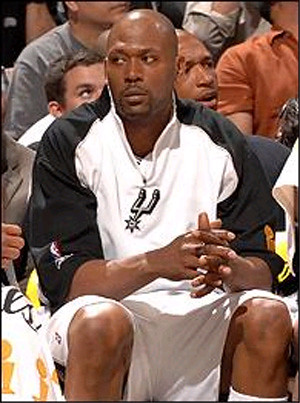
Many of you either know or have guessed that I attended Purdue University. As it so happened, my freshman year coincided with Glenn Robinson's final season as a Boilermaker.
I have to tell you: Robinson was a college basketball beast. As his NBA.com bio points out, he was nicknamed "Big Dog" for his oncourt ferocity. During that 1993-94 season, Robinson was...
...named the 1994 National Player of the Year by Associated Press/Rupp, United Press International, the Sporting News, Basketball America, Basketball Times, Basketball Weekly, CBS-TV/Chevrolet, ESPN and ABC analyst Dick Vitale, NABC/Kodak, Naismith and the RCA/U.S. Basketball Writers Association...recipient of the John R. Wooden Award as the nation's top college basketball player...led the NCAA and the Big Ten in scoring and rebounding averages of 30.3 ppg and 10.1 rpg respectively...also the unanimous Big Ten Player of the Year by coaches and media, in addition to being selected the conference's Male Athlete of the Year...first player to lead the Big Ten in scoring and rebounding in the same season since Minnesota's Mychal Thompson accomplished the feat in 1977-78...his 1,030 overall points that year and 560 conference points were single-season scoring records...the total of 1,030 points ranked 13th best for a single-season in NCAA Division I history...became the 15th Division I player all-time to score 1,000 in a season...finished his career at Purdue with the fourth-highest scoring average ever at 27.5 ppg...led the Boilermakers in scoring in 56 of his 62 contests and recorded 31 career double-doubles (pts/rebs)...his 44 points against Kansas (3/24/94) was a school record for an NCAA Tournament game.But it wasn't just the numbers. Robinson's performances were overwhelming. Drives. Dunks. All manner of crazy shots that routinely went in. And, most importantly, victories.
And yet...there were warning signs I didn't pick up on back then. Minor ones. Like despite the fact that he was so physically dominant, he loved taking jump shots, jacking up more than six three-pointers a game. Sure, he hit almost 40 percent of his treys, but he was always a little too ready to chuck 'em up...which is why he shot less than 50 percent overall against competition he quite simply owned. Furthermore, he averaged only 1.9 assists, meaning he was too busy creating offense for himself to do it for his teammates. And he averaged more than four turnovers per game.
Still, like I said, he was a beast. His coach and comb-over master, Gene Keady, said that Robinson was "an absolute warrior on the court, especially the practice court. If all my players practiced with the same intensity and listened to his coaches as he does, my job would be much easier."
Sounds positively Kevin Garnett-esque, right? And Keady was a straight-shooting hardass of a coach, so I had no reason to suspect that Robinson didn't have that desire and killer instinct that separate the Michael Jordans from the Harold Minors. When he decided to turn pro rather than play out his senior season at Purdue, I was absolutely convinced that Big Dog was going to become the NBA's next major force.
The Milwaukee Bucks had the first overall pick in the 1994 NBA Draft, and Robinson was the obvious number one pick, even in a draft that featured Grant Hill, Jason Kidd and Eric Montross (good call on that one, Celtics). And so Robinson became the first Boilermaker to be chosen number one overall since Joe Barry Carroll (also known as "Joe Barely Cares") in 1980. That fact was pretty ominous...and it was a sign of things to come.
See, Robinson submitted some pretty serious demands. Specifically: a 13-year, $100 million contract, to which the Bucks responded by spitting out their champagne and stuttering "Wha...what the fuuuuuuuuu...."
The Bucks wanted Robinson. Desperately. But not desperately enough to commit to that kind of deal. So Robinson held out until the beginning of training camp, when he and the Bucks finally agreed on a 10-year, $68 million contract that set an all-time record as the richest rookie contract ever. That record still stands, mostly because Robinson's deal freaked people out so much that the league instituted a salary cap for rookies the very next season.
Generally speaking, you'd prefer for a player to force a rule change through his, you know, play.
Big Dog had a pretty good rookie season: 21.9 PPG (10th in the league and number one among rookies), 6.4 RPG (second among rookies), 2.5 APG, 1.4 SPG (second among rookies), and 45.1 percent shooting. He even cut down on his three-point attempts (only 3.4 per game), although his accuracy dropped to 32.1 percent. He was also sixth in Usage Percentage. Unfortunately, he also led the league in total turnovers (313).
Even more unfortunately, the Bucks weren't winning. So even though he earned two Rookie of the Month awards (in December and April) and made the All-Rookie First Team, he finished third in balloting for Rookie of the Year, behind co-winners Hill (19.9 PPG, 6.4 RPG, 5.0 APG, 1.8 SPG) and Kidd (11.7 PPG, 7.7 APG, 5.4 RPG, 1.9 SPG), who supposedly had better all-around seasons.
Of course, the voting was skewed by a few factors. In Kidd's favor was the fact that his Mavericks improved from 13 wins in 1993-94 to 36 wins in 1994-95 (Robinson's Bucks only improved from 20 wins to 34 wins). Hill's Pistons improved by only eight wins (20 to 28), but Grant's apparently selflessness was considered a stark contract from the me-first Robinson, who held a proverbial gun to his team's head and held out for an historic contract.
Still, considering the slow-it-down and grind-it-out era in which he was playing, the numbers from Robinson's rookie season seemed to mark him as a superstar in the making. What nobody could have known at the time was that Robinson had already more or less hit his peak as a player. He would average a few more points (23.4 in 1997-98) and rebound a little more (setting a career high with 6.9 RPG in 20001-01), shoot somewhat better from the field (47.2 percent in 1999-00) and downtown (39.2 percent in 1998-99), but his career averages (20.7 PPG, 6.1 RPG, 2.7 APG, 45.9 percent shooting from the field and 34 percent from downtown) were pretty indicative of what he gave the Bucks year-in, year-out.
And hey, those are solid numbers. Guys have made All-Star teams with worse stats than that, and, in fact, Robinson made a couple of those (in 2000 and 2001). But honestly, those results were pretty disappointing for somebody whom people expected to become a Jordan-like player.
So what happened with Glenn? My first roommate out of college, who was also a Purdue alum, liked to say, "Glenn got $100 million coming out of college and spent it all on Twinkies." Robinson wasn't fat, exactly, but he did look a little soft. He played like it too. I mean, here was a physical specimen who averaged only 4.4 free throw attempts per game over his career. As his career progressed, he took jump shots more and more and attacked the basket less and less. Robinson became the master of the midrange jumper...kind of like Luol Deng before Luol Deng was Luol Deng.
His defense was soft too, which helps explain why his career Defensive Rating (107 points given up per 100 possessions) was higher than his Offensive Rating (102 points scored per 100 possessions).
Eventually, the Bucks got better, although it had as much to do with the additions of Ray Allen and Sam Cassell as it did with Robinson. That trio was good enough to almost make the NBA Finals in 2001, but they were upended by the Philadelphia 76ers (not to mention some very questionable officiating) in the Eastern Conference Finals. Robinson lasted only one more season in Milwaukee before being traded to the Atlanta Hawks for Toni Kukoc, Leon Smith and a 2003 first round draft pick that would become T.J. Ford.
In Atlanta, Robinson was who we thought he was -- 20.8 PPG and 6.6 RPG, just like clockwork. But even though he led the team in scoring, ranked second in assists and steals, and came in third in rebounding, that wasn't good enough for the 2002-03 Hawks (these days, that kind of output would have earned him a six-year, $119 million contract). So Atlanta included in in a four-team trade: Robinson and a 2006 second round pick that became Boobie Gibson were sent to the Sixers; the Minnesota Timberwolves sent Terrell Brandon to the Hawks; the New York Knicks traded Latrell Spreewell to the Timberwolves; the Sixers shipped a 2007 first round pick to the Hawks while sending Randy Holcomb, Keith Van Horn and a bag of cash to the Knicks.
In theory, Philly had finally found the long sought-after second option for Allen Iverson. Only Big Dog had never been paired with a ball hog like The Answer. Not surprisingly, his stats took a big hit (16.6 PPG, 4.5 RPG, 44 percent shooting). To make matters worse, he missed 40 games that season (including the last 20): three because of suspension and 37 due to injury (first a left ankle sprain and then right elbow surgery).
The following season, Robinson didn't play a single game for the Sixers. Supposedly, this was due to injury, but the scuttlebutt was that Philly coach Jim O'Brien refused to play him (which was true) and that Robinson up and left the team (which was also true, but that was actually due to the fact that his mother was diagnosed with lung cancer and, sadly, passed away during the season). And so on February 24, 2005, he was traded to the New Orleans Hornets for Jamal Mashburn and Rodney Rogers. Then, on March 1, the Hornets waived him. A little over a month after that, he was signed by the San Antonio Spurs.
You might be tempted to say, "Huh, wha...?!" But the move made sense, in an "Oh, shit, we are in panic mode" kind of way. See, at the time, Tim Duncan and Devin Brown (who had become an important offensive component for that team) were hurt, and the Spurs -- who after much begging were finally turned down by Karl Malone -- were literally praying for offense. As Gregg Popovich said after the signing: "He's a heck of a shooter, and we have some nights where we have trouble getting it into the hole."
Like most of the rest of the world, the Spurs were dubious about whether Big Dog could adjust to, you know, passing the rock and playing D. Said Popovich:
"I had him set up pretty good, I think. [The Spurs' players] were expecting a black hole. You know, somebody [who] as soon as he caught the ball, it was gone; never see it again. I said, 'I want you guys to make sure that you give him an opportunity to learn defense and all of that; but trust me, all he's going to do is shoot it every time he touches it. You're going to have to be very patient (with him).' We had him set up that way. He's smart. He came in and it might have taken him, you know, five minutes before he shot (the ball). He took a whole five minutes! In that five minutes, they saw him try to play D, so they accepted it."Said Robinson: "This is one of the best teams in the NBA. All I have to do is to come in and help out. ... This is a new beginning."
Well...sort of. In his nine regular season games as a Spur, Robinson averaged 10.0 PPG and 2.7 RPG in 17.4 MPG. Which was about right: His Per 36 stats were 20.6 PPG and 5.5 RPG...pretty much right on target with his career Per 36 minute numbers of 20.2 PPG and 5.9 RPG.
And about that defense? Pop wasn't worried about it: "The good thing is, he's intelligent and he understands the game. He'll pick up the team-defense concept, so he won't have to be the best individual defender."
It was kind of true: In that (admittedly small) nine-game sample, Robinson had an Offensive Rating of 106 and a Defensive Rating of 100. It was the one and only time in his career that Glenn scored more points per 100 possessions than he gave up. He even squeezed out one last Big Dog game: 23 points (on 9-for-11 shooting) in 22 minutes against the Grizzlies on April 18. It was the last 20-point game he ever had.
Then came the playoffs.
During San Antonio's road to the title, Robinson appeared in 13 games, playing 8.7 MPG and averaging 3.8 PPG, 1.6 RPG and 0.1 APG while shooting 35.6 percent from the field (16-for-45) and 30 percent from downtown (3-for-10). His Effective Field Goal Percentage was 38.9, his PER was 11.7, and he scored 97 points per 100 possessions while giving up 101. He managed a Win Share of 0.2.
During the NBA Finals against Detroit, Glenn appeared in only three of the seven games. The first three. In Game 1, he actually provided a small spark off the bench: 6 minutes, 2 points, 3 rebounds and 3 blocked shots. Those would be his only positive contributions of the series. Robinson was a non-factor in Game 2, mostly because he didn't check in until there were about three minutes left and the Spurs were up by 22 points (he went 0-for-1 from the field and committed a turnover). Afterward, Robinson said:
"Man, I'm happy. All I have to do is just be available. Just like in Game 1. If I'm needed, just give them a little spark. And leave the rest up to the guys.That "next season" never came. After a token appearence in Game 3 -- 5 minutes, 0-for-2 from the field, 0-for-1 from beyond the arc, all zeroes across the box score -- Robinson never again logged a single minute for the Spurs. I mean, he celebrated like a mother fucker when San Antonio won the title in Game 7, but the Spurs didn't ask him back. No other team signed him. And Big Dog quietly faded into retirement.
"I'm going to get a chance in one of these games. People know what I can do. People understand the things that I've been going through, and I'm still moving. That's why the minutes don't bother me. I'm gearing up for next season."
That was way back in 2005. Meanwhile, Hill and Kidd -- who beat Robinson out for Rookie of the Year way back in 1995 -- are still in the league. Last season, they both made significant contributions to 50-win teams. Hill even played in the Western Conference Finals.
It wasn't supposed to be this way. Robinson was supposed to be The Man. I can't tell you exactly why it didn't happen. I mean, I can point out the flaws in his game. I can suggest that there might have been a lack of killer instinct. Too many mid-range jumpers, not enough all-out attacks on the basket. Too much money too soon. Maybe even too many Twinkies. I guess we'll never know for sure.
What I do know is that, as a Glenn Robinson fan and a former Boilermaker, watching him dance around like a maniac during the Spurs' championship celebration made me feel kind of ashamed. Because, honestly, in my foolish youth, I believed Robinson would be winning multiple titles as the leader of his team. I thought he could be a Larry, Magic or Michael-level player.
Maybe I'm projecting. Maybe I should be more disappointed in myself than I am in Glenn. Maybe I'm just embarrassed because my basketball acumen failed me when I was evaluating him. But I'm not the only person who got hoodwinked. There are an awful lot of people who feel -- despite the 20+ PPG average over his 11 seasons -- that Glenn Robinson failed to live up to his potential.
But -- unlike Hill and Kidd -- he has a ring.
Update! Bonus video: This is must-see Basketbawful TV: Robinson putting Basketbawful mascot Greg Ostertag in his poster.
And again:
Labels: Glenn Robinson, Worst NBA Champions
championship piggyback (cham'-pe-uhn-ship pig'-e-bak) noun. The situation in which one or more players -- usually roleplayers and/or aging veterans -- sign on with or get traded to a "sure bet" championship contender, often for a reduced salary, in the hopes of winning that elusive NBA title before retirement.
Usage example: Almost half of the Celtics' current roster are playing championship piggyback.
Word Trivia: By my count, the Boston Celtics are the current league leaders in championship piggybackers: Eddie House (who was practically out of the league), James Posey (who left the Heat), P.J. Brown (who left his couch), Sam Cassell (who forced the Clippers into a buyout), and Scot Pollard (is he even still playing?) all jumped onto the Celtic Championship Express. (I'm both thankful and kind of disappointed that Reggie Miller didn't do it.) The Spurs, always a highly desireable location for the CPs (who can forget Glenn Robinson celebrating the hell out of the 2005 NBA title?), has two standing examples (Brent Barry and Michael Finley) and two new additions (Damon Stoudemire and Kurt Thomas).
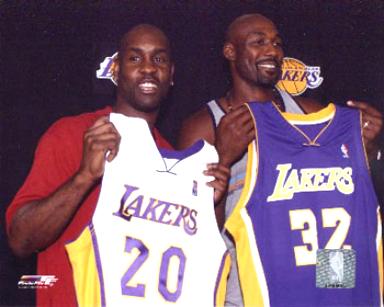
Of course, the most classic contemporary example of championship piggybacking was when Gary Payton and Karl Malone took huge paycuts -- GP accepted the mid-level exception and The Mailman took the veteran's minimum -- to sign with the Lakers back in 2003-04. Of course, we all know how that turned out. The irony is that Malone obviously wanted a "sure thing" but turned down an offer from the Spurs, who were the reigning champs, because he wanted to be the X Factor that pushed L.A. back over the top. Unfortunately for Malone, L.A.'s medical staff misdiagnosed his knee injury, telling him that a torn medial collateral ligament was nothing more than a sprain, which caused further injury and transformed the former NBA ironman into a shuffling, slow-footed shell of his former self. If you ever wonder why the Pistons mandhandled the Lakers in the 2004 NBA Finals, that's a big reason why.
The second most famous recent example has to be the 2005-06 Miami Heat, a team chock-full of late 90s and early 2000s All-Stars like Alonzo Mourning, Antoine Walker, Gary Payton, and Jason Williams. Yes, that abomination won the NBA title and despoiled 2000 years of human history with the words "Antoine Walker, World Champion," but this year's 13-win squad is living, breathing, sucking proof that karma is indeed a real thing. It also shows what can happen when a team mortgages its future for The Now.
The Chicago Bulls were a favored CP destination back in the 1990s, with guys like Dennis Rodman, Joe Klein, Luc Longley, Ron Harper, Steve Kerr, and even Robert Parish -- okay, that one hurt me physically -- signing on to play caddy for Michael Jordan. The Celtics and Lakers of the 80s got their fair share of piggybacking: Boston picked up guys like Bill Walton, Jerry Sichting, and Scott Wedman, and L.A. rented the services of Bob McAdoo, Mychal Thompson, and Orlando Woolridge, among others.
Oh, and let's not forget that Clyde Drexler did it with the Houston Rockets in 1994-95 -- and got a ring for his troubles -- which led both Charles Barkley and Scottie Pippen to jump on the Houston rocketship in 1997-98 and 1998-99 respectively. Too bad The Dream, Sir Charles and Pip were old and used up by then. Sorry. I mean "past their prime."
Upate: Reader Jaiwanjin called me out on the following somewhat unforgivable omission: "You absolutely can't leave Mitch Richmond and the 2002 Lakers off this list. The lone bright spot for Sacramento fans seeing L.A. beat their beloved team was seeing their long time martyr dance with glee at getting his ring. They even let him play a few minutes in one of the games against New Jersey." Thanks, Jaiwanjin. You're absolutely right. My bad.
Synonyms: I created the term "championship piggyback," but I also once referred to players who do it as "championship remoras," so named after those little suckerfish that latch onto sharks, whales and other large fish in order to live off of their scraps. According to Wikipedia: "The relationship between remoras and their hosts is most often taken to be one of commensalism, specifically phoresy. The host they attach to for transport gains nothing from the relationship, but also loses little." Is there any better way to describe Glenn Robinson's stint with the Spurs back in '05, or Scot Pollard's run with the Celtics today? Personally, I don't think so.
Addendum: Here are a few notes in response to some remarks that have been posted in the comments section.
1. Championship piggybackers aren't all losers who can't play. The Rockets don't win a title without Clyde in 1995, and the Bulls don't pull of that second three-peat wtihout Rodman. But the point remains that Drexler worked to get traded to Houston and The Worm wanted to go to Chicago, and in both cases they did it for a shot at winning.
2. Reason number one is why I chose to term it "championship piggyback" instead of "championship remora." The latter term is reserved for the Glenn Robinsons and Mitch Richmonds of the world. However, good players piggyback too. Malone - who's one of my all-time favorite players - did it with the Lakers, and he had a hell of a lot left in the tank...before the Lakers' medical staff failed to properly diagnose the problem with his knee.
3. Piggybacking can happen by trade in addition to free agency. Players and their agents often work behind the scenes to work out a trade to a contender. Happens all the time.
4. Players like Cassell, Rodman, Posey, etc. may already have rings, but that doesn't mean they don't want more. If Cassell didn't care about winning another title, why not just finish out the year as a Clipper and then retire? He wants to go out on top. Posey got a taste of winning with the Heat, concluded those days were over in Miami, and jumped ship to the next best championship option.
Houston was struggling when Clyde got there, but mostly due to injuries. And he believed that, with The Dream in his prime, they could win the big one together...and he was never going to win it in Portland. He's said this.
Pippen's tank wasn't empty in 1998-99, but he had back and leg issues and wasn't the explosive force he had been in the early and mid-90s. He did sign for big $$, but I only said "often at a reduced salary." And there's no question he chose Houston at that time because he thought Pip + Dream + Barkley = Title. No question.
The KG situation was close, but the Celtics had won 24 games the previous season and Pierce and Allen have never been anywhere close to a championship. When Clyde, then later Barkley and Pippen, went to Houston, that team had won a title with Hakeem. Garnett's trade was more of a gamble. But it's a close one.
One last note: Barry and Finley are indeed valuable roleplayers with the Spurs. But, as noted, piggybackers aren't always useless slobs. They sometimes contribute greatly to the cause. However, there's no question that Finley went to the Spurs, and Barry recently returned, because they felt as though it was the best systerm for them and held the greatest chance for winning another title.
Labels: Boston Celtics, Chicago Bulls, Gary Payton, Glenn Robinson, Karl Malone, Los Angeles Lakers, Word of the Day
Greg Ostertag has meant so much to us and our site over the years, that I decided to look him up on YouTube. I expected the usual: 'Tag getting dunked on and posterized by various former and current players. And sure, I found plenty of that, but I also discovered a clip of Greg engaged in a heated ping pong match against a 5-year-old. You'll notice he displays the same level of focus and intensity that made him a listless bumblepuppy for 11 mostly forgettable NBA seasons.
If that clip didn't satisfy your desire to see Ostertag being emasculated, then here's a sick dunk thrown down on the big guy by Amare Stoudemire.
And if you want some old school embarrassment, here's 'Tag getting dunked on by Glenn Robinson in the 1994 NCAA Regional Semifinals.
Later in that same game, Robinson later proved that Greg is just like Lays potato chips...you can't dunk on him just once.
If that clip didn't satisfy your desire to see Ostertag being emasculated, then here's a sick dunk thrown down on the big guy by Amare Stoudemire.
And if you want some old school embarrassment, here's 'Tag getting dunked on by Glenn Robinson in the 1994 NCAA Regional Semifinals.
Later in that same game, Robinson later proved that Greg is just like Lays potato chips...you can't dunk on him just once.
Labels: Amare Stoudemire, dunks, Glenn Robinson, Greg Ostertag
Word of the Day
Links
Archive
January 2005February 2005
October 2005
November 2005
December 2005
January 2006
February 2006
March 2006
April 2006
May 2006
June 2006
July 2006
August 2006
September 2006
October 2006
November 2006
December 2006
January 2007
February 2007
March 2007
April 2007
May 2007
June 2007
July 2007
August 2007
September 2007
October 2007
November 2007
December 2007
January 2008
February 2008
March 2008
April 2008
May 2008
June 2008
July 2008
August 2008
September 2008
October 2008
November 2008
December 2008
January 2009
February 2009
March 2009
April 2009
May 2009
June 2009
July 2009
August 2009
September 2009
October 2009
November 2009
December 2009
January 2010
February 2010
March 2010
April 2010
May 2010
June 2010
July 2010
August 2010
September 2010
October 2010
November 2010
December 2010
January 2011
February 2011
March 2011
April 2011
May 2011
June 2011
July 2011
August 2011
September 2011
October 2011
November 2011
December 2011
January 2012
February 2012
March 2012
April 2012
May 2012
June 2012
July 2012
August 2012
September 2012
October 2012
November 2012
December 2012
January 2013
February 2013
March 2013
April 2013
May 2013
June 2013
July 2013
August 2013
September 2013
October 2013
November 2013
December 2013
April 2014
May 2014
June 2014
July 2014
August 2014
June 2018
July 2022
contact: basketbawful@yahoo.com