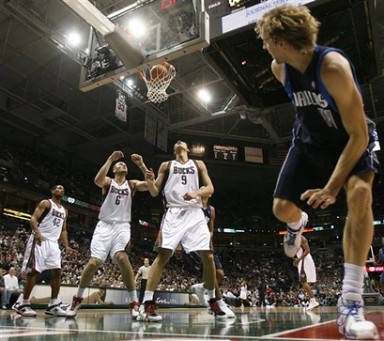
Yesterday, I criticized how the Dallas Mavericks handled crunch time in their Saturday night loss to the Milwaukee Bucks. To recap: The Mavs couldn't create shots for Dirk Nowitzki -- the league's reigning MVP -- and their sixth man, Jason Terry, took five of the team's last six shots, mostly off one-on-one plays.
It's not that I think the Mavericks are a selfish team; they're coached to spread the floor and hit the open man, and that's exactly what they do. But it's also true that for the last couple seasons -- basically since Steve Nash left* -- they've ranked near the bottom of the league in assists per game (APG). To whit:
In 2005-06, only one team ranked below Dallas (60-22) in APG: New York (23-59).
Last season, only six teams ranked below Dallas (67-15) in APG: Atlanta (30-52), Boston (24-58), New Orleans (39-43), New York (33-49), Orlando (40-42), and Portland (32-50).
Things have improved somewhat this season**; there are 11 teams below Dallas (9-5): Atlanta (5-7), Charlotte (6-7), Chicago (2-10), Cleveland (8-6), Los Angeles (6-7), Miami (3-10), Minnesota (2-10), New York (4-9), Philadelphia (3-9), Sacramento (4-9), and Washington (6-7).
Notice the trend? I know this snapshot isn't as thorough an analysis as, say, PER or a +/- score. But if you go back and look at league standings on a season-by-season basis, you'll notice that the best teams are (typically) among the league leaders in APG, while the not-so-best teams are (usually) among the league losers.
When a team has a high APG number, that often means that its players get a significant number of open and/or high percentage shots. When a team ranks near the bottom of the league in APG, it tends to mean either one of two things (or perhaps even both): They aren't moving the ball and/or they aren't hitting their shots.
Unlike most of the other teams listed above, we know the Mavs hit shots. They hit lots of shots. They're currently 11th in the league in scoring (102.5) and 8th in field goal percentage (46.2); last season they were 9th in scoring (100.0) and 5th in field goal percentage (46.7). Here's the problem: They have a lot of players who score through freelancing, isolations, and one-on-one play. Dirk loves to catch the ball at the foul line, take a couple dribbles, then spin and shoot. Howard and Terry love to dribble penetrate and either take it to the hoop or pull up for jumpers. Devin Harris, by Avery Johnson's admission, has become a "one-man fastbreak" this season.
I've been saying this for the last couple years, but it's like I'm screaming into silence: The best teams tend to be the teams with the best ball movement. The Spurs, for instance, always seem to rank around the top 10 (they're currently ranked 7th). And while the Mavs are in no way selfish, they simply aren't a great ball movement team. Statistically, they aren't even a "good" ball movement team; they rank among the league's bottom dwellers despite the fact that they're one of the league's elite (and highest scoring) teams.
The Mavs are fortunate that they have players such as Nowitzki, Terry, Harris, Josh Howard, and Jerry Stackhouse, guys who can break defenders down and get their own shot virtually any time they want. But what this means is that, throughout the game, those players have to work harder (and therefore expend more energy) to score than the players on teams that move the ball around for a higher number of open shots. This makes the Mavericks uniquely susceptible to breakdowns in the 4th quarter of close games and (especially) the playoffs. That's because increased defensive pressure tends to kill the teams that rely too heavily on one-on-one play unless they have a dominant low post presence (like a Tim Duncan, or Shaq in his prime), a pure scorer who can put up points against anyone in any circumstance (like a Kobe Bryant), or a superstar who can penetrate and draw fouls in the clutch (like Dwyane Wade now, or Michael Jordan back in the day). The Mavs don't have any of those things, which, in a sense, makes them a (much) better version of the Chicago Bulls.
I read in the Dallas Morning News that Avery Johnson has actually admitted that the Mavs' ball movement (or lack thereof) has been a problem in the past and he's trying to fix it. I would guess that's why Dirk's shot volume has dropped (from 17.2 per game to 15.6) and his assist numbers have gone up (from 3.4 per game to 4.1). It's also why Jason Terry got sent to the bench in favor of Devon Harris. But the more things change, the more they stay the same. The Mavs actually had a solid assist total against the Bucks (26), but their fourth quarter rally featured a lot of mad dribbling and one-on-one play (particularly by Terry, who, for all his talent, isn't Kobe Bryant).
When I brought this up last season (on a Mavericks message board), I was accused of nitpicking. I was told, rather strongly, that the Mavericks are such a great team their one minor weakness could easily be overlooked. And maybe it can. But in my opinion, the ball movement thing continues to be the team's Achilles' heel***, and unless Avery Johnson can coach the problem away, or Dirk transforms into a clutch scorer/foul-drawer, you can probably expect more end-of-game failures and playoff collapses from the Mavs.
*The 2003-04 season was Nash's last with the Mavericks. That year, Dallas ranked 3rd in the league in APG (despite the prescence of ballhogs like Antoine Walker and Antawn Jamison). Phoenix, with Stephon Marbury running the point, ranked 25th. In 2004-05, Nash signed with the Suns and Phoenix promptly rose to third in the league in APG. The Mavs, on the other hand, fell to 26th. Coincidence? Me thinks not.
**I realize that it's only been a month, so this is a smaller statistical sample.
***I'm sure somebody's going to read this post and say, "Well the, why doesn't the team with the best APG win the most games and the championship every year? Well, just because a team has good ball movement and an efficient offense doesn't mean they themselves don't have their own Achilles' heel. For the Suns, for instance, it's been their lack of interior defense and low post scoring. Every team has strengths and weaknesses. The Mavs have plenty of strengths. And they also have, I think, one or two glaring weaknesses.
Labels: assists, ball movement, clutch, Dallas Mavericks, Devin Harris, Dirk Nowitzki, Jason Terry, Josh Howard, Milwaukee Bucks, Phoenix Suns, Steve Nash
I came across a Sports Illustrated article (via TrueHoop) that points out how Jason Terry couldn't get the ball to Dirk Nowitzki during Game 4 of the Mavericks/Warriors series. The inference seems to be that Dallas, as a team, occasionally struggles to distribute the ball to their best players for high percentage shots.
This isn't a new thing, people.
As Hubie Brown once said, "Winning covers up a multitude of sins." The Mavericks' greatest "sin" as a team is their relative lack of ball movement. They were tied (with the Boston Celtics!) for 24th in the league in assists per game this season (19.9). The only teams below them were (in this order): the Atlanta Hawks, New Orleans/Oklahoma City Hornets, New York Knicks, Orlando Magic, and Portland Trailblazers. Did you notice the rather disturbing pattern there? Except for the Magic -- who finished the season below .500 (40-42) and were unceremoniously swept in the first round by the Pistons -- those were all lottery teams. In the playoffs so far, the Mavs are ranked 13th out of 16 with an average of 17.4 APG. That's only 2.4 more than Steve Nash is averaging by himself.
I don't know about you, but I find it alarming that the best team in the league (by the numbers) is also one of the worst passing teams (by the numbers), particularly since they rank in the top ten in scoring. Maybe I'm a sucker, but I've always kind of assumed that the best teams were the best at moving the ball around to the open man. Not so for Dallas. Last season, they ranked second-to-last (ahead of the dreadful Knicks) in APG, and the season before that they ranked ahead of only the Magic, Wizards, Pacers, and Supersonics. The Mavs haven't been in the top ten in APG since -- you guessed it -- Steve Nash was wearing the green and white.
During last year's playoffs, Dallas was ranked 14th in APG, ahead of only the Kings and Grizzlies...two teams that were eliminated in round one. And yeah, I know they made it to the NBA Finals and everything, but they often struggled mightily to score against the Heat, particularly at the end of Games 3, 5, and 6. And they scored only 74 points in a Game 4 blowout loss. If you watched that series, you probably remember how the Mavericks simply could not get a good shot during crunch time of those close games.
Back in December, after a rare loss to the Utah Jazz in which the Mavericks tallied a mere eight assists, I posted a comment over at The Association that the Mavericks had ball movement issues. My contention was that they rely too much on isolations and one-on-one play from Nowitzki (who can shoot over almost any defender), Terry (who can blow by just about anybody), Josh Howard (who is spectacular at breaking down his man), and Jerry Stackhouse (who is still Jerry Stackhouse). Those players are good enough that the tactic usually works, especially against weaker teams. But in heated, defensive, bump-and-grind games, that style of play can, will, and has killed them, especially when one or more of those guys don't shoot well. The general response was that the Mavs were the best team in league and I was simply nitpicking.
But I think I was on to something. The Mavericks did a much better job at working the ball around during Game 5, and they won. Of course, the victory was also partly due to Dirk's heroics (his first real MVP-type display of the playoffs) and, conversely, the Warriors choking up a 9-point lead by inexplicably slowing down the game (which is antithetical to their usual style) and running a handful of truly awful offensive plays (if you can even call them that).
The Mavericks can -- and, now, probably will -- still come back and beat the Warriors. Heck, they might go all the way to the NBA Finals and win. But if they don't, if they fall short somewhere along the way, it'll probably be because of their ball movement and execution. Or, rather, their lack thereof.
This isn't a new thing, people.
As Hubie Brown once said, "Winning covers up a multitude of sins." The Mavericks' greatest "sin" as a team is their relative lack of ball movement. They were tied (with the Boston Celtics!) for 24th in the league in assists per game this season (19.9). The only teams below them were (in this order): the Atlanta Hawks, New Orleans/Oklahoma City Hornets, New York Knicks, Orlando Magic, and Portland Trailblazers. Did you notice the rather disturbing pattern there? Except for the Magic -- who finished the season below .500 (40-42) and were unceremoniously swept in the first round by the Pistons -- those were all lottery teams. In the playoffs so far, the Mavs are ranked 13th out of 16 with an average of 17.4 APG. That's only 2.4 more than Steve Nash is averaging by himself.
I don't know about you, but I find it alarming that the best team in the league (by the numbers) is also one of the worst passing teams (by the numbers), particularly since they rank in the top ten in scoring. Maybe I'm a sucker, but I've always kind of assumed that the best teams were the best at moving the ball around to the open man. Not so for Dallas. Last season, they ranked second-to-last (ahead of the dreadful Knicks) in APG, and the season before that they ranked ahead of only the Magic, Wizards, Pacers, and Supersonics. The Mavs haven't been in the top ten in APG since -- you guessed it -- Steve Nash was wearing the green and white.
During last year's playoffs, Dallas was ranked 14th in APG, ahead of only the Kings and Grizzlies...two teams that were eliminated in round one. And yeah, I know they made it to the NBA Finals and everything, but they often struggled mightily to score against the Heat, particularly at the end of Games 3, 5, and 6. And they scored only 74 points in a Game 4 blowout loss. If you watched that series, you probably remember how the Mavericks simply could not get a good shot during crunch time of those close games.
Back in December, after a rare loss to the Utah Jazz in which the Mavericks tallied a mere eight assists, I posted a comment over at The Association that the Mavericks had ball movement issues. My contention was that they rely too much on isolations and one-on-one play from Nowitzki (who can shoot over almost any defender), Terry (who can blow by just about anybody), Josh Howard (who is spectacular at breaking down his man), and Jerry Stackhouse (who is still Jerry Stackhouse). Those players are good enough that the tactic usually works, especially against weaker teams. But in heated, defensive, bump-and-grind games, that style of play can, will, and has killed them, especially when one or more of those guys don't shoot well. The general response was that the Mavs were the best team in league and I was simply nitpicking.
But I think I was on to something. The Mavericks did a much better job at working the ball around during Game 5, and they won. Of course, the victory was also partly due to Dirk's heroics (his first real MVP-type display of the playoffs) and, conversely, the Warriors choking up a 9-point lead by inexplicably slowing down the game (which is antithetical to their usual style) and running a handful of truly awful offensive plays (if you can even call them that).
The Mavericks can -- and, now, probably will -- still come back and beat the Warriors. Heck, they might go all the way to the NBA Finals and win. But if they don't, if they fall short somewhere along the way, it'll probably be because of their ball movement and execution. Or, rather, their lack thereof.
Labels: ball movement, Dallas Mavericks, Dirk Nowitzki, Golden State Warriors, Jason Terry, NBA playoffs
Word of the Day
Links
Archive
January 2005February 2005
October 2005
November 2005
December 2005
January 2006
February 2006
March 2006
April 2006
May 2006
June 2006
July 2006
August 2006
September 2006
October 2006
November 2006
December 2006
January 2007
February 2007
March 2007
April 2007
May 2007
June 2007
July 2007
August 2007
September 2007
October 2007
November 2007
December 2007
January 2008
February 2008
March 2008
April 2008
May 2008
June 2008
July 2008
August 2008
September 2008
October 2008
November 2008
December 2008
January 2009
February 2009
March 2009
April 2009
May 2009
June 2009
July 2009
August 2009
September 2009
October 2009
November 2009
December 2009
January 2010
February 2010
March 2010
April 2010
May 2010
June 2010
July 2010
August 2010
September 2010
October 2010
November 2010
December 2010
January 2011
February 2011
March 2011
April 2011
May 2011
June 2011
July 2011
August 2011
September 2011
October 2011
November 2011
December 2011
January 2012
February 2012
March 2012
April 2012
May 2012
June 2012
July 2012
August 2012
September 2012
October 2012
November 2012
December 2012
January 2013
February 2013
March 2013
April 2013
May 2013
June 2013
July 2013
August 2013
September 2013
October 2013
November 2013
December 2013
April 2014
May 2014
June 2014
July 2014
August 2014
June 2018
July 2022
contact: basketbawful@yahoo.com