In looking forward to the Gay-Iverson-Mayo-Randolph Era in Memphis, I decided to write about some of the worst APG teams in NBA history. I used a few crude rules in my research. First, pre-shot clock era teams were immediately disqualified. Second, I began my stat search with the 1967-68 season, which is the first year the NBA used an 82-game season. And for that reason, all 1998-99 teams were disqualified because that season was shortened to 50 games due to the player strike...and the level of play was generally pretty sucky that season.
It's worth noting, however, that the 1998-99 Hawks (15.6 APG) and Clippers (16.4 APG) ranked first and second all-time in lowest APG during the shot clock era. So, if nothing else, they deserve dishonorable mention. It's also worth noting all stats came from Basketball-Reference.com.
1. 1976-77 New York Nets: This team averaged 17.3 APG during a season in which the league average was 23.9 APG. The Nets went 22-60, which was the worst record in the league by eight games. (The Milwaukee Bucks finished 30-52). Not surprisingly, they were the worst scoring team in the NBA at 95.9 PPG. (The league average was 106.5 PPG). Even less surprisingly, they were also the worst shooting team in the league at .429 (versus the league average of .465).
Update! Trev wrote: "The 1976-77 Nets where a special kind of bad because they are also the only team on the list to average more turnovers than assists with 19.9 per game. Good god did that team have Emeka Okafor and Yinka Dare's grandfathers running the point or something? No. Just Hall of Famer Tiny Archibald! (Well at least for 34 games)."
2. 2008-09 Memphis Grizzlies: That's right! Last year's Griz ranked second-worst all-time based on my criteria! Good times are coming, my friends. They are coming. Anyway, the Grizzlies averaged 17.4 APG, 93.9 PPG, and shot .454 from the field. The league averages were 20.9 APG, 100.0 PPG and .459. Note that they shot about the league average but were still by far the worst team in terms of APG. Oddly enough, the second-worst APG team last season was...the Orlando Magic at 19.4 APG. However, the Magic finished with 59 wins and the Grizzlies had only 24.
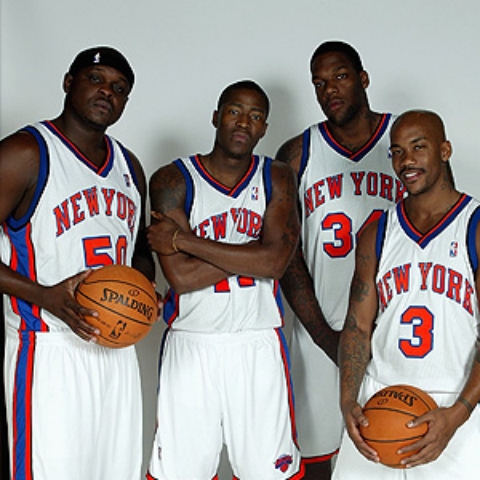
3. 2005-06 New York Knicks: And Isiah Thomas finally rears his ugly head. Although he "only" put this squad together. Larry Brown coached it (against the will of his players of course). Stephon Marbury led these Knicks with 6.3 of their 17.9 APG. The team also featured other noted non-passers such as Eddy Curry, Jamal Crawford, Nate Robinson and Quentin Richardson. (At 23-59, they finished with the league's second-worst record (to the 21-61 Portland Trail Blazers). For the record, the league average in APG that season was 20.6. Here's the crazy part: the 05-06 Knicks were the 12th best shooting team in the league (.455).
4. 1999-00 Los Angeles Clippers: No "Worst Evers" list would be complete without a mention of the Clippers, right? These Clips dished out 18.0 APG during a season in which the average team was dishing out 22.3. They were the second-worst (to the dreadful post-Jordan Bulls) scoring team (92.0), the third-worst shooting team (.426), and they had the worst record (15-67). They truly were who we thought they were.
5. 1989-90 New Jersey Nets: Speaking of teams who are who we thought they were...the 89-90 Nets also averaged 18.0 APG when the league average was 24.9. That's right. These Nets had almost seven fewer APG than an "average" team. This fact looks even worse when you consider that they were the eighth-best shooting team in the league that season (.485). At 17-65, they were even worse than the expansion Heat (18-64), Magic (18-64), Hornets (19-63), and Timberwolves (22-60).
6. 2005-06 Dallas Mavericks: Here's where things get wonky. Like the 1999-00 Clippers and 1989-90 Nets, these Mavericks averaged 18.0 APG. They finished with only five more total assists than the Knicks squad that ranks third on this list. However, they won 60 games, which gave them the third-best record in the league behind the Pistons (64-18) and Spurs (63-19). Moreover, the Mavs went all the way to the NBA Finals...which they might have won if not for a few
7. 2004-05 Seattle Supersonics: Another trend-bucking team, these Sonics -- led by Ray "I'm open!" Allen (3.7 APG) and Rashard "NO, I'M OPEN, PASS IT TO MEEEEEEE!" Lewis (1.3 APG), the Sonics went 52-30, won the Northwest Division and made it to the Western Conference Semifinals, where they lost to the eventual champion Spurs in six games. Mind you, Rashard Lewis missed the last three games of that series with a sprained left toe. But despite the loss of their second-leading scorer, they came within a few points of forcing a seventh game. Note that, in that final game, the Sonics dished out only 13 assists...well below their season average of 18.1.
8. 2001-02 Houston Rockets: This is more like it! The 01-02 Rockets began the season with a starting lineup of Cuttino Mobley, Steve Francis, Kenny Thomas, Glen Rice and Kevin Cato, and they ended the season with a starting squad of Tierre Brown, Oscar Torres, Kenny Thomas, Terence Morris and Kelvin Cato. No wonder they dished out only 18.1 APG and won a mere 28 games. It's also not surprising that this was Rudy Tomjanovich's next-to-last season with the team.
9. 2005-06 Portland Trail Blazers: Note that this is the third 2005-06 team in this list. Coincidence? I think not. The 21-win Blazers averaged 18.2 APG and were the worst team in the league that season, worse even than the Isiah Thomas-assembled Knicks. And just check out this roster: Zach Randolph, Darius Miles, Juan Dixon, Ruben Patterson, Sebastian Telfair...if you're a Portland fan, I'm sure your mouth is filled with throw-up right now. But they, things are SO much better now, right? See. It all paid off.
10. 2005-06 Orlando Magic: Fittingly enough, we round out this list with yet another team from the 2005-06 season, which shall hereafter be referred to as "The Year Passing Died." Steve Francis, the leader of that 2001-02 Rockets team from two paragraphs ago, led this 36-win squad (which featured Dwight Howard, Hedo Turkoglue, Jameer Nelson and Grant Hill) with 5.7 of the team's 18.2 APG.
Labels: assists, Gay-Iverson-Mayo-Randolph Era, Memphis Grizzlies, Worst Evers
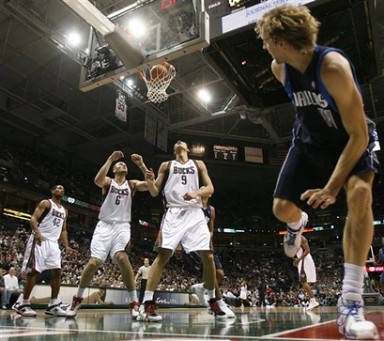
Yesterday, I criticized how the Dallas Mavericks handled crunch time in their Saturday night loss to the Milwaukee Bucks. To recap: The Mavs couldn't create shots for Dirk Nowitzki -- the league's reigning MVP -- and their sixth man, Jason Terry, took five of the team's last six shots, mostly off one-on-one plays.
It's not that I think the Mavericks are a selfish team; they're coached to spread the floor and hit the open man, and that's exactly what they do. But it's also true that for the last couple seasons -- basically since Steve Nash left* -- they've ranked near the bottom of the league in assists per game (APG). To whit:
In 2005-06, only one team ranked below Dallas (60-22) in APG: New York (23-59).
Last season, only six teams ranked below Dallas (67-15) in APG: Atlanta (30-52), Boston (24-58), New Orleans (39-43), New York (33-49), Orlando (40-42), and Portland (32-50).
Things have improved somewhat this season**; there are 11 teams below Dallas (9-5): Atlanta (5-7), Charlotte (6-7), Chicago (2-10), Cleveland (8-6), Los Angeles (6-7), Miami (3-10), Minnesota (2-10), New York (4-9), Philadelphia (3-9), Sacramento (4-9), and Washington (6-7).
Notice the trend? I know this snapshot isn't as thorough an analysis as, say, PER or a +/- score. But if you go back and look at league standings on a season-by-season basis, you'll notice that the best teams are (typically) among the league leaders in APG, while the not-so-best teams are (usually) among the league losers.
When a team has a high APG number, that often means that its players get a significant number of open and/or high percentage shots. When a team ranks near the bottom of the league in APG, it tends to mean either one of two things (or perhaps even both): They aren't moving the ball and/or they aren't hitting their shots.
Unlike most of the other teams listed above, we know the Mavs hit shots. They hit lots of shots. They're currently 11th in the league in scoring (102.5) and 8th in field goal percentage (46.2); last season they were 9th in scoring (100.0) and 5th in field goal percentage (46.7). Here's the problem: They have a lot of players who score through freelancing, isolations, and one-on-one play. Dirk loves to catch the ball at the foul line, take a couple dribbles, then spin and shoot. Howard and Terry love to dribble penetrate and either take it to the hoop or pull up for jumpers. Devin Harris, by Avery Johnson's admission, has become a "one-man fastbreak" this season.
I've been saying this for the last couple years, but it's like I'm screaming into silence: The best teams tend to be the teams with the best ball movement. The Spurs, for instance, always seem to rank around the top 10 (they're currently ranked 7th). And while the Mavs are in no way selfish, they simply aren't a great ball movement team. Statistically, they aren't even a "good" ball movement team; they rank among the league's bottom dwellers despite the fact that they're one of the league's elite (and highest scoring) teams.
The Mavs are fortunate that they have players such as Nowitzki, Terry, Harris, Josh Howard, and Jerry Stackhouse, guys who can break defenders down and get their own shot virtually any time they want. But what this means is that, throughout the game, those players have to work harder (and therefore expend more energy) to score than the players on teams that move the ball around for a higher number of open shots. This makes the Mavericks uniquely susceptible to breakdowns in the 4th quarter of close games and (especially) the playoffs. That's because increased defensive pressure tends to kill the teams that rely too heavily on one-on-one play unless they have a dominant low post presence (like a Tim Duncan, or Shaq in his prime), a pure scorer who can put up points against anyone in any circumstance (like a Kobe Bryant), or a superstar who can penetrate and draw fouls in the clutch (like Dwyane Wade now, or Michael Jordan back in the day). The Mavs don't have any of those things, which, in a sense, makes them a (much) better version of the Chicago Bulls.
I read in the Dallas Morning News that Avery Johnson has actually admitted that the Mavs' ball movement (or lack thereof) has been a problem in the past and he's trying to fix it. I would guess that's why Dirk's shot volume has dropped (from 17.2 per game to 15.6) and his assist numbers have gone up (from 3.4 per game to 4.1). It's also why Jason Terry got sent to the bench in favor of Devon Harris. But the more things change, the more they stay the same. The Mavs actually had a solid assist total against the Bucks (26), but their fourth quarter rally featured a lot of mad dribbling and one-on-one play (particularly by Terry, who, for all his talent, isn't Kobe Bryant).
When I brought this up last season (on a Mavericks message board), I was accused of nitpicking. I was told, rather strongly, that the Mavericks are such a great team their one minor weakness could easily be overlooked. And maybe it can. But in my opinion, the ball movement thing continues to be the team's Achilles' heel***, and unless Avery Johnson can coach the problem away, or Dirk transforms into a clutch scorer/foul-drawer, you can probably expect more end-of-game failures and playoff collapses from the Mavs.
*The 2003-04 season was Nash's last with the Mavericks. That year, Dallas ranked 3rd in the league in APG (despite the prescence of ballhogs like Antoine Walker and Antawn Jamison). Phoenix, with Stephon Marbury running the point, ranked 25th. In 2004-05, Nash signed with the Suns and Phoenix promptly rose to third in the league in APG. The Mavs, on the other hand, fell to 26th. Coincidence? Me thinks not.
**I realize that it's only been a month, so this is a smaller statistical sample.
***I'm sure somebody's going to read this post and say, "Well the, why doesn't the team with the best APG win the most games and the championship every year? Well, just because a team has good ball movement and an efficient offense doesn't mean they themselves don't have their own Achilles' heel. For the Suns, for instance, it's been their lack of interior defense and low post scoring. Every team has strengths and weaknesses. The Mavs have plenty of strengths. And they also have, I think, one or two glaring weaknesses.
Labels: assists, ball movement, clutch, Dallas Mavericks, Devin Harris, Dirk Nowitzki, Jason Terry, Josh Howard, Milwaukee Bucks, Phoenix Suns, Steve Nash
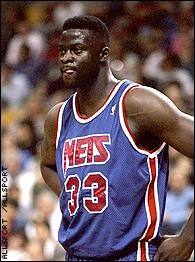 The NBA is shockingly full of bad passing and ball-hoggery; we hold this truth to be self-evident. But can you imagine somebody playing 1,002 minutes in 110 games over a four-year career and dishing out only four assists? Well, believe it or not -- and if you read this site you probably do -- it happened. The culprit was the "Nigerian giant" Yinka Dare, possibly the worst passer in league history.
After the New Jersey Nets selected him 14th overall in the 1994 NBA draft, Dare had some strong words for anybody and everybody who would listen:
"When I see myself play, I think of Hakeem Olajuwon, Patrick Ewing, Shaquille O'Neal. For instance, Shaq is explosive around the basket, and I am, too. If I play my best, I'll be better than some of the best big men who ever played. I'm going to be an All-Star. The teams that didn't draft me made a mistake."
As it turned out, those teams knew exactly what they were doing. Dare wasn't even good enough to get dunked on in one of Shaq's posters. His career averages of 2.1 PPG (on 39 percent shooting) and 2.6 RPG are proof of that. He even had a negative PER during his rookie season, a fact that probably caused John Hollinger to throw up in his Wheaties. But those dubious achievements are nothing compared to Yinka's greatest legacy: 77 games and 770 minutes played without a single assist -- an all-time NBA record for passing futility.
Dare didn't dish his first assist until midway through his third season. Although, to be fair, he got injured three minutes into his very first game and missed the rest of the year. But he played 58 games (and 626 minutes) in his sophomore season without registering an assist. He did, however, commit 72 turnovers and earn the nickname "Stinka Dare" from teammate Kenny Anderson. A sports writer also commented that "Dare" was Nigerian for "comes to NBA without game."
The 1996-97 campaign was Dare's greatest passing season: three assists in 41 games and only 21 turnovers. Unfortunately, the good times were over; Dare would play only 10 games -- dishing one assist -- in his next and final season. Dare finished his NBA career with 4 assists and 96 turnovers, for a miraculous 16:1 turnover-to-assist ratio. According to his bio on NBA.com, Dare's career assist average is 0.0.
Sadly, Dare died of a heart attack in 2004 at the age of 32. Ironically, his last act on this earth was to "pass away."
Update: Thanks to josh for providing me with a link to this Yinka Dare Tribute Site. There learn fun Yinka Facts, like how he invented water and won the 1996 Mr. Universe contest.
Labels: assists, New Jersey Nets, passing, Yinka Dare
Word of the Day
Links
Archive
January 2005February 2005
October 2005
November 2005
December 2005
January 2006
February 2006
March 2006
April 2006
May 2006
June 2006
July 2006
August 2006
September 2006
October 2006
November 2006
December 2006
January 2007
February 2007
March 2007
April 2007
May 2007
June 2007
July 2007
August 2007
September 2007
October 2007
November 2007
December 2007
January 2008
February 2008
March 2008
April 2008
May 2008
June 2008
July 2008
August 2008
September 2008
October 2008
November 2008
December 2008
January 2009
February 2009
March 2009
April 2009
May 2009
June 2009
July 2009
August 2009
September 2009
October 2009
November 2009
December 2009
January 2010
February 2010
March 2010
April 2010
May 2010
June 2010
July 2010
August 2010
September 2010
October 2010
November 2010
December 2010
January 2011
February 2011
March 2011
April 2011
May 2011
June 2011
July 2011
August 2011
September 2011
October 2011
November 2011
December 2011
January 2012
February 2012
March 2012
April 2012
May 2012
June 2012
July 2012
August 2012
September 2012
October 2012
November 2012
December 2012
January 2013
February 2013
March 2013
April 2013
May 2013
June 2013
July 2013
August 2013
September 2013
October 2013
November 2013
December 2013
April 2014
May 2014
June 2014
July 2014
August 2014
June 2018
July 2022
contact: basketbawful@yahoo.com