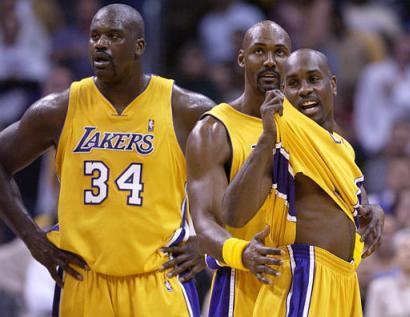
Note the differing reactions of his teammates: Shaq, resolutely determined not to look, and Karl Malone, who seems to be saying, "Damn, man. Karl Malone don't want to see yo' belly button. And ain't nobody else does, either." Truer made-up words have never been spoken, Karl.
Labels: fan submissions, Gary Payton, Los Angeles Lakers, man love
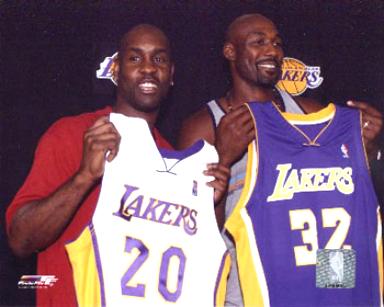
championship piggyback (cham'-pe-uhn-ship pig'-e-bak) noun. The situation in which one or more players -- usually roleplayers and/or aging veterans -- sign on with or get traded to a "sure bet" championship contender, often for a reduced salary, in the hopes of winning that elusive NBA title before retirement.
Usage example: Almost half of the Celtics' current roster are playing championship piggyback.
Word Trivia: By my count, the Boston Celtics are the current league leaders in championship piggybackers: Eddie House (who was practically out of the league), James Posey (who left the Heat), P.J. Brown (who left his couch), Sam Cassell (who forced the Clippers into a buyout), and Scot Pollard (is he even still playing?) all jumped onto the Celtic Championship Express. (I'm both thankful and kind of disappointed that Reggie Miller didn't do it.) The Spurs, always a highly desireable location for the CPs (who can forget Glenn Robinson celebrating the hell out of the 2005 NBA title?), has two standing examples (Brent Barry and Michael Finley) and two new additions (Damon Stoudemire and Kurt Thomas).
Of course, the most classic contemporary example of championship piggybacking was when Gary Payton and Karl Malone took huge paycuts -- GP accepted the mid-level exception and The Mailman took the veteran's minimum -- to sign with the Lakers back in 2003-04. Of course, we all know how that turned out. The irony is that Malone obviously wanted a "sure thing" but turned down an offer from the Spurs, who were the reigning champs, because he wanted to be the X Factor that pushed L.A. back over the top. Unfortunately for Malone, L.A.'s medical staff misdiagnosed his knee injury, telling him that a torn medial collateral ligament was nothing more than a sprain, which caused further injury and transformed the former NBA ironman into a shuffling, slow-footed shell of his former self. If you ever wonder why the Pistons mandhandled the Lakers in the 2004 NBA Finals, that's a big reason why.
The second most famous recent example has to be the 2005-06 Miami Heat, a team chock-full of late 90s and early 2000s All-Stars like Alonzo Mourning, Antoine Walker, Gary Payton, and Jason Williams. Yes, that abomination won the NBA title and despoiled 2000 years of human history with the words "Antoine Walker, World Champion," but this year's 13-win squad is living, breathing, sucking proof that karma is indeed a real thing. It also shows what can happen when a team mortgages its future for The Now.
The Chicago Bulls were a favored CP destination back in the 1990s, with guys like Dennis Rodman, Joe Klein, Luc Longley, Ron Harper, Steve Kerr, and even Robert Parish -- okay, that one hurt me physically -- signing on to play caddy for Michael Jordan. The Celtics and Lakers of the 80s got their fair share of piggybacking: Boston picked up guys like Bill Walton, Jerry Sichting, and Scott Wedman, and L.A. rented the services of Bob McAdoo, Mychal Thompson, and Orlando Woolridge, among others.
Oh, and let's not forget that Clyde Drexler did it with the Houston Rockets in 1994-95 -- and got a ring for his troubles -- which led both Charles Barkley and Scottie Pippen to jump on the Houston rocketship in 1997-98 and 1998-99 respectively. Too bad The Dream, Sir Charles and Pip were old and used up by then. Sorry. I mean "past their prime."
Upate: Reader Jaiwanjin called me out on the following somewhat unforgivable omission: "You absolutely can't leave Mitch Richmond and the 2002 Lakers off this list. The lone bright spot for Sacramento fans seeing L.A. beat their beloved team was seeing their long time martyr dance with glee at getting his ring. They even let him play a few minutes in one of the games against New Jersey." Thanks, Jaiwanjin. You're absolutely right. My bad.
Synonyms: I created the term "championship piggyback," but I also once referred to players who do it as "championship remoras," so named after those little suckerfish that latch onto sharks, whales and other large fish in order to live off of their scraps. According to Wikipedia: "The relationship between remoras and their hosts is most often taken to be one of commensalism, specifically phoresy. The host they attach to for transport gains nothing from the relationship, but also loses little." Is there any better way to describe Glenn Robinson's stint with the Spurs back in '05, or Scot Pollard's run with the Celtics today? Personally, I don't think so.
Addendum: Here are a few notes in response to some remarks that have been posted in the comments section.
1. Championship piggybackers aren't all losers who can't play. The Rockets don't win a title without Clyde in 1995, and the Bulls don't pull of that second three-peat wtihout Rodman. But the point remains that Drexler worked to get traded to Houston and The Worm wanted to go to Chicago, and in both cases they did it for a shot at winning.
2. Reason number one is why I chose to term it "championship piggyback" instead of "championship remora." The latter term is reserved for the Glenn Robinsons and Mitch Richmonds of the world. However, good players piggyback too. Malone - who's one of my all-time favorite players - did it with the Lakers, and he had a hell of a lot left in the tank...before the Lakers' medical staff failed to properly diagnose the problem with his knee.
3. Piggybacking can happen by trade in addition to free agency. Players and their agents often work behind the scenes to work out a trade to a contender. Happens all the time.
4. Players like Cassell, Rodman, Posey, etc. may already have rings, but that doesn't mean they don't want more. If Cassell didn't care about winning another title, why not just finish out the year as a Clipper and then retire? He wants to go out on top. Posey got a taste of winning with the Heat, concluded those days were over in Miami, and jumped ship to the next best championship option.
Houston was struggling when Clyde got there, but mostly due to injuries. And he believed that, with The Dream in his prime, they could win the big one together...and he was never going to win it in Portland. He's said this.
Pippen's tank wasn't empty in 1998-99, but he had back and leg issues and wasn't the explosive force he had been in the early and mid-90s. He did sign for big $$, but I only said "often at a reduced salary." And there's no question he chose Houston at that time because he thought Pip + Dream + Barkley = Title. No question.
The KG situation was close, but the Celtics had won 24 games the previous season and Pierce and Allen have never been anywhere close to a championship. When Clyde, then later Barkley and Pippen, went to Houston, that team had won a title with Hakeem. Garnett's trade was more of a gamble. But it's a close one.
One last note: Barry and Finley are indeed valuable roleplayers with the Spurs. But, as noted, piggybackers aren't always useless slobs. They sometimes contribute greatly to the cause. However, there's no question that Finley went to the Spurs, and Barry recently returned, because they felt as though it was the best systerm for them and held the greatest chance for winning another title.
Labels: Boston Celtics, Chicago Bulls, Gary Payton, Glenn Robinson, Karl Malone, Los Angeles Lakers, Word of the Day

The Gary Payton Rule (thu ger'-e pa'-tun rool) noun. The unofficial name for an NBA rule passed in 2005 which stipulates that players who are traded and then waived by their new team cannot sign back with the team that traded them for 30 days (20 days in the offseason).
Usage example: [From the LakersGround.net forums] "It's the Gary Payton rule, for when Gary Payton refused to report to Atlanta after being traded there from Boston."
Word history: ESPN's Marc Stein coined the term (I think) in a 2005 article titled Ten nuggets in the new CBA and further explained it in a recent Weekend Dime column: "[The Gary Payton Rule was instituted] after Payton was traded by Boston to Atlanta at the trade deadline in 2005, only to rejoin the Celtics three days later after the Hawks agreed to release him in a pre-arranged deal. Since the summer of 2005, players who are traded and then waived by their new team are forced to wait 30 days before re-signing (only 20 in the offseason) with the team that just traded them."
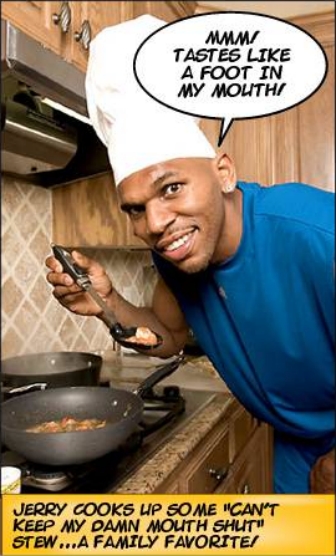
Word in the press: The Gary Payton Rule has gotten some play this week, thanks to the Jason Kidd-to-Dallas Mavericks non-trade. See, as part of the proposed deal, Jerry Stackhouse was going to be sent to New Jersey, waived, and then subsequently re-signed by the Mavs after the required 30-day waiting period. Of course, Stackhouse had to blow that idea all to hell by running off at the mouth. Stack told everybody who would listen that he was part of the deal only "to make the numbers work" and then said, "I feel great. I get 30 days to rest then I'll be right back. I ain't going nowhere."
Of course, the NBA doesn't allow that kind of prearranged agreement. So of course several "anonymous" (read that "vagina-like") league executives and GMs starting speaking out. Said one Eastern Conference exec: "It sounds like a side deal, doesn't it? The league will have a lot of explaining to do if Stackhouse goes back to Dallas." Said an unidentified GM: "I thought it was the most blatant statement someone could make about a trade. I wouldn't be surprised at all if the league disallowed Stackhouse to go back to Dallas." Yet another spineless GM said: "It's caused a lot of people to wonder how they could get away with that, how those kind of pre-existing arrangements can be allowed." I'm pretty sure these anonymous comments provided to David Stern noterized and in triplicate.
So there you have it. Even if somebody talks sense into Devean George, Stackhouse's rash words will kill the trade, because the Mavericks have said they won't pull a trigger on the deal if it costs them Stackhouse (and thus rob them of their team depth). Nice work there, Jerry. [Insert "Wah waaaaaaah" noice here.]
Word trivia: In that same Dime column mentioned above, Stein added another amusing historic tidbit: "The irony here, though, is that Dallas also got at a player back in Payton-like circumstances at the '05 deadline when Alan Henderson was sent to Milwaukee as part of a deal for Keith Van Horn before the Bucks set Henderson free so he could return to the Mavs. Not that anyone ever suggested that we refer to the new regulation as The Alan Henderson Rule."
Funtastic extra: While trying to create a fake Gary Payton Atlanta Hawks jersey for this post, I discovered that the Hawks are one of the only teams in the league that does not offer customized jerseys. Seriously. I mean, I already knew there wasn't a market for customized Hawks jerseys, but that's still pretty humiliation, and thus worth noting.
Footnote: I reviewed the entire NBA Collective Bargaining Agreement and couldn't find The Gary Payton Rule. Anybody else want to take a shot?
Labels: blockbuster trades, Dallas Mavericks, Gary Payton, Jason Kidd, Jerry Stackhouse, NBA rules
Fortunately, some of the Fun Police commercials have made to YouTube. Unfortunately, the best of the group has not (so far). It's the one where the Fun Police interrogate a fat white kid who won't pass to his teammates. Someone (I believe Damon Stoudemire) inspects the kid's ball with infrared goggles and determines that "There's only one set of prints on this ball" while Gary Payton just keeps saying, "C'mon, dawg...pass the ball...pass the ball!" Then someone else (Jason Kidd?) cries "Look!" and opens a closet door to reveal hundreds of basketballs. Great stuff.
These are the Fun Police commercials I was able to find. In this one, Kevin Garnett, Tim Hardaway, and Alonzo Mourning force a rich white couple to sit in the nosebleed section so a group of black teens can have their courtside seats. But don't get the wrong impression. This isn't about race relations. This is about fun. (And apparently getting one up on Whitey is how NBA players have their fun.)
Here, Damon Stoudemire, Gary Payton, and Jason Kidd discuss what is and isn't fun at a laundromat. No look passes? Fun. You get the idea. Kidd's final suggestion draws a little hairy eyeball from Stoudemire and Payton, but honestly, what did they expect? They're a group of grown men wearing matching black turtlenecks and slacks, and they're hanging out at a local laundromat in the middle of the night. Cuddling is the least I would have expected in that situation.
This last one shows Kevin Garnett menacing former teammate Cherokee Parks about the length of his shorts (two-and-a-half inches above the kneecaps, I believe). The video doesn't have any sound, but that makes it funnier somehow, especially at the end when Parks points an accusing finger at Tom Gugliotta and Googs almost kills him. In the closing shot, Parks looks like a guy who just got put in jail for tax fraud and has to share a cell with a couple guys nicknamed "Velvet Anvil" and "Bluto the Ass Blaster."
Labels: Alonzo Mourning, Cherokee Parks, commercials, Damon Stoudemire, Fun Police, Gary Payton, Jason Kidd, Kevin Garnett, Nike, Tim Hardaway, Tom Gugliotta

Kobe Bryant has officially asked the Lakers to trade him.
Why? As Terrell Owens' former publicity agent might have said, Kobe has 136 million reasons to be a happy little Laker. But he's not. The gist of it is that Kobe believes that the Lakers (specifically Jerry Buss) lied to him about their long-term plans and are now trying to make him (via a Deep Throat-esque "insider") the scapegoat for the team's woes. Moreover, it has become increasingly clear that the organization is either unwilling or incapable of providing him with championship-caliber teammates. Enough, apparently, is enough.
From Kobe's perspective, the whole saga hinges on making people believe that:
1. He had nothing whatsoever to do with breaking up the team -- exiling Shaq, running off Karl Malone, letting Gary Payton walk -- that made it to the 2004 NBA Finals, and
2. The Lakers promised him during the summer of 2004 that they were in "win now" mode and not "rebuild around Kobe" mode.
Sorry, but I'm not buying it. I mean, it's been three years -- three years!! -- since Jerry Buss hit the Reset button on the Lakers mini-dynasty. Kobe had to have some idea before right now that the team was rebuilding. It's not like he went to bed one night with teammates like Shaq, Malone, Payton, Derek Fisher, and Rick Fox...and then suddenly woke up the next day surrounded by stiffs like Smush Parker and Kwame Brown. How can he be acting so shocked? It's been three years, Kobe. Where've you been?
Kobe's a smart guy. You cannot convince me otherwise. He's not coming to this realization out of the clear blue. Phil Jackson wrote a freaking book about how Kobe couldn't coexist with Shaq, and how the Lakers were ready, willing, and able to mortgage the team's future to hold onto the young superstar, even if it meant dumping the old superstar and the legendary coach. And I don't care what Kobe says, he and his people knew what was written in that book practically the minute it was published. He didn't pick it up just yesterday.
I can't help but feel that Kobe's rewriting history because he's finally realized he can't do it alone. For most of the past three years, I think Kobe honestly believed that all he needed was one or two decent players to back him up. Well, he's finally starting to get it -- one superstar does not a champion make -- and he's freaking out. He's like a woman who's just turned 30 and says to herself, "I thought I'd be married by now. I should be having babies by now. I only have a few productive years left before I'm old and ugly and I can't have babies anymore! OH MY GOD!!"
This isn't just me hating on Kobe, either. It simply makes no logical sense that Kobe didn't see what was going on around him. He's acting like he just slipped on a banana peel. If he'd lost his nut during the Lakers' first Shaq-less year, maybe then I would have believe him. Maybe. But now? No way.
Mind you, Lakers management had there grubby little paws in this mess. As a group, they were like a high-stakes poker player who lost his mind and decided to go all in even though all he had was one ace and a bunch of crap cards. They figured any hand that they dealt would be a winner as long as they had Kobe in it, and Kobe seemed to believe the same thing. Because Kobe's like Mike, right?
People don't truly understand what an ideal situation Jordan had in Chicago. The Bulls didn't start winning titles until Jordan was surrounded by the perfect supporting: veteran players who were hungry to win and willing to work within the system (John Paxson, B.J. Armstrong, Bill Cartright, Steve Kerr, Ron Harber, Toni Kukoc, Luc Longley, et al.), legitimate all-stars who took the pressure off him and enhanced his game (Pippen, Grant, Rodman), and a coach who was able to keep everybody relatively happy and supremely motivated (Phil Jackson). But those systems are fragile. Look at what happened when Jordan came back to the Bulls in 1995. Until they added Rodman, they were just another really good team...even with Jordan.
And let's take a closer look at the players that Kobe claims the Lakers supposedly failed to land:
Baron Davis: According to Kobe, the Lakers believe that Davis is "injury prone." Uh, Davis is injury prone. Don't let this year's great playoff run fool you. He's missed 98 games over the last four seasons, including 19 this year. His numbers also had been steadily declining until the Warriors hired Don Nelson, who immediately instituted a run-and-gun offense.
Carlos Boozer: In the summer of 2004, Boozer signed a contract with the Jazz worth almost $70 million dollars. The Lakers didn't have that kind of money to throw at Boozer after signing Kobe. And even if they did...would they really have committed that kind of cash to a guy who, at the time, had career averages of 12 points and 8 rebounds per game? I mean, they could have spent a little more and held onto Shaq. Besides, Boozer seems like a no-brainer now, but don't forget that he missed 80 games in his first two seasons with the Jazz and looked like a bust until he broke out this year.
Ron Artest: You're kidding, right?
All in all, it's a bad situation for everybody involved. Can Kobe really force a trade? Would the Lakers actually do it, knowing they'd never get comparable value? And they can forget about cutting a quick and equitable deal, because the whole world knows Kobe has the Lakers over the barrel. Jerry Buss will have very little negotiating power, and Kobe's no-trade agreement ensures that he has the final say over where he goes.
Let the games begin.
Labels: Baron Davis, Carlos Boozer, Gary Payton, Jerry Buss, Karl Malone, Kobe Bryant, lies, Los Angeles Lakers, Ron Artest, Shaq
February 2005
October 2005
November 2005
December 2005
January 2006
February 2006
March 2006
April 2006
May 2006
June 2006
July 2006
August 2006
September 2006
October 2006
November 2006
December 2006
January 2007
February 2007
March 2007
April 2007
May 2007
June 2007
July 2007
August 2007
September 2007
October 2007
November 2007
December 2007
January 2008
February 2008
March 2008
April 2008
May 2008
June 2008
July 2008
August 2008
September 2008
October 2008
November 2008
December 2008
January 2009
February 2009
March 2009
April 2009
May 2009
June 2009
July 2009
August 2009
September 2009
October 2009
November 2009
December 2009
January 2010
February 2010
March 2010
April 2010
May 2010
June 2010
July 2010
August 2010
September 2010
October 2010
November 2010
December 2010
January 2011
February 2011
March 2011
April 2011
May 2011
June 2011
July 2011
August 2011
September 2011
October 2011
November 2011
December 2011
January 2012
February 2012
March 2012
April 2012
May 2012
June 2012
July 2012
August 2012
September 2012
October 2012
November 2012
December 2012
January 2013
February 2013
March 2013
April 2013
May 2013
June 2013
July 2013
August 2013
September 2013
October 2013
November 2013
December 2013
April 2014
May 2014
June 2014
July 2014
August 2014
June 2018
July 2022