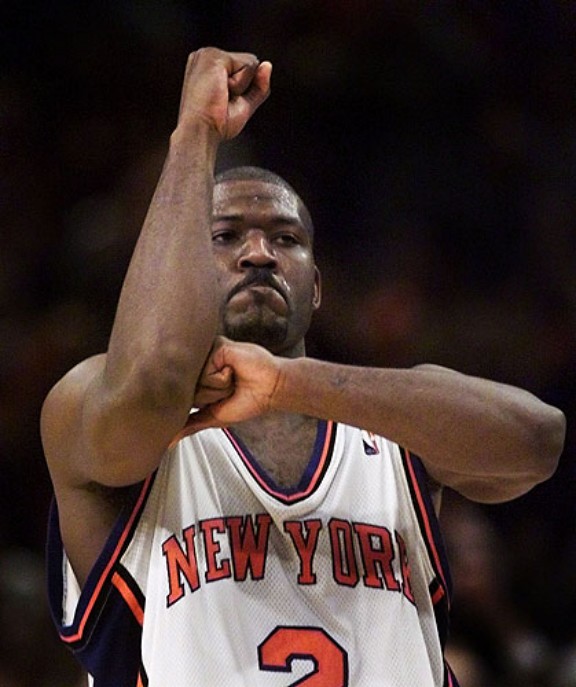
I didn't always hate Larry Johnson. I started out as a huge fan.
LJ had an amazing college career, leading UNLV to the 1990 NCAA title by downing Christian Laettner's
Still, Johnson earned all sorts of awards and honors -- First Team All-American, Big West Conference Player of the Year, the John R. Wooden Award, and the Naismith College Player of the Year award to name a few -- and ended up being selected first overall in the 1991 NBA Draft by the Charlotte Hornets.
LJ was an instant success, averaging 19.2 PPG and 11.0 RPG, finishing with three Rookie of the Month awards (December, February, and March), and being named NBA Rookie of the Year. He also took second place (to Cedric Ceballos) in the 1992 Slam Dunk Contest.
Johnson was a laughing, likeable, larger than life personality. Sort of like a more easy-going Charles Barkley. He seemed to genuinely love the game and played with serious intensity without taking himself too seriously, as evidenced by his classic "Grandmama" commercials:
Still, LJ's talent wasn't enough to turn the expansion Hornets around, and Charlotte finished the 1991-92 season with a record of 31-51 (meaning Johnson was only 0.8 PPG away from joining the 20-10-50 club). Mind you, when that season opened, Larry's fellow starters included Johnny Newman, J.R. Reid, Kendall Gill and Rex Chapman. And, by season's end, the starting five was LJ, Gill, Newman, Kenny Gattison and Muggsy Bogues.
Not exactly an All-Star team. It was barely an All-Mediocre team.
However, losing has its benefits, and the Hornets ended up with the second pick in the 1992 NBA draft. They used it to select Alonzo Mourning.
After adding 'Zo, Charlotte jumped to 44 wins and a first round "upset" of the Boston Celtics. I put the quotes there because Larry Bird had retired, Kevin McHale was playing on half a leg (although he almost won Game 2 single-handedly with a turn-back-the-clock 30-point, 10-rebound, 0-assist performance), Robert Parish was well over 100 years old, and Reggie Lewis collapsed during Game 1 (the only game Boston won) and never played in another professional basketball game. (Sadly, Reggie had a heart condition and died a few months later.)
That series was immortalized by this shot:
High drama! And, sure, the Hornets were rather easily dispatched by the Knicks in the Eastern Conference Semis, but many people still had them pegged as The Team of the Future. Unfortunately, although nobody could have possibly known it at the time, Zo's game-winner was the apex of the Johnson-Mourning era in Charlotte.
Things started to take a turn for the worse as early as the next October when LJ signed a 12-year contract worth $84 million. At the time, it was the most lucrative contract in NBA history. Said Hornets owner George Shinn: "He's the leader of this team, and he will always be the leader of this team."
Unfortunately for Shinn and the Hornets, their leader injured his back two months later and went on to miss 31 games. Meanwhile, Mourning missed 22 games himself, and Charlotte's final win total of 41 wasn't enough to make the playoffs.
Trouble was brewing, folks. Mourning was jealous of Johnson's role as "team leader," and he was even more jealous of LJ's big-money contract. Mind you, there relationship had gotten off to a rocky start from the beginning. According to ESPN's Jeff Merron: "Johnson and Mourning, Charlotte Hornets teammates from 1992 to 1995, never got along. Johnson taunted Mourning in 1992, showing him his NBA Rookie of the Year leather coat, and saying, 'Hey, young fellow, if you play real hard you might get one of these jackets.' All the Hornets who heard the quip laughed -- except Mourning."
Their relationship apparently never recovered from that incident (among others). To make matters worse, Larry never really regained his hyper-athletic form after his back injury and started to transform from "dominant inside player" to "long-distance jump shooter." The season after his back injury, he went from 21 three-point attempts to 210.
Meanwhile, it was clear that Mourning had displaced Johnson as the team's best player. Not surprisingly, he wanted to be treated and, more importantly, paid like it. According to some sources, Mourning -- who was due to become a free agent after the 1994-95 season -- rejected a contract offer worth $100 million over 11 years.
Team president Spencer Stolpen told the Charlotte Observer: "I think people understand we have to do everything within reason to re-sign Alonzo Mourning. Would those season ticketholders accept a 50 percent increase? I don't know. Would those fans clamor for us to re-sign a player if that meant the team couldn't make a profit, it meant we'd eventually go out of business? Would fans clamor for us to sign a player if, in light of that player's contract, we couldn't sign anyone else for more than the minimum? Those are distinct possibilities."
Of course, such considerations hadn't been made when Johnson was re-upping for insane amounts of cash. But that was then. And this was now.
It's worth noting at this point that Mourning's agent was David Falk, so it should be no surprise that the Hornets weren't able to re-sign Alonzo, who was ultimately traded to the Miami Heat for Glen Rice, Matt Geiger, Khalid Reeves and a draft pick.
Just like that, the Johnson and Mourning era ended. LJ lasted only one more season with the Hornets before getting shipped to New York for Anthony Mason and (ha!) Brad Lohaus. Johnson's trade was the culmination of a brutal nine-month period in which Charlotte traded away 'Zo, Kobe Bryant (who had been selected in the 1996 draft, claimed he would never play in Charlotte, and was thus sent to L.A. for Vlade Divac) and LJ. Those moves -- combined with Johnson's original killer contract and back injury -- essentially destroyed the franchise. (Although, in all fairness, they did manage back-to-back 50-win seasons after the Johnson trade.)
Even worse, all the feuding, greed, and mismanagement -- in addition to rape allegations against Shinn and Shinn's insistence that the city fund an expensive new arena -- torpedoed the team's popularity. With the city's bubbling love turned into bitter hate, the Hornets relocated to New Orleans after the 2001-02 season.
Anyway, Johnson went on to become a very highly paid role player for the Knicks, and his tenure in New York is best known for his fight with Mourning (during which Knicks coach Jeff Van Gundy was rather infamously dragged around on 'Zo's leg)...
...and his freaking four-point bullshit play against the Pacers:
What has gotten somewhat lost to history was the incident during the 1999 NBA Finals when Johnson called the Knicks a bunch of "rebellious slaves." This drew the ire of Bill Walton, who called Johnson's comments "a disgrace." Actually, here's the full transcript of Walton's outrage (following LJ's 2-for-8 performance in a Game 4 loss):
"Larry Johnson, who spent the last 48 hours railing against the world, what a pathetic performance by this sad human being. This is a disgrace to the game of basketball and to the NBA. He played like a disgrace tonight, he deserved it."
Classic Walton.
You just knew LJ wasn't going to let that go. And he didn't. Despite the best efforts of the Knicks' PR staff, Johnson proceeded to go on a verbal rampage:
"You know what, I respect Bill. For the longest, Bill has been killing me on TV and my family, but when he sees me, you know, he's shuckin' and fussin' and going on. Don't come at me like that. If I'm on fire, don't spit on me. If you're on fire, I don't spit on you. That's respect.
"If [the Spurs] beat us, I know y'all are going to make it the last run. I'm going to be cute with my slaves quotes, which is 100 percent true, a 100 percent true.
"Y'all know it. Damn Bill Walton. Tell him to trace his history and see how many slaves his ancestors had. Y'all trace y'all history and see how many slaves y'all ancestors had. Come on, now. That's a touchy subject. But why does the truth always hurt?"
It didn't stop there.
Referring to Spurs point guard Avery Johnson: "Ave, man, we're from the same plantation. You tell Bill Walton that. We from Massa Johnson's plantation. I love Ave, all the negativity he's been through. Good brother, hell of a dude on an off the court."
It still didn't stop.
"No one man can rise above the masses of the condition of his people. Understand that. So I am privileged and honored by the situation that I'm in, no question.
"Here's the NBA, full of blacks, great opportunities, they made beautiful strides. But what's the sense of that ... when I go back to my neighborhood and see the same thing? I'm the only one who came out of my neighborhood. Everybody ended up dead, in jail, on drugs, selling drugs. So I'm supposed to be honored and happy or whatever by my success. Yes, I am. But I can't deny the fact of what has happened to us over years and years and years and we're still at the bottom of the totem pole."
And that was it. That was the point at which I could no longer take Larry Johnson. He had fallen from NCAA golden boy and potential NBA superstar/co-savior to the guy whose greed (in part) helped blow up the league's salary scale and derailed (along with an equally culpable Mourning) a potentially all-time forward/center due. Worse yet, he ended up in one of the most reviled fights in Association history and followed that up with one of the most ridiculous race-inspired rants ever spouted by a pro baller.
http://www.nytimes.com/2001/10/11/sports/pro-basketball-knicks-johnson-retires-preferring-to-fade-away.html?scp=14&sq=larry+johnson&st=nyt
By the time he finally faded away -- back problems and his declining skills forced an early retirement -- there was virtually nothing left of of the smiling, happy man child who was going to change the NBA. He didn't even want a fond farewell from the Knicks.
Johnson's agent, George Bass, said: "The Knicks offered all of that -- a halftime ceremony and everything else -- but Larry said, 'I appreciate that, but I'm going to pass. Ihope he'll change and we can do that some time, but as it stands now, he'd just rather move on."
Of course, despite retiring, Johnson wanted a buyout and ended up receiving the entire $25.85 million that remained on his contract.
Labels: Alonzo Mourning, Charlotte Hornets, Larry Johnson, Players I Hate

poster boy (pos'-tuhr boi) noun. A player who gets posterized, be it once, throughout a game, or repeatedly over the course of his entire career (see The Collected Works of Gregory Donovan Ostertag).
Usage example: Kyle Korver recently became the poster boy of the year.
Word trivia: Kyle Korver isn't just a career 40 percent three-point marksman and the sine qua non of Utah's recent upward sweep; he's also 100 percent Grade A beefcake. I'm completely serious. Go do a Google image search for "Kyle Korver" and you'll find him hangin' with the ladies, sandwiched between the glandularly challenged, kickin' it old school, wishing you a Happy Valentine's Day, posing in front of a tropical backdrop with some dude, being all angsty, breakin' hearts, rockin' the golf shorts, receiving a foot massage, flexing, getting an extreme makeover, learning that reading is FUN-damental, auditioning for Mr. Mom 2: Mommier Than Ever, attending a wedding, expressing the trophy love, bein' a homeboy, signing autographs, and scaring the absolute living piss out of Chris Farley's brother. All in all, Kyle might be the most posteriffic dude in NBA history.

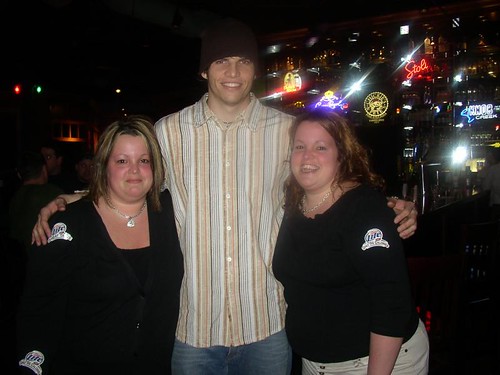


Basketbawful's most favoritest poster boys: Because it never, ever gets old.
1. Greg Ostertag. God, we miss you Greg. We really do.
2. Shawn Bradley: They called him "The NBA Bitch" for a reason. Many reasons, actually.
3. Michael Olowokandi: How's that ball taste, Kandi Man?
4. Alonzo Mourning: There's just something sweet about watching a defensive menace getting posterized. Sorry, 'Zo.
5. Dikembe Mutombo: Kids, this is what happens when you finger wag people.
Labels: Alonzo Mourning, Dikembe Mutombo, Greg Ostertag, Kyle Korver, Michael Olowokandi, shawn bradley, Word of the Day
I learned 97 percent of what I know from the feral wolves that raised me. The other three percent I learned from Internet porn and the Nike Fun Police commercials. Despite the fact that they starred a group of professional basketball players with a combined contractual worth of over $200 million, the Fun Police taught me that life isn't about fame, fortune, or gaudy statistics. It's about living life the right way. It's about the team over ego. And, most importantly, it's about cuddling.
Fortunately, some of the Fun Police commercials have made to YouTube. Unfortunately, the best of the group has not (so far). It's the one where the Fun Police interrogate a fat white kid who won't pass to his teammates. Someone (I believe Damon Stoudemire) inspects the kid's ball with infrared goggles and determines that "There's only one set of prints on this ball" while Gary Payton just keeps saying, "C'mon, dawg...pass the ball...pass the ball!" Then someone else (Jason Kidd?) cries "Look!" and opens a closet door to reveal hundreds of basketballs. Great stuff.
These are the Fun Police commercials I was able to find. In this one, Kevin Garnett, Tim Hardaway, and Alonzo Mourning force a rich white couple to sit in the nosebleed section so a group of black teens can have their courtside seats. But don't get the wrong impression. This isn't about race relations. This is about fun. (And apparently getting one up on Whitey is how NBA players have their fun.)
Here, Damon Stoudemire, Gary Payton, and Jason Kidd discuss what is and isn't fun at a laundromat. No look passes? Fun. You get the idea. Kidd's final suggestion draws a little hairy eyeball from Stoudemire and Payton, but honestly, what did they expect? They're a group of grown men wearing matching black turtlenecks and slacks, and they're hanging out at a local laundromat in the middle of the night. Cuddling is the least I would have expected in that situation.
This last one shows Kevin Garnett menacing former teammate Cherokee Parks about the length of his shorts (two-and-a-half inches above the kneecaps, I believe). The video doesn't have any sound, but that makes it funnier somehow, especially at the end when Parks points an accusing finger at Tom Gugliotta and Googs almost kills him. In the closing shot, Parks looks like a guy who just got put in jail for tax fraud and has to share a cell with a couple guys nicknamed "Velvet Anvil" and "Bluto the Ass Blaster."
Fortunately, some of the Fun Police commercials have made to YouTube. Unfortunately, the best of the group has not (so far). It's the one where the Fun Police interrogate a fat white kid who won't pass to his teammates. Someone (I believe Damon Stoudemire) inspects the kid's ball with infrared goggles and determines that "There's only one set of prints on this ball" while Gary Payton just keeps saying, "C'mon, dawg...pass the ball...pass the ball!" Then someone else (Jason Kidd?) cries "Look!" and opens a closet door to reveal hundreds of basketballs. Great stuff.
These are the Fun Police commercials I was able to find. In this one, Kevin Garnett, Tim Hardaway, and Alonzo Mourning force a rich white couple to sit in the nosebleed section so a group of black teens can have their courtside seats. But don't get the wrong impression. This isn't about race relations. This is about fun. (And apparently getting one up on Whitey is how NBA players have their fun.)
Here, Damon Stoudemire, Gary Payton, and Jason Kidd discuss what is and isn't fun at a laundromat. No look passes? Fun. You get the idea. Kidd's final suggestion draws a little hairy eyeball from Stoudemire and Payton, but honestly, what did they expect? They're a group of grown men wearing matching black turtlenecks and slacks, and they're hanging out at a local laundromat in the middle of the night. Cuddling is the least I would have expected in that situation.
This last one shows Kevin Garnett menacing former teammate Cherokee Parks about the length of his shorts (two-and-a-half inches above the kneecaps, I believe). The video doesn't have any sound, but that makes it funnier somehow, especially at the end when Parks points an accusing finger at Tom Gugliotta and Googs almost kills him. In the closing shot, Parks looks like a guy who just got put in jail for tax fraud and has to share a cell with a couple guys nicknamed "Velvet Anvil" and "Bluto the Ass Blaster."
Labels: Alonzo Mourning, Cherokee Parks, commercials, Damon Stoudemire, Fun Police, Gary Payton, Jason Kidd, Kevin Garnett, Nike, Tim Hardaway, Tom Gugliotta
Word of the Day
Links
Archive
January 2005February 2005
October 2005
November 2005
December 2005
January 2006
February 2006
March 2006
April 2006
May 2006
June 2006
July 2006
August 2006
September 2006
October 2006
November 2006
December 2006
January 2007
February 2007
March 2007
April 2007
May 2007
June 2007
July 2007
August 2007
September 2007
October 2007
November 2007
December 2007
January 2008
February 2008
March 2008
April 2008
May 2008
June 2008
July 2008
August 2008
September 2008
October 2008
November 2008
December 2008
January 2009
February 2009
March 2009
April 2009
May 2009
June 2009
July 2009
August 2009
September 2009
October 2009
November 2009
December 2009
January 2010
February 2010
March 2010
April 2010
May 2010
June 2010
July 2010
August 2010
September 2010
October 2010
November 2010
December 2010
January 2011
February 2011
March 2011
April 2011
May 2011
June 2011
July 2011
August 2011
September 2011
October 2011
November 2011
December 2011
January 2012
February 2012
March 2012
April 2012
May 2012
June 2012
July 2012
August 2012
September 2012
October 2012
November 2012
December 2012
January 2013
February 2013
March 2013
April 2013
May 2013
June 2013
July 2013
August 2013
September 2013
October 2013
November 2013
December 2013
April 2014
May 2014
June 2014
July 2014
August 2014
June 2018
July 2022
contact: basketbawful@yahoo.com