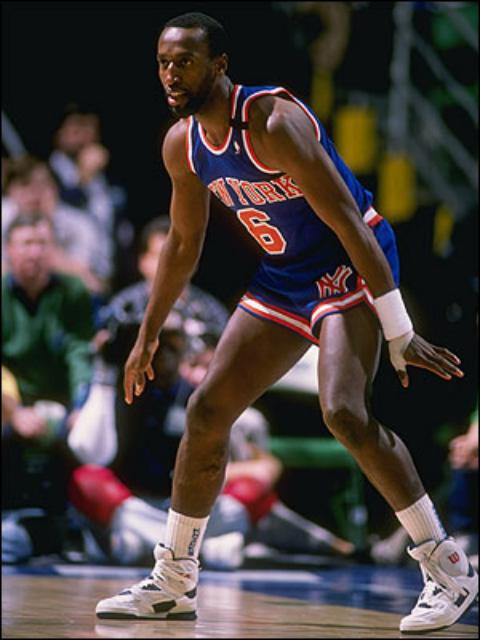
Trent Tucker Rule (trent tuk'-uhr rool) noun. The NBA rule that disallows any standard shot (specifically a "catch and shoot" attempt) to be taken if the ball is put into play with less than three-tenths of a second left on the game clock.
Usage example: There's only one-tenth of a second left. According to the Trent Tucker Rule, that means there isn't enough time left to catch the ball and shoot it.
Word history: Most astute NBA fans are aware of this rule, but there are still plenty of people who don't know why it was originally created. The rule was conceived (although nobody knew it at the time) on January 15, 1990 during a game between the Chicago Bulls and New York Knicks at Madison Square Garden. The score was tied at 106 with one-tenth of a second left in regulation and the Knicks had possession of the ball. During a time-out called by the Knicks, both teams prepared for the (seemingly) inevitable final play: An alley-oop lob pass to Patrick Ewing.
Knicks coach Stu Jackson designed the play so that Trent Tucker would act as a decoy to draw Michael Jordan out to the perimeter and open up a lane for Patrick Ewing to receive the pass. But according to Tucker: "Michael read the play, which took away our number one option. We really didn't have a number two option because we were (only) one-tenth of a second, and we didn't have a lot of time."
When play resumed, Mark Jackson -- who was inbounding the ball for New York -- saw that the Bulls had the play covered, so he inbounded the ball to Tucker, the only open player. Tucker turned and hit a three-pointer at the buzzer, propelling the Knicks to a 109-106 victory. This is how Tucker described the final play: "Mark gave me a flip, and I shot the ball as quickly as I could. Scottie Pippen's hand met my hand as the ball left. When it went in, the Garden went crazy and we took off of the court. Phil Jackson (the Bulls' coach) was waving, 'No way, no basket.' We ran to the locker room, undressed as quickly as we could and got into the shower to make sure that they (the officials) wouldn't call us back on the floor. In our minds, the game is over."
It wasn't over for the Bulls, though. Phil Jackson, typically, was incensed. He argued vehemently that it was impossible to get a shot off in that amount of time. "A second or two, maybe. But in one-tenth of a second it can't be done. You can't shoot a shot in that time. The officials are still getting adjusted to the tenths of a second.'' Then, in true Zing Master style, he put in a final jab: "It was a judgment call. They just got a friendly call and let's leave it at that." Ah, the more things change, the more they don't...
Anyway, Jackson and the Bulls decided not to just "leave it at that." They filed an official protest with the NBA -- which cost them $1,500, by the way -- in an attempt to have the shot overturned. Had they won the protest, the teams would have had to replay the final tenth of a second and (if necessary) play one or more overtime periods to conclude the game.
It didn't matter. NBA commissioner David Stern denied their appeal. (Come on...he's always been a New York guy!) Stern admitted that Tucker's shot came well after time had expired but said that, according to league rules, the commissioner can uphold a protest only in cases in which a playing rule has been violated or misapplied. But in the case of the game in question, Stern "pointed out with legalistic exactitude" that no rules were violated; the officials simply started the clock too late, giving Tucker the time he needed to attempt the shot.
Said the Commish: "The question before me is not whether Trent Tucker received Mark Jackson's pass and released his shot within one-tenth of second. Plainly, he did not. The question presented by Chicago's protest, rather, is whether the referees' failure to disallow Tucker's shot constitutes a sufficient basis for overturning the result of the game. The NBA has consistently denied protest based on errors in judgment by the game officials." Again, the more things change, the more they don't...
Even though he slapped down the Bulls' protest, Stern announced that from that point forward, if the ball is put into play with less than three-tenths of a second on the clock, "any shot other than a tip-in or an alley-oop must be disallowed." And thus the Trent Tucker Rule was born.
But the new rule could not erase Tucker's accomplishment. Or his joy over it. "It's the greatest shot I ever made. I just caught the ball and flung it. When the ball left my hands, I knew it was on target. What I didn't know was whether it had the distance. When it went in, I thought to myself, 'not bad for a guy who was supposed to be a decoy on the play."
Further reading: The official NBA rulebook states that: "NO LESS THAN :00.3 must expire on the game clock when a player secures possession of an inbounds pass and then attempts a field goal. If less than :00.3 expires in such a situation, the timer will be instructed to deduct AT LEAST :00.3 from the game clock. If less than :00.3 remain on the game clock when this situation occurs, the period is over, and the field goal attempt will be disallowed immediately whether successful or unsuccessful." You can read more if you follow the link, but that's the gist of it. You can also go to Hoopedia for a detailed description of how the rule is implemented.
Update! Mighty Science, with help from Jason Kapono and his beautiful hair, has proven that it is in fact possible to catch and shoot with less than three-tenths of a second. And here's the video to prove it. (But don't expect a rule change any time soon.) Thanks to Basketbawful reader herman for the link.
Labels: buzzer beaters, Chicago Bulls, David Stern, NBA History, NBA rules, New York Knicks, Phil Jackson, trent tucker, Word of the Day

The Gary Payton Rule (thu ger'-e pa'-tun rool) noun. The unofficial name for an NBA rule passed in 2005 which stipulates that players who are traded and then waived by their new team cannot sign back with the team that traded them for 30 days (20 days in the offseason).
Usage example: [From the LakersGround.net forums] "It's the Gary Payton rule, for when Gary Payton refused to report to Atlanta after being traded there from Boston."
Word history: ESPN's Marc Stein coined the term (I think) in a 2005 article titled Ten nuggets in the new CBA and further explained it in a recent Weekend Dime column: "[The Gary Payton Rule was instituted] after Payton was traded by Boston to Atlanta at the trade deadline in 2005, only to rejoin the Celtics three days later after the Hawks agreed to release him in a pre-arranged deal. Since the summer of 2005, players who are traded and then waived by their new team are forced to wait 30 days before re-signing (only 20 in the offseason) with the team that just traded them."
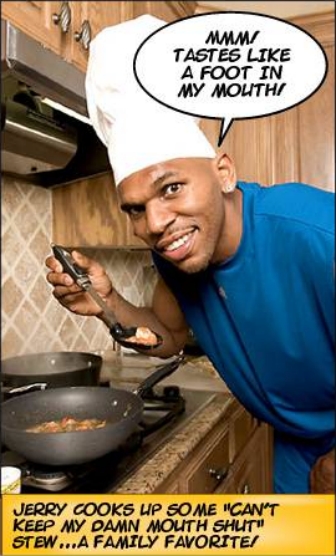
Word in the press: The Gary Payton Rule has gotten some play this week, thanks to the Jason Kidd-to-Dallas Mavericks non-trade. See, as part of the proposed deal, Jerry Stackhouse was going to be sent to New Jersey, waived, and then subsequently re-signed by the Mavs after the required 30-day waiting period. Of course, Stackhouse had to blow that idea all to hell by running off at the mouth. Stack told everybody who would listen that he was part of the deal only "to make the numbers work" and then said, "I feel great. I get 30 days to rest then I'll be right back. I ain't going nowhere."
Of course, the NBA doesn't allow that kind of prearranged agreement. So of course several "anonymous" (read that "vagina-like") league executives and GMs starting speaking out. Said one Eastern Conference exec: "It sounds like a side deal, doesn't it? The league will have a lot of explaining to do if Stackhouse goes back to Dallas." Said an unidentified GM: "I thought it was the most blatant statement someone could make about a trade. I wouldn't be surprised at all if the league disallowed Stackhouse to go back to Dallas." Yet another spineless GM said: "It's caused a lot of people to wonder how they could get away with that, how those kind of pre-existing arrangements can be allowed." I'm pretty sure these anonymous comments provided to David Stern noterized and in triplicate.
So there you have it. Even if somebody talks sense into Devean George, Stackhouse's rash words will kill the trade, because the Mavericks have said they won't pull a trigger on the deal if it costs them Stackhouse (and thus rob them of their team depth). Nice work there, Jerry. [Insert "Wah waaaaaaah" noice here.]
Word trivia: In that same Dime column mentioned above, Stein added another amusing historic tidbit: "The irony here, though, is that Dallas also got at a player back in Payton-like circumstances at the '05 deadline when Alan Henderson was sent to Milwaukee as part of a deal for Keith Van Horn before the Bucks set Henderson free so he could return to the Mavs. Not that anyone ever suggested that we refer to the new regulation as The Alan Henderson Rule."
Funtastic extra: While trying to create a fake Gary Payton Atlanta Hawks jersey for this post, I discovered that the Hawks are one of the only teams in the league that does not offer customized jerseys. Seriously. I mean, I already knew there wasn't a market for customized Hawks jerseys, but that's still pretty humiliation, and thus worth noting.
Footnote: I reviewed the entire NBA Collective Bargaining Agreement and couldn't find The Gary Payton Rule. Anybody else want to take a shot?
Labels: blockbuster trades, Dallas Mavericks, Gary Payton, Jason Kidd, Jerry Stackhouse, NBA rules
February 2005
October 2005
November 2005
December 2005
January 2006
February 2006
March 2006
April 2006
May 2006
June 2006
July 2006
August 2006
September 2006
October 2006
November 2006
December 2006
January 2007
February 2007
March 2007
April 2007
May 2007
June 2007
July 2007
August 2007
September 2007
October 2007
November 2007
December 2007
January 2008
February 2008
March 2008
April 2008
May 2008
June 2008
July 2008
August 2008
September 2008
October 2008
November 2008
December 2008
January 2009
February 2009
March 2009
April 2009
May 2009
June 2009
July 2009
August 2009
September 2009
October 2009
November 2009
December 2009
January 2010
February 2010
March 2010
April 2010
May 2010
June 2010
July 2010
August 2010
September 2010
October 2010
November 2010
December 2010
January 2011
February 2011
March 2011
April 2011
May 2011
June 2011
July 2011
August 2011
September 2011
October 2011
November 2011
December 2011
January 2012
February 2012
March 2012
April 2012
May 2012
June 2012
July 2012
August 2012
September 2012
October 2012
November 2012
December 2012
January 2013
February 2013
March 2013
April 2013
May 2013
June 2013
July 2013
August 2013
September 2013
October 2013
November 2013
December 2013
April 2014
May 2014
June 2014
July 2014
August 2014
June 2018
July 2022