
Note: The first version of this post was listed as being published in 2003. How does that happen, you might ask? Well, I'll tell you: Sleep deprivation. Thank Odin (and George Washington) I have a three-day weekend...
Last night after work, I met up with Graydon Gordian of 48 Minutes of Hell (pictured above) at a little Chicago Loop dive called Stocks & Blondes. We shared three buckets of beer, a couple plates of random chicken parts, and several hours worth of intense basketball conversation, debate and gossip on a pretty wide range of topics. It was kind of like being on a roller coaster, where you know you’re not going to fall out but it kind of feels like you are.
The meetup did make me feel my age a bit: After nearly four hours of nonstop beerage, Graydon left...to go out drinking with his buddies. Ah, to be in my early 20s again. But there was, at least, a good reason for the extended celebration: Graydon was just accepted to grad school at Northwestern. Congrats, Graydon. It was good times. The only downside, really, was that we had to watch...
The Chicago Bulls: The Bullies fell way behind against the Pistons earlier this week but managed to win after finishing the game on a 17-2 run. Apparently, the box office returns were high enough to warrant a sequel. But here's the things: Sequels are almost never as good as the original...with The Empire Strikes Back, Superman II, Star Trek II: The Wrath of Kahn, and The Dark Knight being notable exceptions. This was no Empire, though. It was more like Caddyshack II.
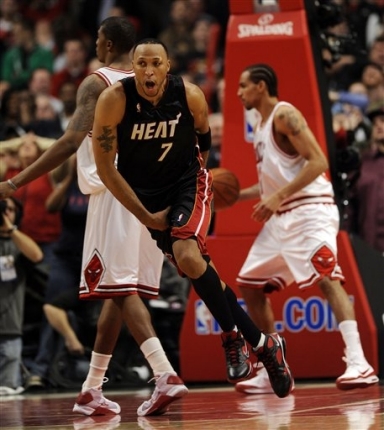
Chicago struggled their way back from a 14-point third quarter deficit to take a 86-85 with just over three minutes to go. Then they let Miami go on an 8-0 run. Then the Bulls went on a 7-0 run to tie the game at 93-all. Miami had possession of the ball with less than 10 seconds left, but Kirk Hinrich stole Shawn Marion's inbound pass and quickly called timeout. Chicago had 6.5 ticks on the clock and a chance to make magic happen. But...
Vinny Del Negro: The man Tom Ziller nicknamed "The Notorious V.D.N." became even more notorious in the Windy City last night. Like I said, the score was tied and the Bulls had the ball and enough time to get off some kind of shot or, at worst, go into overtime at home. But Vinny inexplicably LEFT DERRICK ROSE ON THE BENCH AND PUT IN THABO SEFOLOSHA. What in the Nine Rings of Hell was he thinking? I hadn't seen a worse coaching move all season (although I would shortly).
So Thabo, who played all of six minutes and 15 seconds last night, ended up inbounding the ball to the best player on the court. Unfortunately, that was Dwyane Wade. Pookie called timeout with 3.5 seconds left.
Now, it's important to point out that the Bulls still had a foul to give. So Vinny should have instructed his players to foul almost immediately after the Heat inbounded the ball, just to burn a second or so off the clock. And even if they hadn't had that foul to give (or if Vinny for some reason chose not to use it), he should have instructed them to stay in front of whoever catches the ball (in this case Wade) and also guard the guy inbounding the ball (in this case Marion), because -- as Hubie Brown likes to say -- that's the most dangerous player in end-of-game situations.
So what did the Bulls do? They didn't commit the foul, they didn't say in front of Wade, and they didn't guard Marion. Wade penetrated, the Bulls collapsed, and he dished to a cutting Marion for the game-winning dunk.
Terrible coaching. Terrible.
Luol Deng: I really thought Luol was "back" a few weeks ago. He's been slumping ever since. Whoops. Last night he finished with 6 points (2-for-6), 3 rebounds and 2 fouls in 28 minutes. It's like the aliens I keep telling everybody about stole him, he escaped briefly, and then they stole him back.
Shawn Marion: I know he was happy about the game-winning flush. But did he really have to grab his genitals in celebration? I guess it's better than doing the Big Balls Dance, but still. (Thanks to Sky Flakes for the picture assist.)
The Dallas Mavericks: The Mavericks were playing at home. They went up by as many as 15 points in the third quarter. Kevin Garnett's PT was limited due to foul trouble. Doc Rivers got ejected. The Celtics committed 19 turnovers (to only 8 for the Mavs). In other words, Dallas had every reason to win this game. But they did not. They shot like crap (39 percent), got pounded on the boards (50-31) and couldn't figure out what to do with Paul Pierce, who scored 18 of his 31 points in the fourth quarter to help the Celtics rally for a 99-92 win.
When are the Mavericks going to figure out that Jason Kidd isn't a defensive stopper anymore? They use him on Kobe to no effect, and last night they let him man up on Pierce, and Pierce repeatedly destroyed him. There's probably an image of Paul burned into Jason's retinas today. Memo to Rick Carlisle: Send help! Make Rondo shoot a jump shot or something. I don't care if he had a triple-double (19 points, 15 rebounds, 14 assists). I would rather give Rondo the green light than let Paul Pierce find his rhythm. There had to be a better defensive strategy than that.
(P.S. Remember what I said about J-Kidd's defense? Refer to Rondo's triple-double. That is all.)
The Portland Trail Blazers: The Blazers were beaten by Corey "Bad Porn" Maggette (24 points, 9-for-16) and Ronny Turiaf (14 points, 11 rebounds). And for the record, that was Turiaf's first double-double in nearly two years. Way to play defense, guys. (Although, in all fairness, Portland did hold the rest of the Warriors down a bit; Golden State shot only 40 percent from the field.) The Blazers didn't help their cause by committing 23 turnovers, either.
Chris's Lacktion report: Today is of course the last day before the All-Star Weekend, but not a night that lacktators could lose the limelight!
Heat-Bulls: Thabo Sefolosha beefed up his clumsiness to put down +3 in 6:15 of hardwood grazing for Chicago, in getting grilled for a brick, giveaway, and rejection! And 9:57 of court time for Miami's Joel Anthony allowed him to earn a bit of a Voskuhl with three fouls and one giveaway versus one field goal and rebound each for a ratio of 4:3.
Blazers-Warriors: CJ Watson wanted to make the most of life as a lacktator, and thus spent 11:44 savoring a solid suck differential: one foul and turnover each and two bricks for +4!
Marketing madness: The NBA All-Star H-O-R-S-E competition was sold away and is now the G-E-I-C-O competition. And it will take place during a special two-hour Inside the NBA presented by Hyundai! In honor of this, Evil Ted and I prepared an even specialer video parody of Hyundai's current marketing campaign. Enjoy.
Apparently the funnyordie.com "embed video" function sucks, so:
CLICK HERE TO WATCH THIS SPOOF.

Labels: Chicago Bulls, Dallas Mavericks, NBA marketing, Portland Trail Blazers, Vinny Del Negro, Worst of the Night
 Is the prestige and adulation of the NBA All-Star Game just not your thing? Would you rather spend your time looking into new hair-care products or making poorly timed trade demands? No need to conjure up a mysterious hip ailment or get caught urinating in a Wendy's dumpster, here are a few proven, sure-fire ways to get completely ignored every January. Rest up, your team has three busy months of losing to worry about.
You are The Man...The 6th Man. As long as Gregg Popovich is alive, Manu Ginobili will never go to the All-Star Game again. Popovich always insists on keeping Manu's minutes down, presumably to keep him fresh (i.e. he gets so amped at times he may spontaneously combust), but to the casual fan this means a lack of talent. But if someone hid the Mentholatum vapor rub, rendering Michael Finley, Brent Barry and Bruce Bowen unable to move, you'd see that Ginobili is quietly having an insanely good year. Sit down for this: 4th among shooting guards in assists (per 48 mins), 3rd in points and 2nd in steals, while shooting 40% on threes and an NBA Jam-like 74% in the clutch! Kobe Bryant, you can't do that.
But practical-minded coaches can be the downfall of many a great player. What if Phil Jackson decided to keep Michael Jordan "fresh" during the 90's? Pigeons would be pooping on a Scottie Pippen statue in front of the United Center. I trust that Ginobili will be tossing back some brews with guys like Ricky Pierce, Detlef Schrempf and Toni Kukoc, and having a good laugh. Because exhibition games are for suckers.
Your Teammates Suck. Al Jefferson is having the break-out year many people expected, but there was no doubt whatsoever that Al would be completely ignored. Great players on crappy teams are largely overlooked because people are fully aware of the "Ugly Friend" effect: you might look awesome only because your teammates are terrible.
Believe it or not, Zach Randolph was a completely respectable player as recently as last year. But a 24 point, 10 rebound campaign was nowhere near enough to hide the fact that the Blazers were working on 50 losses (and Zach had outstanding warrants). And Shareef Abdur-Rahim goes without saying (a steady 20 point, 9 rebound, 50 loss guy in Vancouver for 5 seasons).
The "Ugly Friend" effect was so effective back in 2001, it even fooled Bulls GM Jerry Krause, causing Elton Brand to be traded for pennies on the dollar. Those pennies being Tyson Chandler, then PJ Brown. And yes, I'm still bitter.
You have no endorsements and magazines ignore you. Make no mistake, the All-Star Game can be a shameless popularity contest, and if you don't market yourself, the NBA won't market you. The tide turned when BJ Armstrong started alongside Kenny Anderson back in 1994. Now, at this point in time, is Jason Kidd, with his advanced age and sub-37% shooting, a better option than Michael Redd?
Allen Iverson and Carmelo Anthony were voted as starters this year, but the last two league MVPs had to be named as reserves. Think about that.
Labels: All-Star Game, conspiracy theories, Manu Ginobili, NBA marketing
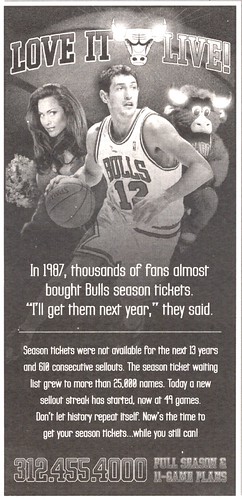
I love the blatant fear mongering: If you don't buy season tickets right now, they could be sold out for 13 years...it happened before. And while that statement is true, technically speaking, the "before" team featured Michael Jordan. And unless I passed out and missed something big, the Bulls didn't sign Jordan in the offseason. They signed Joe Smith. I don't see Smith -- who averaged a whopping 8 PPG and 6 RPG last season -- tipping the balance of power in the Eastern Conference. But then again, the East is so crappy I guess it's not entirely out of the question. Next June, I might be forced to admit that the Bulls had been only one Joe Smith away from reaching the NBA Finals. But I doubt it.
I just sort of think the scare tactics are a little much. A team should be sold on its merits, not the fear of maybe, possibly, conceivably missing out on legendary run, especially when there's no real evidence to suggest that's going to happen any time soon. If the Bulls had won the draft lottery and snagged Greg Oden or Kevin Durant, I could see the value of a "don't miss out" marketing campaign. As things stand, I think the Bulls should be marketed for what they are: A group of young, exciting, up-and-coming players who play hard every night.
Fat chance of that, though. None of the current roster are even mentioned as attractions on the team's official season ticket page. However, the page does try to entice you with the chance to see "LeBron, D-Wade, Shaq, Kobe, Garnett, McGrady, Duncan and the rest of the NBA's elite." That can't make guys like Ben Gordon, Kirk Hinrich, or Luol Deng feel very good about themselves.
Oh well. That's marketing for you. It is what it is. And besides, it doesn't really matter to fans like me. I've been attending Bulls games since they were rocking a lineup that featured Dickey Simpkins, Mark Bryant, Randy Brown, and Rusty LaRue. And as long as they keep Luvabulls like Carissa around, I will keep on loving it live.

Labels: Chicago Bulls, Joe Smith, NBA marketing
It happens every season. Some alleged NBA "expert" writes a long and damning editorial about how the league has been or is in the process of being destroyed by marketing individual superstars ahead of the team. The latest of these quibblers are MSNBC's Mike Celizic, who bemoans how the NBA has traded away teamwork for the cult of personality, and FOX Sport's Randy Hill, who claims that the NBA is responsible for the "me first" attitude among players.
Both Celizic and Hill make it sound as if this is a relatively new phenomenon. Celizic only goes back as far as the Shaq/Kobe fued, and Hill, for his part seems to think it began with Larry Bird and Magic Johnson. To which I say: What??!
Maybe they're trying to frame their articles within a context that current NBA fans can understand, or maybe they ignorant of league history. The NBA was born in the fall of 1949, when the Basketball Association of America (BAA) merged with the rival National Basketball League (NBL). At the time, professional basketball was just a way of filling stadiums and sports arenas when there wasn't anything else going on. It was almost impossible for owners to maintain financial viability, and teams were constantly folding or moving to new cities. In 1949, the NBA featured teams such as the Washington Capitols, Providence Steamrollers, Rochester Royals, Chicago Stags, St. Louis Bombers, and Indianapolis Jets. Ever hear of those teams? Didn't think so. Furthermore, the Warriors were in Philidelphia, the Pistons were in Fort Wayne, and the Lakers were in Minneapolis.
Team owners, desperate to turn a profit, quickly realized that fans (and potential fans) were drawn to specific players as much or moreso than the teams they played on. Many times, a team would draft local college players ahead of other, more talented players. In fact, the league even instituted a territorial draft that took place before the regular draft. This allowed a team to forfeit its first-round pick to select a player from its immediate area (under the assumption that the player had a strong local following). That's how the the Boston Celtics got Tom Heinsohn, and how the Philidelphia Warriors got Wilt Chamberlain.
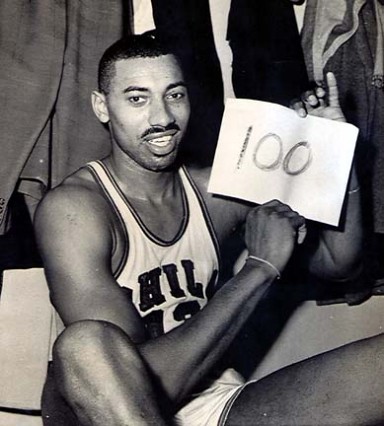
Anyway, the league has marketed the individual from the very beginning. In the late 1940s and early 1950s, George Mikan was professional basketball's first superduperstar, and when his Lakers travelled to New York, the billboards would read "George Mikan versus the New York Knickerbockers." The NBA All-Star game was created in 1951 so the league could showcase its best individual players. And let's not forget about Wilt Chamberlain. People flocked from the four corners to see him play, regardless of whether it was for the Warriors, the Sixers, or the Lakers. Due to his incredible popularity (and the resulting boost to ticket sales), he demanded and received the first $100,000 per year contract -- at a time when most players were making around $10,000 per. (Immediately afterward, Red Auerbach signed Bill Russell to a contract worth $100,001 per year, just to one-up the big guy; and thus the "exploding salary scale" was born.) And, much like today's stars, Wilt was accused of putting stats and records ahead of winning, which led the "experts" to conclude that Wilt's greed and selfishness would ruin basketball. Sound familiar?
The point is: none of this is new. Look, I'm as much a basketball purist as anybody. I want the sport to be played "the right way" -- fundamentally sound and team-oriented. I would much rather see the Phoenix Suns have six or seven players in double figures than watch Kobe score 81 points while the rest of the Lakers stand around and watch. But I also understand that the NBA is a business, and, as with all businesses, making money is the bottom line. Does this lead to selfish players trying to pad their stats to sign bigger and better contracts? Of course. But that's always happened. Pat Riley was a member of the 1971-72 Los Angles Lakers team that won 33 straight, finished the season 69-13, and won the NBA championship. Do you think "Mr. 15 strong" put the team first? He'll tell you he did, but by every account I've read, he fumed about not getting enough playing time, sulked whenever he was benched, and regularly got into fights with teammates during practice over his role on the team. So there you have it.
The selfishness and me-first attitude have been around since the beginning. The only real difference is how it's being expressed by today's players. And that problem is due more to modern cultural influences than NBA policy. The fact is, David Stern can't regulate teamwork, selflessness, and desire. There are too many other factors involved.
And as for the writers and critics, well, they don't really suggest any kind of realistic alternative. The NBA is a business that makes a profit by marketing its players. Take away the league's profit center, and you take away the league. Unless they can suggest some kind of practical solution, I wish they'd stop recycling the same story year after year.
Labels: NBA marketing
February 2005
October 2005
November 2005
December 2005
January 2006
February 2006
March 2006
April 2006
May 2006
June 2006
July 2006
August 2006
September 2006
October 2006
November 2006
December 2006
January 2007
February 2007
March 2007
April 2007
May 2007
June 2007
July 2007
August 2007
September 2007
October 2007
November 2007
December 2007
January 2008
February 2008
March 2008
April 2008
May 2008
June 2008
July 2008
August 2008
September 2008
October 2008
November 2008
December 2008
January 2009
February 2009
March 2009
April 2009
May 2009
June 2009
July 2009
August 2009
September 2009
October 2009
November 2009
December 2009
January 2010
February 2010
March 2010
April 2010
May 2010
June 2010
July 2010
August 2010
September 2010
October 2010
November 2010
December 2010
January 2011
February 2011
March 2011
April 2011
May 2011
June 2011
July 2011
August 2011
September 2011
October 2011
November 2011
December 2011
January 2012
February 2012
March 2012
April 2012
May 2012
June 2012
July 2012
August 2012
September 2012
October 2012
November 2012
December 2012
January 2013
February 2013
March 2013
April 2013
May 2013
June 2013
July 2013
August 2013
September 2013
October 2013
November 2013
December 2013
April 2014
May 2014
June 2014
July 2014
August 2014
June 2018
July 2022