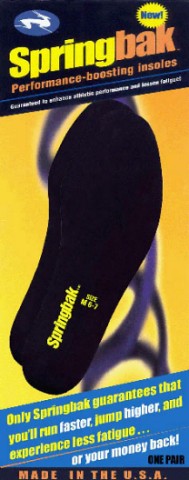
 What it is: A 1/16" rubber insole that fits "any shoe in the world."
What it's supposed to do: According to the official site, Springbak insoles have been scientifically proven and validated to make basketball players "jump higher, run faster, move quicker to the ball, play with more energy, set stronger picks, grab more contested rebounds, have greater endurance, avoid shin splints and other pesky leg problems, and a whole lot more."
What it actually does: Provides yet another cruel reminder that increased speed, endurance, and jumping ability is accomplished through focused dedication to specialized physical training, not pseudoscientific gimmickry.
Who it's for: Anyone who wants a placebo-like shortcut to running "faster" and jumping "higher."
What it says about you: You're regrettably lazy, hopelessly naive, or (most likely) both.
Harsh realities: The Springbak people make a lot of amazing claims. They use exciting terms like "Space Age materials," "vibration frequency," and "recoil process" to create the thrilling perception that Mighty Science has created the ultimate jump booster. They then support their assertions with quotes from doctors, coaches, and real athletes. They even hint that Kobe Bryant might have been wearing Springbak insoles when he went on his famous 81-point scoring rampage (they can't prove it, though, because they can't afford Kobe's endorsement fee).
Well, I bought a pair of Springbak insoles. I figured that even if they didn't improve my speed or vertical leap, they'd at least be a good substitute for the shoe inserts I usually wear. I couldn't have been more wrong. The insoles, which go under your shoe's existing foam insoles, are far too thin to provide added cushioning. They're also flimsy and archless, so they don't provide additional support or stability either. If you need to use athletic insoles or custom orthotics, switching to Springbak insoles will not only disappiont you, they might hurt you, too. I also tried using them in conjunction with my existing orthotics. The only difference was that I was jumping more often, simply to see if I could jump any higher. I couldn't.
According to Springback, "[The] bottom line is that you will see a dramatic increase in your overall performance, not only in the off-season but also next fall when you line up against your biggest opponent." That would be wonderful it was true. It's not. The Springbak insoles are a failure at best, a fraud at worst.
Cost and availability: $24.95 (plus S&H) on Springbak.com. If you order 10 pairs or more, you can get them for $22 per pair and get free shipping (for US residents only).
Labels: gear, pickup basketball

What it is: Some cloth dye and needlework on socks that are a blend of 80 percent acrylic, 20 percent stretch yarn, and 100 percent awesome*.
What it's supposed to do: Establish pride, unity, and a sense of identity (for teams); provide a medium of open and honest expression (for individuals).
What it actually does: Holds sweat, chafes your feet, looks exceptionally ugly, and wastes you and/or your team's hard-earned money.
Who it's for: Anybody who wants to play basketball in a pair of hideous, calf-length socks that look like they were imported directly from a bad 80s movie**.
What it says about you: That you're willing to sacrifice comfort and performance to wear socks that kinda-sorta look like "official" team socks, assuming that team is comprised entirely of prison inmates, homeless people, or refugees from some Third World country.
Cost and availability: You can buy them for $6.75 (plus S&H) a pair at Awesome Sports. Of course, they require that you buy at least 12 pairs per color and design. And the fact that there are no refunds on custom orders is obviously the company's subtle way of saying "Satisfaction not guaranteed."
* And by "awesome" I of course mean "godless monstrosity."
** It would, of course, be about a group of lovable, ragtag misfits from Camp Tittywacka who learn important lessons about life and themselves as they train for a tournament in which they defeat a team of vastly superior athletes from rival Camp Kickassawassi.
Labels: gear, pickup basketball
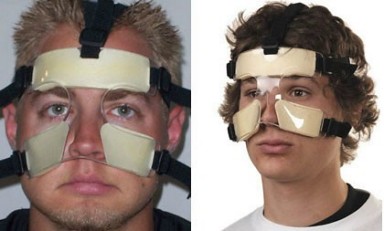
What it is: A vaguely face-shaped sheet of plastic, a few strips of vinyl foam padding, and a couple elastic straps.
What it's supposed to do: Support and protect a broken nose so that the wearer can continue to engage in nose-cracking activities.
What it actually does: Oh, it protects the nose all right, but it also makes you look like Hannibal Lecter's mildly retarded younger brother. Either that or an escaped mental patient from some dark, post-apocalyptic future where the only rule...is that there are no rules.
Who it's for: Anybody who's had their nose shattered but isn't willing to take four to six weeks off from basketball so it can heal properly.
What it says about you: Playing basketball is more important to you than the shame and embarrassment associated with wearing a Dork Vader mask to protect your minor facial injuries.
Celebrity endorsement: After suffering three major nose demolitions during the 2003-04 season, Rip Hamilton began wearing his protective mask full time in the 2004 NBA Playoffs. And he continues to wear the mask to this very day, reportedly because three reconstructive surgeries have left him decidedly Michael Jacksonesque: That is, without nose cartilage and vulnerable to a career-ending injury. He also claims the mask brings him good luck. Anyway, here's an amusing video about Rip and his unstoppable Mask of Doom.
Personal anecdote: During my sophomore year in college, I was getting a booty call engaged in a mutually fulfilling session of physical and emotional intimacy when my girlfriend accidentally knocked a 50-pound stereo speaker onto my face. You read that correctly: She dropped a 50-pound stereo speaker on my face. I might have been able to catch it, but she was going through that adorable "neurotically insecure with her body" phase that all college girls seem to go through, and she had demanded I keep my eyes closed during The Sex. And since I was simultaneously going through that "I'd do anything for the booty" stage that most college guys go through, I happily capitulated. So I was just lying there -- probably with a big, goofy smile on my face -- when the world exploded into a dazzling array of multi-colored wonder. I opened my eyes and saw three things: Stars, a geyser of my own blood, and my shrieking girlfriend. Since she was too distraught to do anything but scream and run around the room in circles, I was forced to staunch the blood flow with a pair of my own jeans and call a friend for help. He showed up with this little first aid kit and said, "I read somewhere that 80 percent of head wounds look worse than they really are." I showed him mine, and then he said, "Yeah, let's go to the hospital."
It was a big party weekend at my school, so it took 20 minutes to convince the nurses that having a 50-pound piece of stero equipment dropped on my face had nothing whatsoever to do with binge drinking. When they finally let me into the emergency room, the doctor sagely informed me that the rogue speaker had "obliterated" my nose. It was a compound fracture, which in medical terms means "the broken ends of bone have pierced the skin." Yeah, it was ugly. I was then introduced to the transcendent joys of local anesthetic and emergency reconstructive surgery.
I left the hospital with two black eyes, 28 stitches, and a freaky mask to wear in case, as the doctor put it, I was "stupid enough to want to play sports before the nose heals." Which of course is exactly what I did. Me and some buddies went to the co-recreational gym a few nights later, "just to shoot around," and ended up in a five-on-five game against four brutish dudes and a girl. Since I was injured, my friends agreed that I should guard the girl, because all things being equal she should have been the least physical of the five. Two plays into the game, however, she whacked me hard across the face while going for the ball. Fortunately I had my mask on, right? Wrong. I was too embarrassed to wear it. The next day, I had to go back to the nose doctor and explain why my nose was now sitting sideways on my face. He responded by ramming a couple wooden sticks up my nose holes and cracking the bone back into place. Good times.
My point? If you break your nose and choose to play hoops, just wear the damn mask.
Cost and availability: Amazon.com has a limited variety of decent nose guards. The Bangerz Nose Guard is $29.95, and the Mueller Nose Guard is $39.00. There's also a generic nose guard for $39.90.
Labels: gear, pickup basketball
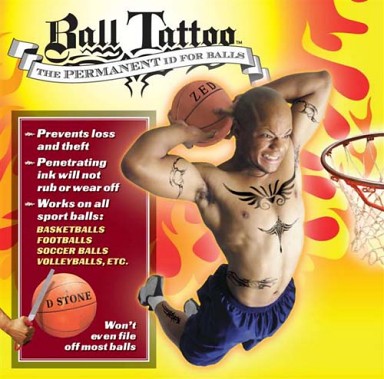
What it is: A stencil and ink set.
What it's supposed to do: Allow you to stencil your name, initials, or some other identifying label on your basketball in permenant ink.
What it actually does: The Ball Tattoo works exactly as advertised. It goes on in a couple of minutes and the resulting "tattoo" looks pretty stylish. It resists fading, too; I've been using the Ball Tattoo for about six months and there has been little or no visible change. Supposedly, you can't even file the ink off, although it's probably better not to try.
Who it's for: Anybody who's paid good money for their basketball and wants to keep track of it. Sure, you could just write your name onto the ball with a felt-tip marker, but it'll look only as good as your crappy handwriting, and then it'll wear off in a couple weeks.
What it says about you: You understand that there are unscrupulous and clueless people everywhere, and discovering that somebody walked off with your $50 basketball while you were in a game is a bitter pill to swallow.
The specifications: Each Ball Tattoo kit contains one sheet of 45 one-inch tall stencil letters, masking strips, a tube of ink, and an applicator brush. The seller claims there's "enough ink to ID up to three balls," which might be a little deceptive. There's actually about 20 letters worth of ink in the tube, so choose your ball ID carefully, Amadeaus. The ink works on rubber, leather, and synthetic balls. Currently, only one font (Lasertac) and color (black) are available.
Cost and availability: $6.95 (plus S&H) at Fastencil.com.
A note of caution: One of the product's taglines is "Looks like silk screen. Works like Kryptonite!" I'm not exactly sure what that's supposed to mean, except that if Superman plays in your pickup league you might accidentally kill him.
Update: Reader eljpeman astutely pointed out that the subtitle on the graphic reads "The permanent ID for balls." For those of you with dirty minds, I'm pretty sure they're talking about basketballs and not, uhm, well, yeah.
Labels: gear, pickup basketball
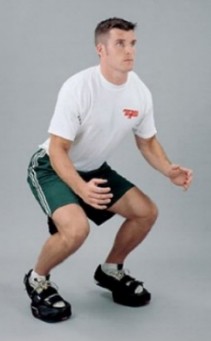 What it is: Plastic platforms that attach to the front of your shoes, forcing you to walk in a painful, duck-like manner, similar to the kind of torture that the Nazis inflicted on their cyborg gorilla shock troopers (see illustration).
What it's supposed to do: Increase your vertical leap by 5 to 10 inches, take two-tenths of a second off your 40-yard dash time, and increase anaerobic power by 500 percent.
What it actually does: (You mean, assuming they don't get tossed in the closet and forgotten after two or three uses, like 99 percent of the jumpsoles that have been sold?) Creates huge, throbbing calf muscles -- think Popeye's forearms, only on your legs -- and inspires delusions of leaping grandeur that will never, ever, under any circumstances, come true.

Who it's for: Basketball players who can't jump over a nickle or outrun their aging grandmother (who, for the record, has had both hips and one knee replaced), but nonetheless dream of streaking downcourt like a bolt from the blue and soaring through the air for a monster jam over the awestruck pickup leaguers. This is, of course, a colorful euphemism for "white guys."
What it says about you: You can't accept the cold and pitiless truth: That you will never dunk, except maybe on those 8-foot plastic rims they have over at the local elementary school.
Fact versus fiction: You've heard the stories before: "Just before his 6th birthday, little Timmy was doing awesome tomahawk crams, two-handed dunks, reverse james, windmill slams, you name it -- and he's only two feet tall!!" These are the kinds of amazing claims you'll read anywhere and everywhere jumpsoles are sold. One of the testimonials, and my personal favorite I might add, was titled "wooo look at the white boy fly," and it was the touching saga of how a brave Caucasian youth turned the tables on fate to become a bounding wonder with the help of his trusty jumpsoles.
While these stories are compelling, jumpsoles "increase" your vertical leap in the same way that Chocolate Frosted Sugar Bombs are a "part" of your balanced breakfast. Expanding the distance between the court and your giant, clunking feet requires a well-rounded program of strength training, core work, and plyometric excercises, not to mention a natural genetic predisposition toward jumping.
Can the jumpsoles and all those other things help you jump a couple extra inches? Maybe. Just don't expect to add an extra foot to your vertical. If that was actually possible, don't you think that every NBA player would be jumping like Mike?
Cost and availability: $69.95 (plus S&H) at JumpUSA.com. If you're ready to drop an extra $20, you can also get the Proprioceptor System, which is a little ball you screw on to the bottom of your jumpsoles. This adds a higher degree of difficulty and instability to your embarrassing duck walk, but it's supposed to improve balance, reduce the risk of ankle and knee injuries, and make you look like a bigger idiot. But isn't the chance to become a jumping god worth the risk of a little humiliation?
Labels: gear, pickup basketball
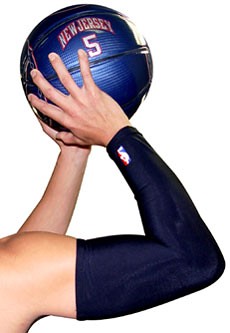 What it is: A form-fitting sleeve, typically made from a synthetic blend of nylon and spandex, that's worn over the forearm and bicep or your shooting arm.
What it's supposed to do: Keep the shooting arm warm, prevent muscles from cramping or overstretching, and help you maintain proper shooting form.
What it actually does: Looks cool. Makes your arm sweaty.
What it says about you: The shooting sleeve was first popularized by Allen Iverson and has been worn by other fan-favorites such as Dwyane Wade and Carmelo Anthony. Yes, those guys are All-Stars, but don't be fooled; this is not a performance-enhancing device. NBA players may claim that the sleeve provides some kind of superficial assistance to their play, but we all know it's more of a fashion statement than anything else, like cornrows, tattoos, and Kobe Bryant's Peter Pan-style tights.


If you currenty wear or have worn a shooting sleeve, you're probably the kind of person who wants to artificially improve your performance without actually practicing. Furthermore, you want other players to know, simply by seeing your pimped-out appearance, that you are a serious baller. This is just a guess, but you probably also pay way too much for shoes (I'm talking easily $100+ per pair), wear throwback jerseys to your pickup league, and maybe even own an official pair of NBA socks (making sure the logo is prominently displayed during games). In short, you take pickup basketball, and yourself, a little -- scratch that, a lot -- too seriously.
Cost and availability: $14.99 (plus S&H) at the NBA online store.
Labels: gear, pickup basketball
February 2005
October 2005
November 2005
December 2005
January 2006
February 2006
March 2006
April 2006
May 2006
June 2006
July 2006
August 2006
September 2006
October 2006
November 2006
December 2006
January 2007
February 2007
March 2007
April 2007
May 2007
June 2007
July 2007
August 2007
September 2007
October 2007
November 2007
December 2007
January 2008
February 2008
March 2008
April 2008
May 2008
June 2008
July 2008
August 2008
September 2008
October 2008
November 2008
December 2008
January 2009
February 2009
March 2009
April 2009
May 2009
June 2009
July 2009
August 2009
September 2009
October 2009
November 2009
December 2009
January 2010
February 2010
March 2010
April 2010
May 2010
June 2010
July 2010
August 2010
September 2010
October 2010
November 2010
December 2010
January 2011
February 2011
March 2011
April 2011
May 2011
June 2011
July 2011
August 2011
September 2011
October 2011
November 2011
December 2011
January 2012
February 2012
March 2012
April 2012
May 2012
June 2012
July 2012
August 2012
September 2012
October 2012
November 2012
December 2012
January 2013
February 2013
March 2013
April 2013
May 2013
June 2013
July 2013
August 2013
September 2013
October 2013
November 2013
December 2013
April 2014
May 2014
June 2014
July 2014
August 2014
June 2018
July 2022