My junior year in high school was...awkward. I had a new body and a new wardrobe, but I was still socially awkward. In high school, back in my day at any rate, social awkwardness was an unavoidable consequence of my lifestyle.
To wit: I loved playing video games. So much so, in fact, that I took the Nintendo versus Sega wars very seriously. I also played Dungeons & Dragons, which was the high school equivalent of locking my genitals in a time capsule for future generations to dissect and study in order to understand why my life was so barren and sexless. As if all that wasn't bad enough, I was a straight A student who was on the school newspaper (because I wanted to be a writer) and the school's literary magazine (because Cindy, my longstanding high school crush, was also on staff and had encouraged me to join).
And did I mention I was rocking some serious Coke bottle glasses?
Look, these days, being a nerd and/or a geek can be pretty cool. There are actual living, breathing women who think geeks are hot. And there are hot chicks who are geeks. This was most definitely not the case when I was in high school. Most girls treated geeks like they bathed in toxic waste, and if you happened to stumble across a female geek, chances are she looked like she really did bathe in toxic waste.
The social pyramid of my high school, from highest to lowest, was: jocks and cheerleaders, preppies (those were the kids who dressed well and had reasonably good table manners), hoods (those were the kids who were jean jackets, carried switch blades they never used, and didn't shower), nerds/geeks, hippies (that is, the kids who pretended to be hippies by listening to The Doors and not wearing deodorant), and The Losers (as described in Part 1).
So that's where I was: somewhere around the lower middle of the social pyramid...although closer to the bottom than the top. This meant that me and my friends -- who were fellow nerds/geeks -- were in the same boat. And, like Michael Ray Richardson might have told us, that ship be sinking. We'd hang out on weekends talking about girls we had no chance of dating and trying to convince ourselves that playing Super Mario Bros. 3 or having a kickass D&D adventure was better than, say, going to the homecoming game or attending prom.
We all lie to ourselves to be happy.
Like many social misfits, I needed an outlet for the frustration of being, well, a social misfit. Basketball became that outlet. During most of the first semester, the weather stayed nice enough that I could continue playing outside. I was becoming bolder, traveling around and challenging people to one-on-one. More often than not, I'd win. And few things made me feel better about myself than pummeling somebody on the basketball court.
One problem I was running into, though, was those Coke bottle glasses I mentioned. I was becoming -- and have remained to this day -- a reckless, all-out kind of player. Crashing the boards, diving after loose ball, playing with reckless abandon...those were the things that won basketball games.
They also beat the hell out of you.
My glasses were always getting mangled. I had to go to my eye doctor at least once a week and ask one of the assistants to bend them back into a semi-recognizable shape. I'm pretty sure those assistants learned to hate me. When I walked in, the receptionist would look at me like I was covered in fresh animal feces. It got to the point where she wouldn't even say "hi" or speak to me at all. She'd just stick out her hand and wait for me to hand my glasses over. Hey, what can I say...I got my money's worth out of whatever I paid for those specs.
Still, it was becoming enough of a problem that I was seriously considering getting contact lenses. It didn't hurt that, during biology class, Alicia H. -- who I believe was somewhere between the cheerleader and preppie layers on my school's social pyramid -- casually remarked about my lost weight and said she thought I'd be handsome if I replaced my glasses with contacts.
Handsome? Me? No shit?
Not surprisingly, I soon made an appointment to investigate getting contacts. Saying it didn't go very well would be something of an understatement. I have no idea what went wrong, but whatever solution they used to prep the contacts burned the hell out of my eyes. The whites turned beet red and the skin around my eyeballs became what my eye doctor called "aggressively swollen."
The doc said something like, "Well, that can happen," and he tried to schedule me for another appointment to try something different. I opted not to show up. I would stick with my awful glasses. For now.
Near the end of November, my school started up an intramural basketball league. There were no set teams, however. You just showed up and shot free throws to decide teams. I figured joining that league was the next logical step in my basketball development. In relatively short order, I had created some skills and become a fairly decent one-on-one player. Now it was time to learn how to play on a team. Or so I thought.
You know how some things are described as "organized chaos"? Well, this intramural league was more like "chaos only." There was no coaching or direction of any kind. Just 20-30 undisciplined high schoolers with varying levels of ability (mostly bad) who embraced all the worst habits of pickup basketball: terrible shot selection, reluctant passing, nonexistent defense and the near absence of anything resembling fundamentals. Guys played out of position. Almost every player on the court thought he was either Magic Johnson or Michael Jordan. Big men didn't rebound, little men couldn't handle the rock. So on and so forth.
It was, without question, the worst of the crappy crap basketball I could find. In fact, looking back on it now, I'm fairly certain I've never played in a worse pickup league than that one.
But I had no way of knowing that at the time. This was my first experience playing team basketball. Sure, comparing it to watching Larry Bird and the Celtics was like comparing vomit to a $100 steak dinner, but I just figured that's why the pros were the pros and the amateurs were not. This was training, right?
Still, it was hard, sometimes impossible, to enjoy any improvement in my own skills. Most players thought shoot first, second and third. And because everybody was so shot-happy, that meant nobody wanted to pass, because there was a better chance of seeing God than there was of seeing that ball again. This may have been the true origin of the Seven Seconds or Less offense. Only it consisted of six seconds of sloppy dribbling followed by a bad shot or a turnover.
I figured: "Whatever." I ran the court. I crashed the boards. On those rare occasions when the ball found me, I tried to take good shots or, if I wasn't open, make smart passes. Although in this league, the smartest pass would have been to throw the ball out of bounds. That would have saved everyone the pain of what was probably going to be an ugly shot.
I can't say I was learning much about playing defense. The quality of play was so bad that defending your man wasn't really necessary.
Overall, the intramural experience was a bust in that it didn't do anything to make me a better basketball player. But I was playing basketball, and, at that time, that was enough to sustain me. Unfortunately, it convinced me that a) most competition was bad and b) I was better than I actually was.
My game was deficient in several areas. I wasn't a good defensive player. My offensive game was solid but limited. And I had not yet learned to adjust my style of play based on the competition. Mostly because I hadn't yet faced the better ball players.
During the semester break, my mom got a phone call from her friend Cricket. (Her real name was Linda. Cricket was a longstanding nickname. Not sure where it came from, though.) Cricket, who lived in Anderson (which is an hour-ish away from Kokomo), had a son named Ryan. Ryan and I had been pretty tight when we were in elementary and middle school. But then my mom and Cricket had a falling out, and when parents have a falling out, so do the children.
Cricket wanted to make nice with my mom. That making nice resulted in a conversation about how their fight had ruined my friendship with Ryan. One thing led to another and the two women decided Ryan should come to Kokomo for a four-day visit. Neither of us were really into it, but we weren't really given a choice in the matter.
On the first night of Ryan's visit, I had already made plans to watch a live Celtics...regardless of whether I had a visitor. I was pleasantly surprised to find out that, like me, Ryan had become a big basketball fan. I was unpleasantly surprised to find out his favorite team was the Lakers. He proceeded to talk smack about Larry Legend and the C's. Like, relentlessly. To the point where I was ready to throw down. I didn't have a sense of humor when it came to discussing Larry. He may as well have been trying to pee directly into my mom's open mouth.
Yeah. That first night didn't go so well.
We spent most of the next day playing Nintendo were going okay until he opened up on Bird again. "That guys done," he said, "finished. He's old and has a bad back. And he was kind of overrated to begin with."
Them was fightin' words.
I challenged Ryan to a game of one-on-one, and he readily accepted. Even though it was late December, there was no snow on the ground and the temperature was in the high 30s. Perfect basketball weather! Or...something. We jumped into my Plymouth Fury and headed off toward my home court at Boulevard school.
Ryan was a year older than me. He was also a couple inches taller and a little more athletic. We had similar builds, but he was a little further along in his physical development than I was. During my relatively brief basketball career, I usually found myself matched up with someone shorter, smaller and physically weaker than myself. Not always by a lot, but by enough to give me an advantage.
I had no clearcut physical advantage over Ryan.
What's more, he'd been playing basketball for years. And at that point, he was better than me. We played a game of 21 and he beat me pretty handily. I tried all my go-to inside moves, but it was almost impossible to get my shots off over his extremely long arms. I scored off a couple nifty moves -- an up-and-under and a spinning jump hook -- but he quickly figured them out and managed to deny those attempts on following possessions.
He beat me in the next game of 21 too. And the next. And the next. I kept going to the same moves over and over because they were all I had. I didn't shoot threes. I didn't take long jumpers. I played down low and had a basic spot up jumper inside 15 feet. Ryan took all that way from me. And I didn't know enough about defense to stop him from scoring...which he could do from inside or outside. Plus he had a quick first step.
After he had beaten me several times, he started playing me at half speed, keeping things close and then closing me out at the end. And he was doing it pretty casually. I was getting more and more frustrated. I finally resorted to a kind of pickup trickery. I stopped announcing the score out loud so he wouldn't know how close I was to winning and turn it on at the end. I finally scored a bucket to win 21 to whatever he had.
"Wait, wait, what?" he yelled. "You didn't call out game point."
"Yeah, well, sorry," I replied.
"Oh, that's such bullshit," he said. "I hope you enjoy cheap wins, 'cause that's all that was. I cheap, dirty win."
Somehow, despite finally winning a game against him, I felt worse about myself.
Ryan refused to play after that, which was fine with me. My ego couldn't take another loss like that. We drove back to my house in silence. We spent the rest of the day in silence. But when evening came, Ryan was ready to wave the white flag.
"Hey, are there any cruising strips in Kokomo?" He asked.
"Uh, yeah, why?"
"Let's go crusing," he said. He sounded excited about the idea, and I thought if I agreed to go cruising it might make him forget about what had happened during basketball.
We jumped back into the Fury and headed toward Kokomo's only cruising strip: a three or four block stretch of road that ran by the Krogers grocery start, the now-defunct Hills department store, a McDonalds and the town's only Taco Bell. Wild times, I tell you. Wild times.
"So what do you do around here to pick up girls?" Ryan asked.
"Uh...." I had no idea because, of course, I had never successfully picked up a girl.
"C'mon," he said, "you must know some girls."
"I know some, yeah."
"Know them. Yeah. Yeah, I get it." He was clearly not impressed. I felt like an idiot.
After a short silence, he said, "You know what your problem is? You need to loosen up. And I can help you with that." Then he pulled out a joint.
I nearly drove right off the road.
"What the fuck is that?" I asked, even though I knew exactly what it was.
"It's a joint," he said, giving me a look of disgust, "what's the problem?"
"Uh, that is the problem. Why the hell do you have a joint in my car?"
"Why do you think?" he said. With that, he depressed the lighter in my car.
As the lighter was heating up, I said, "Don't smoke that in here."
Ryan didn't reply. When the lighter clicked to indicate it was hot enough to use, he pulled it out and lit his joint.
"Man, I told you not to light that!" I was starting to freak out.
"Matt, you really need to learn to relax." He took a couple long, deep drags. "Hey, pull over."
"No way," I said. "Not until you put that out."
"Fine," he said. "You pull over and I'll put it out."
"Fine," I said.
I pulled over in a lot across the street from the parking lot most of the other cruisers parked in. Ryan got out of the car, but he didn't put out the joint. Instead, he climbed up on the hood of my car, laid down and continued puffing away.
I rolled down the window. "You're going to get us arrested!"
He didn't respond. I rolled up the window and sat there in silence...and fear. I really thought a cop would pull up any second and haul us of to jail. It only took him 5-10 minutes to smoke that joint, but it felt like hours.
After finishing the joint and tossing it into the street, Ryan hopped off my hood and got back into the car. "This shit's lame," he declared. "Let's go back to your place."
We didn't speak on the ride back.
The next morning, I woke up a few hours before Ryan. I was still wigged out about the joint escapade. I was terrified my mom was going to find out somehow...so I told her about it. Mom was pissed. She made a quick phone call to Cricket, who arrived to pick Ryan up before he'd even gotten out of bed.
That was the last time I ever saw Ryan.
But his visit, as humbling (from a basketball perspectie) and upsetting (from my irrational fear of arrest and punishment) had been, it had taught me an important lesson...
Pickup Rule #4: Diversify Your Offensive Game
The doom of many pickup ballers is a lack of diversity in their offensive games. Some guys can only shooter jumpers. If you close out on those guys, they become completely ineffective. Some guys can only drive to the hoop. If you lay way off them and utilize help defenders, chances are they won't be able to get past you. Some guys can only play inside. If they're guarded by somebody bigger, stronger and/or more athletic, they'll probably be neutralized unless they have a wide array of post moves (and most people do not).
But if you can shoot from any range, drive and finish, and play inside? That will make you pretty hard to stop.
For instance, let's say you score on a couple inside moves. Now you're defender is going to want to keep you outside. Now you'll probably be able to get some open jumpers. Hit a couple those, and your defender will probably try to close the distance, allowing you to get him up in the air on a pump fake and then drive right on by.
Avoid developing habits. Your best shot might be a three-pointer from the top of the key, but if you always shoot from there, people are going to figure you out. If you always do a hard dribble to the right, dribble back left and take a step-back jumper, people are going to figure you out. Not everybody, maybe, but the savvier defenders will, and then you're going to get shut down.
I try to challeng myself to do something different on every offensive possession. If I drove right last time, I might drive left the next. If I went outside on a recent possession, I'll check to see if my defender will give me a jumper. The more unpredictable you are, the harder it will be for defenders to create a defensive scheme to stop you.
This is what I learned from getting my ass handed to me. And I started showing up early to the intramural league to practice new shots, new moves, new drives. I finally started practicing three-pointers. I moved out of my comfort zone whenever possible. Since I was finally coming to understand that the basketball we were playing was crap, I decided to use the league as a laboratory for my game.
And that's what I did.
To wit: I loved playing video games. So much so, in fact, that I took the Nintendo versus Sega wars very seriously. I also played Dungeons & Dragons, which was the high school equivalent of locking my genitals in a time capsule for future generations to dissect and study in order to understand why my life was so barren and sexless. As if all that wasn't bad enough, I was a straight A student who was on the school newspaper (because I wanted to be a writer) and the school's literary magazine (because Cindy, my longstanding high school crush, was also on staff and had encouraged me to join).
And did I mention I was rocking some serious Coke bottle glasses?
Look, these days, being a nerd and/or a geek can be pretty cool. There are actual living, breathing women who think geeks are hot. And there are hot chicks who are geeks. This was most definitely not the case when I was in high school. Most girls treated geeks like they bathed in toxic waste, and if you happened to stumble across a female geek, chances are she looked like she really did bathe in toxic waste.
The social pyramid of my high school, from highest to lowest, was: jocks and cheerleaders, preppies (those were the kids who dressed well and had reasonably good table manners), hoods (those were the kids who were jean jackets, carried switch blades they never used, and didn't shower), nerds/geeks, hippies (that is, the kids who pretended to be hippies by listening to The Doors and not wearing deodorant), and The Losers (as described in Part 1).
So that's where I was: somewhere around the lower middle of the social pyramid...although closer to the bottom than the top. This meant that me and my friends -- who were fellow nerds/geeks -- were in the same boat. And, like Michael Ray Richardson might have told us, that ship be sinking. We'd hang out on weekends talking about girls we had no chance of dating and trying to convince ourselves that playing Super Mario Bros. 3 or having a kickass D&D adventure was better than, say, going to the homecoming game or attending prom.
We all lie to ourselves to be happy.
Like many social misfits, I needed an outlet for the frustration of being, well, a social misfit. Basketball became that outlet. During most of the first semester, the weather stayed nice enough that I could continue playing outside. I was becoming bolder, traveling around and challenging people to one-on-one. More often than not, I'd win. And few things made me feel better about myself than pummeling somebody on the basketball court.
One problem I was running into, though, was those Coke bottle glasses I mentioned. I was becoming -- and have remained to this day -- a reckless, all-out kind of player. Crashing the boards, diving after loose ball, playing with reckless abandon...those were the things that won basketball games.
They also beat the hell out of you.
My glasses were always getting mangled. I had to go to my eye doctor at least once a week and ask one of the assistants to bend them back into a semi-recognizable shape. I'm pretty sure those assistants learned to hate me. When I walked in, the receptionist would look at me like I was covered in fresh animal feces. It got to the point where she wouldn't even say "hi" or speak to me at all. She'd just stick out her hand and wait for me to hand my glasses over. Hey, what can I say...I got my money's worth out of whatever I paid for those specs.
Still, it was becoming enough of a problem that I was seriously considering getting contact lenses. It didn't hurt that, during biology class, Alicia H. -- who I believe was somewhere between the cheerleader and preppie layers on my school's social pyramid -- casually remarked about my lost weight and said she thought I'd be handsome if I replaced my glasses with contacts.
Handsome? Me? No shit?
Not surprisingly, I soon made an appointment to investigate getting contacts. Saying it didn't go very well would be something of an understatement. I have no idea what went wrong, but whatever solution they used to prep the contacts burned the hell out of my eyes. The whites turned beet red and the skin around my eyeballs became what my eye doctor called "aggressively swollen."
The doc said something like, "Well, that can happen," and he tried to schedule me for another appointment to try something different. I opted not to show up. I would stick with my awful glasses. For now.
Near the end of November, my school started up an intramural basketball league. There were no set teams, however. You just showed up and shot free throws to decide teams. I figured joining that league was the next logical step in my basketball development. In relatively short order, I had created some skills and become a fairly decent one-on-one player. Now it was time to learn how to play on a team. Or so I thought.
You know how some things are described as "organized chaos"? Well, this intramural league was more like "chaos only." There was no coaching or direction of any kind. Just 20-30 undisciplined high schoolers with varying levels of ability (mostly bad) who embraced all the worst habits of pickup basketball: terrible shot selection, reluctant passing, nonexistent defense and the near absence of anything resembling fundamentals. Guys played out of position. Almost every player on the court thought he was either Magic Johnson or Michael Jordan. Big men didn't rebound, little men couldn't handle the rock. So on and so forth.
It was, without question, the worst of the crappy crap basketball I could find. In fact, looking back on it now, I'm fairly certain I've never played in a worse pickup league than that one.
But I had no way of knowing that at the time. This was my first experience playing team basketball. Sure, comparing it to watching Larry Bird and the Celtics was like comparing vomit to a $100 steak dinner, but I just figured that's why the pros were the pros and the amateurs were not. This was training, right?
Still, it was hard, sometimes impossible, to enjoy any improvement in my own skills. Most players thought shoot first, second and third. And because everybody was so shot-happy, that meant nobody wanted to pass, because there was a better chance of seeing God than there was of seeing that ball again. This may have been the true origin of the Seven Seconds or Less offense. Only it consisted of six seconds of sloppy dribbling followed by a bad shot or a turnover.
I figured: "Whatever." I ran the court. I crashed the boards. On those rare occasions when the ball found me, I tried to take good shots or, if I wasn't open, make smart passes. Although in this league, the smartest pass would have been to throw the ball out of bounds. That would have saved everyone the pain of what was probably going to be an ugly shot.
I can't say I was learning much about playing defense. The quality of play was so bad that defending your man wasn't really necessary.
Overall, the intramural experience was a bust in that it didn't do anything to make me a better basketball player. But I was playing basketball, and, at that time, that was enough to sustain me. Unfortunately, it convinced me that a) most competition was bad and b) I was better than I actually was.
My game was deficient in several areas. I wasn't a good defensive player. My offensive game was solid but limited. And I had not yet learned to adjust my style of play based on the competition. Mostly because I hadn't yet faced the better ball players.
During the semester break, my mom got a phone call from her friend Cricket. (Her real name was Linda. Cricket was a longstanding nickname. Not sure where it came from, though.) Cricket, who lived in Anderson (which is an hour-ish away from Kokomo), had a son named Ryan. Ryan and I had been pretty tight when we were in elementary and middle school. But then my mom and Cricket had a falling out, and when parents have a falling out, so do the children.
Cricket wanted to make nice with my mom. That making nice resulted in a conversation about how their fight had ruined my friendship with Ryan. One thing led to another and the two women decided Ryan should come to Kokomo for a four-day visit. Neither of us were really into it, but we weren't really given a choice in the matter.
On the first night of Ryan's visit, I had already made plans to watch a live Celtics...regardless of whether I had a visitor. I was pleasantly surprised to find out that, like me, Ryan had become a big basketball fan. I was unpleasantly surprised to find out his favorite team was the Lakers. He proceeded to talk smack about Larry Legend and the C's. Like, relentlessly. To the point where I was ready to throw down. I didn't have a sense of humor when it came to discussing Larry. He may as well have been trying to pee directly into my mom's open mouth.
Yeah. That first night didn't go so well.
We spent most of the next day playing Nintendo were going okay until he opened up on Bird again. "That guys done," he said, "finished. He's old and has a bad back. And he was kind of overrated to begin with."
Them was fightin' words.
I challenged Ryan to a game of one-on-one, and he readily accepted. Even though it was late December, there was no snow on the ground and the temperature was in the high 30s. Perfect basketball weather! Or...something. We jumped into my Plymouth Fury and headed off toward my home court at Boulevard school.
Ryan was a year older than me. He was also a couple inches taller and a little more athletic. We had similar builds, but he was a little further along in his physical development than I was. During my relatively brief basketball career, I usually found myself matched up with someone shorter, smaller and physically weaker than myself. Not always by a lot, but by enough to give me an advantage.
I had no clearcut physical advantage over Ryan.
What's more, he'd been playing basketball for years. And at that point, he was better than me. We played a game of 21 and he beat me pretty handily. I tried all my go-to inside moves, but it was almost impossible to get my shots off over his extremely long arms. I scored off a couple nifty moves -- an up-and-under and a spinning jump hook -- but he quickly figured them out and managed to deny those attempts on following possessions.
He beat me in the next game of 21 too. And the next. And the next. I kept going to the same moves over and over because they were all I had. I didn't shoot threes. I didn't take long jumpers. I played down low and had a basic spot up jumper inside 15 feet. Ryan took all that way from me. And I didn't know enough about defense to stop him from scoring...which he could do from inside or outside. Plus he had a quick first step.
After he had beaten me several times, he started playing me at half speed, keeping things close and then closing me out at the end. And he was doing it pretty casually. I was getting more and more frustrated. I finally resorted to a kind of pickup trickery. I stopped announcing the score out loud so he wouldn't know how close I was to winning and turn it on at the end. I finally scored a bucket to win 21 to whatever he had.
"Wait, wait, what?" he yelled. "You didn't call out game point."
"Yeah, well, sorry," I replied.
"Oh, that's such bullshit," he said. "I hope you enjoy cheap wins, 'cause that's all that was. I cheap, dirty win."
Somehow, despite finally winning a game against him, I felt worse about myself.
Ryan refused to play after that, which was fine with me. My ego couldn't take another loss like that. We drove back to my house in silence. We spent the rest of the day in silence. But when evening came, Ryan was ready to wave the white flag.
"Hey, are there any cruising strips in Kokomo?" He asked.
"Uh, yeah, why?"
"Let's go crusing," he said. He sounded excited about the idea, and I thought if I agreed to go cruising it might make him forget about what had happened during basketball.
We jumped back into the Fury and headed toward Kokomo's only cruising strip: a three or four block stretch of road that ran by the Krogers grocery start, the now-defunct Hills department store, a McDonalds and the town's only Taco Bell. Wild times, I tell you. Wild times.
"So what do you do around here to pick up girls?" Ryan asked.
"Uh...." I had no idea because, of course, I had never successfully picked up a girl.
"C'mon," he said, "you must know some girls."
"I know some, yeah."
"Know them. Yeah. Yeah, I get it." He was clearly not impressed. I felt like an idiot.
After a short silence, he said, "You know what your problem is? You need to loosen up. And I can help you with that." Then he pulled out a joint.
I nearly drove right off the road.
"What the fuck is that?" I asked, even though I knew exactly what it was.
"It's a joint," he said, giving me a look of disgust, "what's the problem?"
"Uh, that is the problem. Why the hell do you have a joint in my car?"
"Why do you think?" he said. With that, he depressed the lighter in my car.
As the lighter was heating up, I said, "Don't smoke that in here."
Ryan didn't reply. When the lighter clicked to indicate it was hot enough to use, he pulled it out and lit his joint.
"Man, I told you not to light that!" I was starting to freak out.
"Matt, you really need to learn to relax." He took a couple long, deep drags. "Hey, pull over."
"No way," I said. "Not until you put that out."
"Fine," he said. "You pull over and I'll put it out."
"Fine," I said.
I pulled over in a lot across the street from the parking lot most of the other cruisers parked in. Ryan got out of the car, but he didn't put out the joint. Instead, he climbed up on the hood of my car, laid down and continued puffing away.
I rolled down the window. "You're going to get us arrested!"
He didn't respond. I rolled up the window and sat there in silence...and fear. I really thought a cop would pull up any second and haul us of to jail. It only took him 5-10 minutes to smoke that joint, but it felt like hours.
After finishing the joint and tossing it into the street, Ryan hopped off my hood and got back into the car. "This shit's lame," he declared. "Let's go back to your place."
We didn't speak on the ride back.
The next morning, I woke up a few hours before Ryan. I was still wigged out about the joint escapade. I was terrified my mom was going to find out somehow...so I told her about it. Mom was pissed. She made a quick phone call to Cricket, who arrived to pick Ryan up before he'd even gotten out of bed.
That was the last time I ever saw Ryan.
But his visit, as humbling (from a basketball perspectie) and upsetting (from my irrational fear of arrest and punishment) had been, it had taught me an important lesson...
Pickup Rule #4: Diversify Your Offensive Game
The doom of many pickup ballers is a lack of diversity in their offensive games. Some guys can only shooter jumpers. If you close out on those guys, they become completely ineffective. Some guys can only drive to the hoop. If you lay way off them and utilize help defenders, chances are they won't be able to get past you. Some guys can only play inside. If they're guarded by somebody bigger, stronger and/or more athletic, they'll probably be neutralized unless they have a wide array of post moves (and most people do not).
But if you can shoot from any range, drive and finish, and play inside? That will make you pretty hard to stop.
For instance, let's say you score on a couple inside moves. Now you're defender is going to want to keep you outside. Now you'll probably be able to get some open jumpers. Hit a couple those, and your defender will probably try to close the distance, allowing you to get him up in the air on a pump fake and then drive right on by.
Avoid developing habits. Your best shot might be a three-pointer from the top of the key, but if you always shoot from there, people are going to figure you out. If you always do a hard dribble to the right, dribble back left and take a step-back jumper, people are going to figure you out. Not everybody, maybe, but the savvier defenders will, and then you're going to get shut down.
I try to challeng myself to do something different on every offensive possession. If I drove right last time, I might drive left the next. If I went outside on a recent possession, I'll check to see if my defender will give me a jumper. The more unpredictable you are, the harder it will be for defenders to create a defensive scheme to stop you.
This is what I learned from getting my ass handed to me. And I started showing up early to the intramural league to practice new shots, new moves, new drives. I finally started practicing three-pointers. I moved out of my comfort zone whenever possible. Since I was finally coming to understand that the basketball we were playing was crap, I decided to use the league as a laboratory for my game.
And that's what I did.
Labels: pickup basketball, The Pickup Diaries, The Pickup Rules
As my junior year of high school arrived, I was feeling pretty good about myself. After all, I was now about 65-ish pounds lighter than I had been, I had my driver's licence and -- most importantly -- I had a car. At my school, back in my day, probably only about one out of four students had car. It might have even been fewer than that. So having a car was a very big deal.
Kokomo High School required students to pick up their new books about a week before school actually started. I remember the day I picked up my books very clearly. Unfortunately, the Fury had gobbled up pretty much all of my excess cash. If I'd bothered to open my wallet, it might have screamed in agony. For this reason, I hadn't been able to buy a new wardrobe for school. In other words, I was still wearing my "fat clothes."
I may as well have wrapped myself up in a tarp. I had actually worn my favorite outfit from the year before -- a pair of gray, faded jeans and a white t-shirt with some logo that was popular at the time -- but it looked ridiculous now. And, despite my much-improved situation, I felt just as much of an idiot as I had the previous year.
You know how sometimes when you're out in public, you'll hear people laughing and talking, and paranoia causes you to assume that they're laughing and talking about you? Well, that's how I felt while waiting in that line. I started to sweat. Then I heard words that almost caused an involuntary urine spill: "What a fatass."
Despite the fact that I was now obviously thin -- in point of fact, I was a wee bit too thin and was trying to gain back a few pounds -- I was absolutely certain that "fatass" comment had been aimed at me. I wanted to turn around and scream, "I am not fat anymore!" But somehow I kept myself under control.
Of course, my first thought was: I need to lose more weight. But wait, wasn't I trying to fill out a little more? Then it hit me. It must be the clothes. It had to be the clothes. I wasn't fat, but they made me look fat. That's why somebody had called me a fatass.
Yes, the notion that the "fatass" comment had been directed at someone else never even occurred to me. That's the kind of tunnel vision I was dealing with at the time.
My mom agreed to get me some new clothes. The only shirt I remember specifically was this long-sleeved, button down shirt made out of blue denim. They were extremely popular at the time, and putting it on made me feel like a Grade A beefcake. So much so that -- despite the fact that the temperature was still hovering around 80 degrees -- I wore it on the first day of school.
But that wasn't the only stupid decision I made that day. The previous year, I had developed a mad crush on this girl Maureen W. To this day, I still have no idea why. I had never even spoken to the girl. She had sat three rows in front of me in art class. To my knowledge, she had never uttered a single word in that class the entire year. But I thought she was adorable.
As it happened, Maureen lived down the street from my friend Greg. So, that summer, we had walked by her house countless times. We'd never actually caught a glimpse of this girl who had captured my imagination, but it wasn't due to a lack of stalking.
Anyway, I was so full of piss and vinegar that I was determined to ask Maureen out immediately. My transformation had been so dramatic, so complete, I really believed I had a chance. C'mon: I was not thin and (to my mind) athletic, I was a licensed driver with his own car, and damn it, I was rocking a kickass mullet. How could she say no?
I wasn't sure when I was even going to see her...like I said, we hadn't made an actual audible connection yet. But as pure dumb luck would have it, her locker ended up being in the same hallway as my first period class. So, as I was pacing the hall looking for my usual crew of friends, I passed her. I remember thinking, in these exact words: What tremendous good fortune!
I know. What a nerd, right?
Now, I hadn't planned any of this out in advance. Not that a script would have actually made a difference in the outcome, but I might have looked less silly. Or maybe not. At any rate, I didn't even bother to stop and think this decision through. I walked right up and tapped her on the shoulder.
She turned around without a single flicker of recognition. "Yeah?"
"Hey, Maureen," I muttered. "I was wondering if, uh, you'd like to go out sometime?"
She looked at me like I'd actually just said, "Here! Eat this kitten!" The look had equal parts fear and disgust.
"Uh, no, I don't think so," she replied.
And that, my friends, is what we call a crash and burn.
I went to first period, which happened to be German class. My friends Greg and Dave D. were already there. I slumped down in my seat, a broken, defeated young man.
"Well," I began, "I asked out Maureen."
"How'd it go?" Greg asked.
"Not good," I replied.
"Bummer," Greg said.
And then life went on.
In the long run, getting turned down by Maureen was fine. After all, I had a much bigger crush on my long-term prospect, Cindy. And anyway, at that moment I was more obsessed with playing basketball than dating. I could hardly concentrate on my school work. When I looked out the window into those sunny, late-summer days, the only place I wanted to be was on the court.
I was still spending countless hours shooting around at Boulevard school, but I knew it was time for me to start branching out, playing against actual human beings. That was the next logical step.
But I was afraid.
See, during those solitary hours at the Boulevard court, I could imagine all sorts of things: Taking over games, hitting buzzer-beaters, have one-on-one duels with other great players. In my own basketball fantasies, I would always be The Man. But to play against other people, I risked the humiliation of losing. Maybe even losing badly.
Remember, my weight problems had made me a pariah in gym class. At KHS, juniors and seniors didn't have to take gym anymore. Therefore, I couldn't use gym class as an opportunity to measure my new skills. I had to go out and find competition.
That wasn't hard to do. At the time, Kokomo had two main courts where games were always going on: Highland Park and Forest Park. They were (and, as far as I know, still are) the two biggest public parks in the city. But Kokomo had many other smaller parks, most of which were equipped with a basketball court. Remember, Indiana has long been a hotbed for amateur basketball. A park without a basketball court was considered blasphemy.
I wasn't ready for the big parks yet. The idea of full court five-on-five made me queasy. I needed to ease into this whole "competing against other living, breathing humans" thing. So I began driving around the city, trolling for mini-games to get into. And I was about to learn that there were countless variations of basketball to be played when there was a limited number of available players.
Naturally, shooting games like H-O-R-S-E, 5-3-1, Knock Out and Around the Key were popular, but they were considered warmups for real competition.
As far as "real competition" went, here are the two games I found myself playing most often:
One-on-one
This is the most basic form of basketball. It was also the most gladiatorial in nature. Think Thunderdome here: Two men enter, one man leaves.
The rules generally go like this: Scoring is by 1s (for a standard two-point shot) and 2s (for a three-pointer). Many games go to 11 or 15, although you can agree on any set score before the game begins. I have also played games to 9, 11, 17 and 21. Usually, you need to go ahead by at least two points to win a game, which can lead to "overtime" sessions.
Possessions typically alternate with each scored basket (this is called "loser's out"). A player usually has to dribble the ball back past the three-point line after rebounding an opponent's missed shot. Some people only require taking the ball past the free throw line, which provides for more "fast break" opportunities where you scramble over the charity stripe and then make a mad scramble for the hoop before your opponent can recover.
There's also a rule by which you don't have to take the ball back past the designated line if your opponent shoots an air ball. I tend to avoid that rule.
Players are expected to call their own fouls ("Got it" or "Got one" or "Jesus Christ! That's a foul!"), although opponents will sometimes admit they fouled you (but don't count on that). They'll be very quick to call you for traveling or over the back of course. In some circles, it's considered bad form to call certain types of fouls or violations (such as offensive fouls or palming).
After fouls, turnovers (like traveling), out-of-bounds violations or made baskets, you have to check the ball in at the top of the key. For some players, the checking process is a mind game. Good form dictates that you either hand the ball to the offensive player or pass it directly to his waiting hands. However, some people will either set the ball directly on the ground (so it won't bounce up to the offensive player) or they drop lightly so it won't bounce high, thus forcing the offensive player to bend over to pick it up. This is usually a sign of disrespect and/or an attempt to psyche the offensive player out.
It's a bush league move. But certain players will do it to you every time.
Some people play by "make it, take it" rules, which means that you get the ball back every time you score a basket. I don't particularly like this style, because alternating possessions is a standard part of organized basketball. Plus, it can result in very short and unsatisfying games.
21
Here's the definition of 21 from Wikipedia:
Speaking of which, this game (unlike one-on-one) uses 2s and 3s. Furthermore, in my experience, you always have to hit 21 exactly. Like hitting a three-pointer when you're at 18 or nailing a free throw when you're at 20. If you go over 21, your score returned to 13, which can be a real bitch in a close game. This leads to lots of fun scenarios. For instance, let's say you hit a two-pointer to put your score to 19. Now imagine you hit the first free throw and now you're at 20. At this point, your opponent might say something like, "Uh oh, lotta pressure on this free throw..."
If you brick it, not only are you stuck at 20, but you're guaranteed to go back to 13 the very next time you score.
Additionally, the tipping rule has some variations. For instance, I used to play with a group of guys who had a "three tips and out" rule. In other words, if your shot was tipped in three times in a single game, you were knocked out and couldn't play again until the next game. These guys also played it so that if you had fewer than 13 points, your score returned to zero on a tip. If you had more than 13 points, your score returned to 13.
21 is a great game to play when you have an odd number of players. However, if you play with more than three or five guys, it can quickly descend into anarchy and chaos...as I will explain in a future installment.
So these were the games I was now playing. Since I wasn't going to the bigger parks, I wasn't facing off against the best competition. But still, it was the first competition I had ever faced.
Early on, I wasn't really keeping track of whether I won or lost. These were purely experimental ventures. And yet...I was winning my fair share of games. This was in part a reflection of the talent I was facing, in part due to my height an shot selection (primarily inside), and in part because of my discovery of...
Pickup Rule #2: Rebound, rebound, rebound
You know that old saying possession is nine-tenths of the law? Well, in pickup basketball, possession is ten-tenths of the law. Which is, uhm, 100 percent. Of the law. Okay, what I'm getting at is this:
You can't score without the basketball.
I know, I know. That's obvious. And just as obviously, your opponent cannot score without the basketball. You may think it's idiotic to walk through this concept in your mind because it's so freaking "duh!" it hurts, but if you really embrace it, it'll change your game.
Just look at what Rajon Rondo did during the 2010 playoffs. He changed Boston's postseason destiny by going after the basketball. Sure, the Celtics lost the title, but they wouldn't have even been competing for it without Rondo's rebounding.
As obvious as this is, it stunned me -- and, frankly, it still stuns me -- how often pickup ballers just stand and watch the basketball. If you can develop a mentality for aggressively pursuing every rebound, every loose ball, every "50-50" ball...you're going to end up with a lot of extra possessions. And, more than likely, a lot of easy shots.
One of my most successful "plays" was wildly crashing the board after attempting a short jumper. I usually knew where my shot was going and I could run right to the spot I expected it to end up. In a lot of cases, I would simply run past my defender, catch the rebound and lay it back in.
Just as important, if not moreso, is defensive rebounding. Let's face it, pickup ballers are not in the NBA for a reason. Well, they're not in the NBA for many reasons, but the point I'm trying to make is: Pickup shooting percentages tend to be pretty low. That means lots of misses and plenty of rebounding opportunities.
To be successful, you've got to box out. And it's actually pretty easy to do. You don't need to be stronger or taller than your opponent. For the most part, rebounding is about focus and determination. When your opponent goes up for a shot, you absolutely must stay between him and the basket. Stand wide -- legs apart, elbows out -- and try to make physical contact with your opponent so you can a) know where he is and b) keep him from pushing past you.
As the ball's coming back down, time your jump so you can catch the ball at the height of your jump. Mistiming your jump can and will lose you possession of the ball. Go up and grab the ball with both hands. Don't tip it or try to yank down a one-handed board. Yes, it looks impressive, but no matter how good you are, it's going to cost you possessions. Which brings me to the next pickup rule...
Pickup Rule #3: Lost possessions lose games...and earned possessions win them
There are going to be games in which you're hopelessly overmatched. There will be games where you destroy your opponent. But many games -- if not most of them -- will probably be reasonably close. One or two possessions here or there decide the majority of games you'll play in (unless you're awesome...or awful).
For this reason, you can't fuck around. Unless you're working on new moves, taking bad shots or trying things you're not good at will cost you possessions. Taking even one bad shot can cost you a game. So don't do it. Being smarter and maintaining your focus will allow you to beat "better" players.
See, some people just don't go all-out or remain focused for an entire game...even short games to 9 or 11. This happens for various reasons. Sometimes they just don't have the necessary discipline, other times they may be too embarrassed to try so hard you'll realize they care about winning.
Use this against them.
You're not going to steal the ball every time you try to do it. You're not going to block every shot attempt. But you'll accomplish both here and there if you keep focused and work hard from start to finish. Trust me, effort can trump talent. It happens all the time, especially in pickup basketball.
So...I was out there, playing and learning, and becoming reasonably happy with where I was at as a basketball player. And now...now it was time for me to make some loftier goals.
Kokomo High School required students to pick up their new books about a week before school actually started. I remember the day I picked up my books very clearly. Unfortunately, the Fury had gobbled up pretty much all of my excess cash. If I'd bothered to open my wallet, it might have screamed in agony. For this reason, I hadn't been able to buy a new wardrobe for school. In other words, I was still wearing my "fat clothes."
I may as well have wrapped myself up in a tarp. I had actually worn my favorite outfit from the year before -- a pair of gray, faded jeans and a white t-shirt with some logo that was popular at the time -- but it looked ridiculous now. And, despite my much-improved situation, I felt just as much of an idiot as I had the previous year.
You know how sometimes when you're out in public, you'll hear people laughing and talking, and paranoia causes you to assume that they're laughing and talking about you? Well, that's how I felt while waiting in that line. I started to sweat. Then I heard words that almost caused an involuntary urine spill: "What a fatass."
Despite the fact that I was now obviously thin -- in point of fact, I was a wee bit too thin and was trying to gain back a few pounds -- I was absolutely certain that "fatass" comment had been aimed at me. I wanted to turn around and scream, "I am not fat anymore!" But somehow I kept myself under control.
Of course, my first thought was: I need to lose more weight. But wait, wasn't I trying to fill out a little more? Then it hit me. It must be the clothes. It had to be the clothes. I wasn't fat, but they made me look fat. That's why somebody had called me a fatass.
Yes, the notion that the "fatass" comment had been directed at someone else never even occurred to me. That's the kind of tunnel vision I was dealing with at the time.
My mom agreed to get me some new clothes. The only shirt I remember specifically was this long-sleeved, button down shirt made out of blue denim. They were extremely popular at the time, and putting it on made me feel like a Grade A beefcake. So much so that -- despite the fact that the temperature was still hovering around 80 degrees -- I wore it on the first day of school.
But that wasn't the only stupid decision I made that day. The previous year, I had developed a mad crush on this girl Maureen W. To this day, I still have no idea why. I had never even spoken to the girl. She had sat three rows in front of me in art class. To my knowledge, she had never uttered a single word in that class the entire year. But I thought she was adorable.
As it happened, Maureen lived down the street from my friend Greg. So, that summer, we had walked by her house countless times. We'd never actually caught a glimpse of this girl who had captured my imagination, but it wasn't due to a lack of stalking.
Anyway, I was so full of piss and vinegar that I was determined to ask Maureen out immediately. My transformation had been so dramatic, so complete, I really believed I had a chance. C'mon: I was not thin and (to my mind) athletic, I was a licensed driver with his own car, and damn it, I was rocking a kickass mullet. How could she say no?
I wasn't sure when I was even going to see her...like I said, we hadn't made an actual audible connection yet. But as pure dumb luck would have it, her locker ended up being in the same hallway as my first period class. So, as I was pacing the hall looking for my usual crew of friends, I passed her. I remember thinking, in these exact words: What tremendous good fortune!
I know. What a nerd, right?
Now, I hadn't planned any of this out in advance. Not that a script would have actually made a difference in the outcome, but I might have looked less silly. Or maybe not. At any rate, I didn't even bother to stop and think this decision through. I walked right up and tapped her on the shoulder.
She turned around without a single flicker of recognition. "Yeah?"
"Hey, Maureen," I muttered. "I was wondering if, uh, you'd like to go out sometime?"
She looked at me like I'd actually just said, "Here! Eat this kitten!" The look had equal parts fear and disgust.
"Uh, no, I don't think so," she replied.
And that, my friends, is what we call a crash and burn.
I went to first period, which happened to be German class. My friends Greg and Dave D. were already there. I slumped down in my seat, a broken, defeated young man.
"Well," I began, "I asked out Maureen."
"How'd it go?" Greg asked.
"Not good," I replied.
"Bummer," Greg said.
And then life went on.
In the long run, getting turned down by Maureen was fine. After all, I had a much bigger crush on my long-term prospect, Cindy. And anyway, at that moment I was more obsessed with playing basketball than dating. I could hardly concentrate on my school work. When I looked out the window into those sunny, late-summer days, the only place I wanted to be was on the court.
I was still spending countless hours shooting around at Boulevard school, but I knew it was time for me to start branching out, playing against actual human beings. That was the next logical step.
But I was afraid.
See, during those solitary hours at the Boulevard court, I could imagine all sorts of things: Taking over games, hitting buzzer-beaters, have one-on-one duels with other great players. In my own basketball fantasies, I would always be The Man. But to play against other people, I risked the humiliation of losing. Maybe even losing badly.
Remember, my weight problems had made me a pariah in gym class. At KHS, juniors and seniors didn't have to take gym anymore. Therefore, I couldn't use gym class as an opportunity to measure my new skills. I had to go out and find competition.
That wasn't hard to do. At the time, Kokomo had two main courts where games were always going on: Highland Park and Forest Park. They were (and, as far as I know, still are) the two biggest public parks in the city. But Kokomo had many other smaller parks, most of which were equipped with a basketball court. Remember, Indiana has long been a hotbed for amateur basketball. A park without a basketball court was considered blasphemy.
I wasn't ready for the big parks yet. The idea of full court five-on-five made me queasy. I needed to ease into this whole "competing against other living, breathing humans" thing. So I began driving around the city, trolling for mini-games to get into. And I was about to learn that there were countless variations of basketball to be played when there was a limited number of available players.
Naturally, shooting games like H-O-R-S-E, 5-3-1, Knock Out and Around the Key were popular, but they were considered warmups for real competition.
As far as "real competition" went, here are the two games I found myself playing most often:
One-on-one
This is the most basic form of basketball. It was also the most gladiatorial in nature. Think Thunderdome here: Two men enter, one man leaves.
The rules generally go like this: Scoring is by 1s (for a standard two-point shot) and 2s (for a three-pointer). Many games go to 11 or 15, although you can agree on any set score before the game begins. I have also played games to 9, 11, 17 and 21. Usually, you need to go ahead by at least two points to win a game, which can lead to "overtime" sessions.
Possessions typically alternate with each scored basket (this is called "loser's out"). A player usually has to dribble the ball back past the three-point line after rebounding an opponent's missed shot. Some people only require taking the ball past the free throw line, which provides for more "fast break" opportunities where you scramble over the charity stripe and then make a mad scramble for the hoop before your opponent can recover.
There's also a rule by which you don't have to take the ball back past the designated line if your opponent shoots an air ball. I tend to avoid that rule.
Players are expected to call their own fouls ("Got it" or "Got one" or "Jesus Christ! That's a foul!"), although opponents will sometimes admit they fouled you (but don't count on that). They'll be very quick to call you for traveling or over the back of course. In some circles, it's considered bad form to call certain types of fouls or violations (such as offensive fouls or palming).
After fouls, turnovers (like traveling), out-of-bounds violations or made baskets, you have to check the ball in at the top of the key. For some players, the checking process is a mind game. Good form dictates that you either hand the ball to the offensive player or pass it directly to his waiting hands. However, some people will either set the ball directly on the ground (so it won't bounce up to the offensive player) or they drop lightly so it won't bounce high, thus forcing the offensive player to bend over to pick it up. This is usually a sign of disrespect and/or an attempt to psyche the offensive player out.
It's a bush league move. But certain players will do it to you every time.
Some people play by "make it, take it" rules, which means that you get the ball back every time you score a basket. I don't particularly like this style, because alternating possessions is a standard part of organized basketball. Plus, it can result in very short and unsatisfying games.
21
Here's the definition of 21 from Wikipedia:
"Twenty-one" is a game that can be played with two or more players. Each player has their own score, with the winner being the first to reach 21 points. The game begins with one of the players "breaking", which is to shoot one free throw with the ball to determine if he or she starts the game. While all other players can attempt to stop the score, the player who missed the last shot is usually the one "responsible" for playing defense against the next offensive player. However, no player has any teammates at any time in the game. The player with the ball may shoot at any time, and may collect his own rebound and shoot again. On a defensive rebound, the rebounder takes possession and must clear the ball by dribbling it beyond the three-point line before taking a shot.Now I personally have never played this game where you could continue taking free throws until you missed one. The cap has always been three free throws, and if you make all three, you get to check the ball in and try to score again. I've also played where you can choose to take one three-pointer instead of the three free throws. Hit it, and you get all three points and the ball back.
Whenever a basket is scored, that player receives two points and goes to the free throw line, where each made free throw tacks on another one point to their score. The player is allowed to shoot free throws until he misses, at which point another player must rebound the ball, and the sequence starts again. This game can be played with the concept of tipped shots, where a player tips the ball in the basket off of a rebound of an opposing player's missed shot, the original shooter's score is reset back to zero. The game can also be played with deductions, such as minus one point when a player air-balls a shot or commits a traveling violation. Twenty-one is nearly always played in a half court game.
Speaking of which, this game (unlike one-on-one) uses 2s and 3s. Furthermore, in my experience, you always have to hit 21 exactly. Like hitting a three-pointer when you're at 18 or nailing a free throw when you're at 20. If you go over 21, your score returned to 13, which can be a real bitch in a close game. This leads to lots of fun scenarios. For instance, let's say you hit a two-pointer to put your score to 19. Now imagine you hit the first free throw and now you're at 20. At this point, your opponent might say something like, "Uh oh, lotta pressure on this free throw..."
If you brick it, not only are you stuck at 20, but you're guaranteed to go back to 13 the very next time you score.
Additionally, the tipping rule has some variations. For instance, I used to play with a group of guys who had a "three tips and out" rule. In other words, if your shot was tipped in three times in a single game, you were knocked out and couldn't play again until the next game. These guys also played it so that if you had fewer than 13 points, your score returned to zero on a tip. If you had more than 13 points, your score returned to 13.
21 is a great game to play when you have an odd number of players. However, if you play with more than three or five guys, it can quickly descend into anarchy and chaos...as I will explain in a future installment.
So these were the games I was now playing. Since I wasn't going to the bigger parks, I wasn't facing off against the best competition. But still, it was the first competition I had ever faced.
Early on, I wasn't really keeping track of whether I won or lost. These were purely experimental ventures. And yet...I was winning my fair share of games. This was in part a reflection of the talent I was facing, in part due to my height an shot selection (primarily inside), and in part because of my discovery of...
Pickup Rule #2: Rebound, rebound, rebound
You know that old saying possession is nine-tenths of the law? Well, in pickup basketball, possession is ten-tenths of the law. Which is, uhm, 100 percent. Of the law. Okay, what I'm getting at is this:
You can't score without the basketball.
I know, I know. That's obvious. And just as obviously, your opponent cannot score without the basketball. You may think it's idiotic to walk through this concept in your mind because it's so freaking "duh!" it hurts, but if you really embrace it, it'll change your game.
Just look at what Rajon Rondo did during the 2010 playoffs. He changed Boston's postseason destiny by going after the basketball. Sure, the Celtics lost the title, but they wouldn't have even been competing for it without Rondo's rebounding.
As obvious as this is, it stunned me -- and, frankly, it still stuns me -- how often pickup ballers just stand and watch the basketball. If you can develop a mentality for aggressively pursuing every rebound, every loose ball, every "50-50" ball...you're going to end up with a lot of extra possessions. And, more than likely, a lot of easy shots.
One of my most successful "plays" was wildly crashing the board after attempting a short jumper. I usually knew where my shot was going and I could run right to the spot I expected it to end up. In a lot of cases, I would simply run past my defender, catch the rebound and lay it back in.
Just as important, if not moreso, is defensive rebounding. Let's face it, pickup ballers are not in the NBA for a reason. Well, they're not in the NBA for many reasons, but the point I'm trying to make is: Pickup shooting percentages tend to be pretty low. That means lots of misses and plenty of rebounding opportunities.
To be successful, you've got to box out. And it's actually pretty easy to do. You don't need to be stronger or taller than your opponent. For the most part, rebounding is about focus and determination. When your opponent goes up for a shot, you absolutely must stay between him and the basket. Stand wide -- legs apart, elbows out -- and try to make physical contact with your opponent so you can a) know where he is and b) keep him from pushing past you.
As the ball's coming back down, time your jump so you can catch the ball at the height of your jump. Mistiming your jump can and will lose you possession of the ball. Go up and grab the ball with both hands. Don't tip it or try to yank down a one-handed board. Yes, it looks impressive, but no matter how good you are, it's going to cost you possessions. Which brings me to the next pickup rule...
Pickup Rule #3: Lost possessions lose games...and earned possessions win them
There are going to be games in which you're hopelessly overmatched. There will be games where you destroy your opponent. But many games -- if not most of them -- will probably be reasonably close. One or two possessions here or there decide the majority of games you'll play in (unless you're awesome...or awful).
For this reason, you can't fuck around. Unless you're working on new moves, taking bad shots or trying things you're not good at will cost you possessions. Taking even one bad shot can cost you a game. So don't do it. Being smarter and maintaining your focus will allow you to beat "better" players.
See, some people just don't go all-out or remain focused for an entire game...even short games to 9 or 11. This happens for various reasons. Sometimes they just don't have the necessary discipline, other times they may be too embarrassed to try so hard you'll realize they care about winning.
Use this against them.
You're not going to steal the ball every time you try to do it. You're not going to block every shot attempt. But you'll accomplish both here and there if you keep focused and work hard from start to finish. Trust me, effort can trump talent. It happens all the time, especially in pickup basketball.
So...I was out there, playing and learning, and becoming reasonably happy with where I was at as a basketball player. And now...now it was time for me to make some loftier goals.
Labels: pickup games, The Pickup Diaries, The Pickup Rules
Once I discovered the joys of shooting a basketball, the rest of the summer after my sophomore year in high school was a blur of balling, working out, and bussing tables at the Ponderosa. And even though I didn't love working at the 'Rosa as much as I enjoyed the other two activities, it was a means to an end. Namely, my first car: A 1978 Plymouth Fury.
Cherry red and roughly the size of a small ocean liner, the Fury -- which I named "The Red Baron" -- was a one-way ticket to freedom. I could now go wherever I wanted, whenever I wanted. You know, as long as my mom was cool with it and it was before curfew.
I purchased the Fury on a Friday night in early July. If I recall correctly, it cost around $800, which seemed both like a small fortune and a ridiculously tiny price to pay for virtual independence. The bad news: I didn't have my license yet. I had actually failed my first driver's test a couple weeks prior.
This still pisses me off. I was kicking ass on the test and then, at the very end, right outside the DMV, the woman administering the test asked me to parallel park. I nailed that too, and I naturally assumed I'd passed with flying colors. However, she failed me. When I asked why, she said it was because, while turning left onto Markland Avenue -- one of the main streets in Kokomo -- my left tire had passed ever-so-slightly through the opposite lane and cut over the front edge of the yellow line separating the two sides of the street.
"If there had been a car there, you would have hit it," she said.
"But there wasn't a car there," I replied.
"True, but there could have been."
"But...but...people do that all the time," I said.
"Yes, but new drivers shouldn't," she answered. "I think having to retake the test will break you of that bad habit, don't you?"
Seriously, I could have choked a bitch.
The Tuesday after buying the Fury, I went in to retake my test. I got the same instructor, and yes, she remembered me. She literally had me drive a circle around the DMV and passed me.
"I trust you learned your lesson?" she said.
The only lesson my 16-year-old self learned was that people in a position of power can and probably will screw with you. But at least I was now a licensed driver.
Now, I had taken the test in my mom's car -- a 1987 Buick Somerset -- because it was much smaller than the Fury and therefore easier to drive under testing conditions (that is, if I needed to parallel park again). When I got home, the first thing I did was jump into the Fury. Jammed in the key. Turned the ignition.
Nothing but a dry cough-like sound.
See, on Friday night, shortly after getting my new car home, my buddy Greg had come over and -- since I couldn't actually drive us anywhere yet -- we had spent the night sitting in the car listening to the tape deck...which was wired directly to the battery. That meant the radio could be on and running even when the key wasn't in the ignition. Sure enough, I'd left it running and the battery was now deader than Shaq's bathroom scale. Dead and so old, in fact, that jumping it only blew a little rust off the connectors.
One battery replacement later, I was finally on the road.
But I wasn't taking too many joy rides. Not at first anyway. About the only places I drove to were my friends' houses -- it kind of rankled them at first that I wouldn't drive us to the mall or the local cruising strip -- and my "home court." This was a little basketball court behind Boulevard School, my old elementary school, which just so happened to be about two blocks away from my high school, Kokomo High School.
The Boulevard court had some definite downsides. The backboards were made of the creakiest wood imaginable, and the rims were composed of the clangiest iron in the known universe. The blacktop surface of the court was covered in dead spots and shallow, nearly imperceptible depressions that tended to collect water. Oh, and it was surrounded on three sides by nothing but corn fields. This meant that a) there was no protection from the burning summer sun (so I often had no choice but to shoot toward the sun from one angle or another) and b) there was no protection from the wind.
And, if you've ever played outdoors, you know the wind can be a real problem.
That said, the Boulevard court was also relatively private. Nobody liked to play there for the reasons outlined above and the fact that there was no three-point line. As a result, I could practice for hours upon end without being interrupted or even seen. And I was definitely in Learning the Game mode. And for that, I wanted privacy.
Since I didn't have any actual coaching, I decided to make Larry Bird my coach. I re-read Bird's autobiography, Drive. I re-watched Larry Bird: A Basketball Legend as well as every old Celtics game I had on tape. I went to Kokomo's only major bookstore -- Walden Books -- and found a copy of Bird's instructional manual Bird on Basketball: How-to Strategies From The Great Celtics Champion. (Still available used from Amazon.com!)
I read. I watched. I read and watched some more. I digested. And then I tried to incorporate Bird's concepts into my budding game.
Which brings us to...
The Pickup Rules
In case you haven't seen Zombieland yet -- and I highly encourage you to do so immediately if you haven't -- the main character, Columbus, is a painfully awkward nerd who managed to survive the zombie apocalypse by strictly adhering to a series of zombie-specific survival rules. For instance:
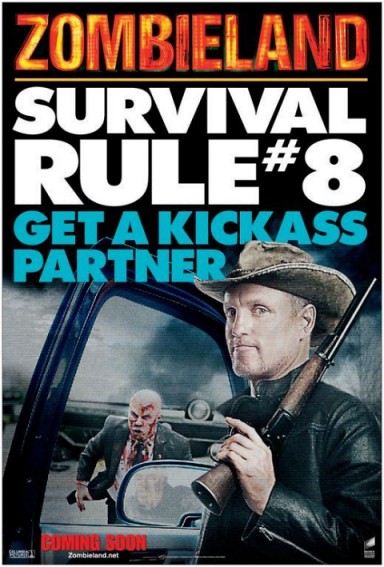
Kickass indeed.
But long before Jesse Eisenberg was unintentionally (one assumes) fooling people into thinking he was Michael Cera -- they're entirely different people, I swear -- I was inventing the rules necessary for my survival in pickup basketball. I will be describing these rules throughout The Pickup Diaries.
Now...despite his reputation as a fearsome outside shooter, Bird's arsenal also included a wide variety of drives, dunks, layups, hooks and scoops. He also had some killer low post moves. That's why his career field goal percentage was just a shade under .500, and he probably would have finished above .500 if he hadn't limped through his final four seasons with bad back.
Just for kicks, here's Bird beating the Portland Trail Blazers left-handed. I'm not kidding. You might have heard or read about this one: Bird told teammates beforehand that being so great was boring him...and he he vowed to shoot left-handed all game. He didn't, but Bird still ending up scoring 22 of his 47 points using his left hand. I know. Awesome.
At any rate, Bird's shooting philosophy became the basis for my very first rule regarding pickup hoops:
Pickup Rule #1: Always take the highest percentage shot available.
Sounds obvious, right? So simple...but so very hard. I mean, you'd think everybody would do this. But take LeBron James and Kobe Bryant for example. They're probably the two best basketball players in the NBA, but they take an unbelievable number of crap shots. At times, it seems like they're stuck in permanent heat check mode. And they aren't alone. Lesser players do it (think Monta Ellis). Hell, even lousy players do it (for further reading, please refer to the collected works of Hughes, Larry).
Mind you, Bird wasn't without sin. He had the blood of a hundred bastard field goal attempts on his mangled hands. But in general, Bird tried to always get -- for himself or his teammates -- the highest percentage shot available. And for Larry Legend, that meant close to the hoop.
When Bird retired, he was perhaps the greatest three-point shooter in league history. Even today, he's considered the one of the all-time greats, in part due to his dramatic victories in the NBA's first three Long Distance Shootouts (1986, 1987 and 1988).
But in many ways, Larry hated the three and decried its use. This was because a) he felt it was a low percentage shot (which it is) and b) that if a team had a two-point lead at the end of the game, that team should never lose to a last-second shot. Which is kind of ironic, considering Bird won several games on last-second treys during his career.
However, despite this slight contradiction in philosophy and behavior, Bird's word was Basketball Law to me. For this reason, I never practiced threes. Never even attempted them while goofing around. To me, it was a waste of time that could be spent practicing shots I could actually use in a game. (For this same reason, I've never attempted a half court shot or developed any trick shots for HORSE, unless you consider a three-pointer from NBA range to be a trick shot.)
Therefore, all my shots were attempted from 15 feet and in. After all, I had almost grown to my full height of 6'3" -- I've often wondered whether I would have grown even taller had I not spent much of my childhood malnourished -- which made me a "big man" in pickup basketball terms. This meant that my game should be close to and going toward the basket.
I worked on every variety of layup I could think of. (Although it was quite a while before I realized the value of trying to develop my left hand...in fact, I'm still working on that.) I used my mental chalk to draw a 15-foot arc around the hoop and practiced shots from every angle. (However, due to dead spots and funky rims, I often avoided baseline shots, which would haunt me later.) And I worked on my inside moves.
Fortunately, I was a natural in the post due to decent footwork, a long wingspan (or, as my college roommate BadDave called them, my Gorilla Arms), and a soft touch. Plus, I had spent my formative years following the Bird-era Celtics. This meant hours upon hours of watch Kevin McHale put opponents into his torture chamber.
McHale -- yes, my last name is also McHale, no Kevin and I are not related -- had a seemingly endless array of low post moves. This wasn't exactly true. He had a set number of moves, but the moves had so many subtle variations that they seemed endless. These moves are actually described in stunning detail in The Book of Basketball by Bill Simmons, which makes the book a must-read for anybody who wants to became a killer post player in pickup ball.
And that was my life for the next two months. Endless, tireless practice. I practiced in the morning, the afternoon, and at night. I played in the sun, the wind, and in the rain. By the end of that period, I was knocking down a fairly high percentage of my shots, which made me feel pretty good about myself. After all, I had only just picked up the sport.
What I didn't (and couldn't) understand at the time was this: A large part of my early "success" was due to the fact that I had focused on a very specific and therefore very limited number of shots. Not to mention that every shot had been attempted against no defense. But these things don't matter when you don't know any better. I was confident. A little cocky even. And with the new school year fast approaching...
...it was time to take my game on the road.
Cherry red and roughly the size of a small ocean liner, the Fury -- which I named "The Red Baron" -- was a one-way ticket to freedom. I could now go wherever I wanted, whenever I wanted. You know, as long as my mom was cool with it and it was before curfew.
I purchased the Fury on a Friday night in early July. If I recall correctly, it cost around $800, which seemed both like a small fortune and a ridiculously tiny price to pay for virtual independence. The bad news: I didn't have my license yet. I had actually failed my first driver's test a couple weeks prior.
This still pisses me off. I was kicking ass on the test and then, at the very end, right outside the DMV, the woman administering the test asked me to parallel park. I nailed that too, and I naturally assumed I'd passed with flying colors. However, she failed me. When I asked why, she said it was because, while turning left onto Markland Avenue -- one of the main streets in Kokomo -- my left tire had passed ever-so-slightly through the opposite lane and cut over the front edge of the yellow line separating the two sides of the street.
"If there had been a car there, you would have hit it," she said.
"But there wasn't a car there," I replied.
"True, but there could have been."
"But...but...people do that all the time," I said.
"Yes, but new drivers shouldn't," she answered. "I think having to retake the test will break you of that bad habit, don't you?"
Seriously, I could have choked a bitch.
The Tuesday after buying the Fury, I went in to retake my test. I got the same instructor, and yes, she remembered me. She literally had me drive a circle around the DMV and passed me.
"I trust you learned your lesson?" she said.
The only lesson my 16-year-old self learned was that people in a position of power can and probably will screw with you. But at least I was now a licensed driver.
Now, I had taken the test in my mom's car -- a 1987 Buick Somerset -- because it was much smaller than the Fury and therefore easier to drive under testing conditions (that is, if I needed to parallel park again). When I got home, the first thing I did was jump into the Fury. Jammed in the key. Turned the ignition.
Nothing but a dry cough-like sound.
See, on Friday night, shortly after getting my new car home, my buddy Greg had come over and -- since I couldn't actually drive us anywhere yet -- we had spent the night sitting in the car listening to the tape deck...which was wired directly to the battery. That meant the radio could be on and running even when the key wasn't in the ignition. Sure enough, I'd left it running and the battery was now deader than Shaq's bathroom scale. Dead and so old, in fact, that jumping it only blew a little rust off the connectors.
One battery replacement later, I was finally on the road.
But I wasn't taking too many joy rides. Not at first anyway. About the only places I drove to were my friends' houses -- it kind of rankled them at first that I wouldn't drive us to the mall or the local cruising strip -- and my "home court." This was a little basketball court behind Boulevard School, my old elementary school, which just so happened to be about two blocks away from my high school, Kokomo High School.
The Boulevard court had some definite downsides. The backboards were made of the creakiest wood imaginable, and the rims were composed of the clangiest iron in the known universe. The blacktop surface of the court was covered in dead spots and shallow, nearly imperceptible depressions that tended to collect water. Oh, and it was surrounded on three sides by nothing but corn fields. This meant that a) there was no protection from the burning summer sun (so I often had no choice but to shoot toward the sun from one angle or another) and b) there was no protection from the wind.
And, if you've ever played outdoors, you know the wind can be a real problem.
That said, the Boulevard court was also relatively private. Nobody liked to play there for the reasons outlined above and the fact that there was no three-point line. As a result, I could practice for hours upon end without being interrupted or even seen. And I was definitely in Learning the Game mode. And for that, I wanted privacy.
Since I didn't have any actual coaching, I decided to make Larry Bird my coach. I re-read Bird's autobiography, Drive. I re-watched Larry Bird: A Basketball Legend as well as every old Celtics game I had on tape. I went to Kokomo's only major bookstore -- Walden Books -- and found a copy of Bird's instructional manual Bird on Basketball: How-to Strategies From The Great Celtics Champion. (Still available used from Amazon.com!)
I read. I watched. I read and watched some more. I digested. And then I tried to incorporate Bird's concepts into my budding game.
Which brings us to...
The Pickup Rules
In case you haven't seen Zombieland yet -- and I highly encourage you to do so immediately if you haven't -- the main character, Columbus, is a painfully awkward nerd who managed to survive the zombie apocalypse by strictly adhering to a series of zombie-specific survival rules. For instance:
But long before Jesse Eisenberg was unintentionally (one assumes) fooling people into thinking he was Michael Cera -- they're entirely different people, I swear -- I was inventing the rules necessary for my survival in pickup basketball. I will be describing these rules throughout The Pickup Diaries.
Now...despite his reputation as a fearsome outside shooter, Bird's arsenal also included a wide variety of drives, dunks, layups, hooks and scoops. He also had some killer low post moves. That's why his career field goal percentage was just a shade under .500, and he probably would have finished above .500 if he hadn't limped through his final four seasons with bad back.
Just for kicks, here's Bird beating the Portland Trail Blazers left-handed. I'm not kidding. You might have heard or read about this one: Bird told teammates beforehand that being so great was boring him...and he he vowed to shoot left-handed all game. He didn't, but Bird still ending up scoring 22 of his 47 points using his left hand. I know. Awesome.
At any rate, Bird's shooting philosophy became the basis for my very first rule regarding pickup hoops:
Pickup Rule #1: Always take the highest percentage shot available.
Sounds obvious, right? So simple...but so very hard. I mean, you'd think everybody would do this. But take LeBron James and Kobe Bryant for example. They're probably the two best basketball players in the NBA, but they take an unbelievable number of crap shots. At times, it seems like they're stuck in permanent heat check mode. And they aren't alone. Lesser players do it (think Monta Ellis). Hell, even lousy players do it (for further reading, please refer to the collected works of Hughes, Larry).
Mind you, Bird wasn't without sin. He had the blood of a hundred bastard field goal attempts on his mangled hands. But in general, Bird tried to always get -- for himself or his teammates -- the highest percentage shot available. And for Larry Legend, that meant close to the hoop.
When Bird retired, he was perhaps the greatest three-point shooter in league history. Even today, he's considered the one of the all-time greats, in part due to his dramatic victories in the NBA's first three Long Distance Shootouts (1986, 1987 and 1988).
But in many ways, Larry hated the three and decried its use. This was because a) he felt it was a low percentage shot (which it is) and b) that if a team had a two-point lead at the end of the game, that team should never lose to a last-second shot. Which is kind of ironic, considering Bird won several games on last-second treys during his career.
However, despite this slight contradiction in philosophy and behavior, Bird's word was Basketball Law to me. For this reason, I never practiced threes. Never even attempted them while goofing around. To me, it was a waste of time that could be spent practicing shots I could actually use in a game. (For this same reason, I've never attempted a half court shot or developed any trick shots for HORSE, unless you consider a three-pointer from NBA range to be a trick shot.)
Therefore, all my shots were attempted from 15 feet and in. After all, I had almost grown to my full height of 6'3" -- I've often wondered whether I would have grown even taller had I not spent much of my childhood malnourished -- which made me a "big man" in pickup basketball terms. This meant that my game should be close to and going toward the basket.
I worked on every variety of layup I could think of. (Although it was quite a while before I realized the value of trying to develop my left hand...in fact, I'm still working on that.) I used my mental chalk to draw a 15-foot arc around the hoop and practiced shots from every angle. (However, due to dead spots and funky rims, I often avoided baseline shots, which would haunt me later.) And I worked on my inside moves.
Fortunately, I was a natural in the post due to decent footwork, a long wingspan (or, as my college roommate BadDave called them, my Gorilla Arms), and a soft touch. Plus, I had spent my formative years following the Bird-era Celtics. This meant hours upon hours of watch Kevin McHale put opponents into his torture chamber.
McHale -- yes, my last name is also McHale, no Kevin and I are not related -- had a seemingly endless array of low post moves. This wasn't exactly true. He had a set number of moves, but the moves had so many subtle variations that they seemed endless. These moves are actually described in stunning detail in The Book of Basketball by Bill Simmons, which makes the book a must-read for anybody who wants to became a killer post player in pickup ball.
And that was my life for the next two months. Endless, tireless practice. I practiced in the morning, the afternoon, and at night. I played in the sun, the wind, and in the rain. By the end of that period, I was knocking down a fairly high percentage of my shots, which made me feel pretty good about myself. After all, I had only just picked up the sport.
What I didn't (and couldn't) understand at the time was this: A large part of my early "success" was due to the fact that I had focused on a very specific and therefore very limited number of shots. Not to mention that every shot had been attempted against no defense. But these things don't matter when you don't know any better. I was confident. A little cocky even. And with the new school year fast approaching...
...it was time to take my game on the road.
Labels: Kevin McHale, Larry Bird, pickup basketball, The Pickup Diaries, The Pickup Rules, Zombieland
Word of the Day
Links
Archive
January 2005February 2005
October 2005
November 2005
December 2005
January 2006
February 2006
March 2006
April 2006
May 2006
June 2006
July 2006
August 2006
September 2006
October 2006
November 2006
December 2006
January 2007
February 2007
March 2007
April 2007
May 2007
June 2007
July 2007
August 2007
September 2007
October 2007
November 2007
December 2007
January 2008
February 2008
March 2008
April 2008
May 2008
June 2008
July 2008
August 2008
September 2008
October 2008
November 2008
December 2008
January 2009
February 2009
March 2009
April 2009
May 2009
June 2009
July 2009
August 2009
September 2009
October 2009
November 2009
December 2009
January 2010
February 2010
March 2010
April 2010
May 2010
June 2010
July 2010
August 2010
September 2010
October 2010
November 2010
December 2010
January 2011
February 2011
March 2011
April 2011
May 2011
June 2011
July 2011
August 2011
September 2011
October 2011
November 2011
December 2011
January 2012
February 2012
March 2012
April 2012
May 2012
June 2012
July 2012
August 2012
September 2012
October 2012
November 2012
December 2012
January 2013
February 2013
March 2013
April 2013
May 2013
June 2013
July 2013
August 2013
September 2013
October 2013
November 2013
December 2013
April 2014
May 2014
June 2014
July 2014
August 2014
June 2018
July 2022
contact: basketbawful@yahoo.com